Biaozhuo BIO/AB-D-II Multi-Function Standard Disc for Calibration of Antibiotic Potency Assay Instruments
| Brand | Biaozhuo |
|---|---|
| Origin | Shanghai, China |
| Model | BIO/AB-D-II |
| Disc Diameter | 90.0 mm ± 0.02 mm |
| Thickness | 2.5 mm ± 0.05 mm |
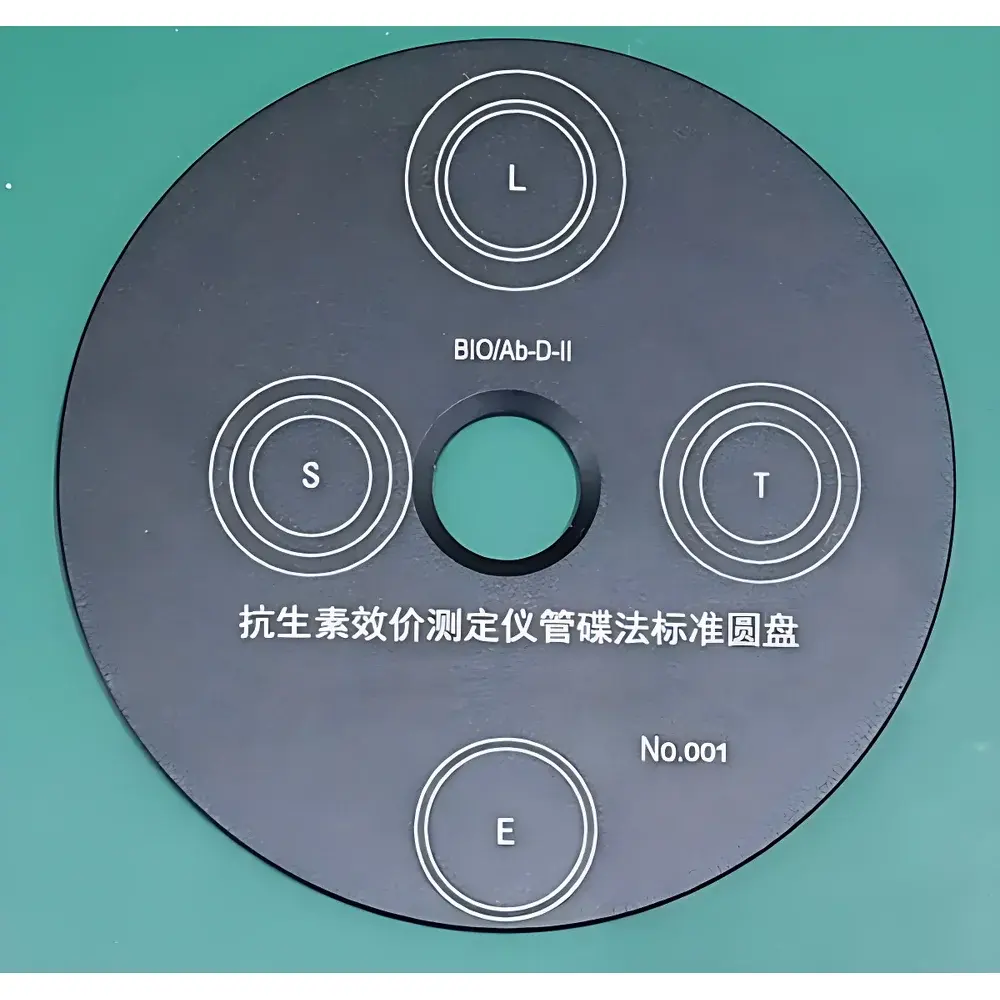
| Center-to-Circle Distances | S=20.0 mm, T=25.0 mm, L=30.0 mm, E=35.0 mm |
| Nominal Diameters | S-group: 12.0, 16.0, 20.0 mm |
| T-group | 12.0, 16.0, 20.0 mm |
| L-group | 14.0, 16.0, 22.0 mm |
| E-group | 16.0, 18.0 mm |
| Expanded Uncertainty (k=2) | ≤ 0.03 mm |
| Compliance | JJG 1614–2017 |
Overview
The Biaozhuo BIO/AB-D-II Multi-Function Standard Disc is a traceable metrological reference artifact engineered specifically for the calibration and performance verification of antibiotic potency assay instruments operating on the cylinder-plate (agar diffusion) method—commonly referred to as the “cup-plate” or “tube-disk” assay. This method, codified in successive editions of the Chinese Pharmacopoeia and aligned with international pharmacopeial standards (e.g., USP <81>, EP 2.6.6, JP 6.05), quantifies antibiotic activity by measuring the diameter of inhibition zones formed around standardized disks or wells in an agar medium seeded with a susceptible microorganism. Accurate measurement of these diameters is fundamental to calculating potency via parallel-line or slope-ratio analysis. The BIO/AB-D-II disc provides a physical, geometry-based calibration standard that directly addresses the core metrological requirements defined in JJG 1614–2017, the national calibration specification issued by the General Administration of Quality Supervision, Inspection and Quarantine of the People’s Republic of China. It enables simultaneous verification of diameter measurement accuracy, repeatability, linearity across measurement ranges, and edge-effect response—critical parameters influencing assay validity under GLP and GMP-regulated environments.
Key Features
- Integrated multi-parameter calibration: Combines S (two-dose), T (three-dose), L (linearity), and E (edge-effect) concentric circle groups on a single precision-machined disc—eliminating the need for multiple artifacts and sequential setups.
- Traceable dimensional metrology: All nominal diameters are realized with an expanded uncertainty of ≤ 0.03 mm (k = 2), certified against national length standards and validated per ISO/IEC 17025-accredited procedures.
- Optimized geometric layout: Four concentric ring sets positioned at precisely defined radial distances (20.0 mm, 25.0 mm, 30.0 mm, and 35.0 mm from disc center) replicate typical inhibition zone locations encountered during routine assay plate imaging and analysis.
- Stable, non-hygroscopic substrate: Manufactured from hardened stainless steel (AISI 420 equivalent) with fine-ground, matte-finished surfaces to minimize specular reflection and ensure consistent optical contrast under automated image capture systems.
- Compact and robust form factor: 90.0 mm diameter × 2.5 mm thickness disc conforms to standard Petri dish handling protocols and integrates seamlessly into existing assay workflows without modification to instrumentation or software.
Sample Compatibility & Compliance
The BIO/AB-D-II disc is compatible with all commercially available antibiotic potency assay instruments utilizing digital image analysis—including systems based on CCD/CMOS cameras, motorized stage positioning, and automated zone detection algorithms. Its design satisfies the dimensional validation requirements specified in JJG 1614–2017 for both manual and automated diameter measurement modes. While not a biological reference material, its geometric fidelity supports compliance with pharmacopeial validation frameworks requiring instrument suitability testing prior to assay execution (e.g., USP <1225>, ICH Q2(R2)). It also facilitates audit readiness for regulatory inspections where evidence of periodic instrument calibration—particularly for critical measurement functions—is mandated under FDA 21 CFR Part 11, EU Annex 11, and WHO TRS 992 Annex 4.
Software & Data Management
No proprietary software is required. The disc functions as a passive, hardware-level calibration standard and is fully interoperable with any image analysis platform used for tube-disk assay quantification—including vendor-specific applications (e.g., BioSys, Halo, WinKQCL) and open-source tools (e.g., ImageJ/Fiji with custom macros). Users record measured diameters against certified nominal values and compute bias, repeatability (RSD%), and linearity (R² or residual plots) using standard statistical packages (e.g., Minitab, JMP, Python SciPy). Calibration records—including operator ID, date, environmental conditions (temperature/humidity), instrument firmware version, and raw image metadata—should be retained for minimum 5 years to satisfy GLP documentation requirements and support trend analysis over time.
Applications
- Initial qualification and periodic re-calibration of antibiotic assay instruments in QC laboratories of pharmaceutical manufacturers and CMOs.
- Verification of measurement system analysis (MSA) components including bias, linearity, and reproducibility per AIAG MSA guidelines.
- Supporting method transfer between sites by providing identical geometric reference points for cross-laboratory instrument alignment.
- Training and competency assessment for analysts performing visual or semi-automated zone measurements.
- Root cause investigation when out-of-trend (OOT) or out-of-specification (OOS) assay results occur—enabling rapid differentiation between instrument drift and biological variability.
FAQ
Is the BIO/AB-D-II disc suitable for use with non-Chinese pharmacopeial methods?
Yes. Although developed to meet JJG 1614–2017, its geometric specifications align with the measurement principles common to USP, EP, and JP tube-disk assays. It validates the dimensional accuracy of the imaging subsystem—not the microbiological protocol itself.
Does the disc require recalibration after purchase?
No. As a passive mechanical standard with no active components or drift mechanisms, it retains its certified dimensional properties indefinitely under proper storage (dry, room temperature, low-vibration environment). However, periodic verification against a higher-order standard is recommended every 12 months for full audit compliance.
Can it be used to calibrate instruments that measure zone area instead of diameter?
Indirectly. Since area is derived from diameter (A = πr²), verifying diameter accuracy inherently constrains area calculation error. For direct area calibration, users should supplement with certified area standards or NIST-traceable printed targets.
What environmental conditions affect measurement accuracy when using this disc?
Ambient temperature fluctuations > ±2 °C may induce minor thermal expansion in the disc or instrument stage; therefore, acclimatization for ≥30 minutes prior to use is advised. Humidity has no measurable effect on dimensional stability.
Is the disc compatible with high-throughput robotic assay platforms?
Yes—provided the platform includes a fixed-focus imaging module capable of resolving features ≥10 µm. Its flat, rigid construction ensures stable positioning in automated disc-handling grippers and stackers.