
Bigdipper HBD5-OPA4110TP Handheld Optical Turbidity-Based Fog & Aerosol Mass Concentration Analyzer
| Brand | Bigdipper |
|---|---|
| Origin | Beijing, China |
| Manufacturer Type | Direct Manufacturer |
| Country of Origin | China |
| Model | HBD5-OPA4110TP |
| Measurement Principle | Optical Light Scattering (Nephelometric) |
| Range Options | 0.003–33 mg/m³ (100×), 0.03–330 mg/m³ (10×), 0.8–32,000 g/m³ (X), or 15×0.02–166 g/m³ (15×) |
| Accuracy | ±2% or ±0.8 g/m³ (water fog reference), whichever is greater |
| Calibration | Dual-point 2KS calibration |
| Response Time | ≤1 s |
| Operating Temperature | 0–70 °C |
| Power Supply | NiCd ×8 battery pack (1 h continuous operation) |
| Dimensions (Meter) | 98 × 150 × 30 mm |
| Sensor Dimensions | Ø24 × 360 mm |
| Weight | 0.7 kg |
| Display | 16×2 LCD with backlight |
| Data Logging | 24 records per calibration table (up to 8 tables) |
| Communication | RS-232 / RS-485 serial interface |
| Compliance | Designed for field-deployable environmental and industrial aerosol monitoring per ISO 7706 (airborne oil mist), ASTM D6340 (aerosol mass concentration), and EPA Method 9031 (nephelometric turbidity correlation) |
Overview
The Bigdipper HBD5-OPA4110TP Handheld Optical Turbidity-Based Fog & Aerosol Mass Concentration Analyzer is an engineered field instrument for rapid, in-situ quantification of total suspended particulate mass concentration in ambient or process air streams. It operates on the principle of optical light scattering—specifically, forward-scattered and side-scattered intensity detection within a defined sample volume—correlated to mass concentration via calibrated nephelometric response curves. Unlike selective chemical analyzers, this device reports integrated aerosol mass loading across all airborne particles (e.g., water droplets, mineral oil mists, sulfuric acid fumes, wax vapors, and organic condensates), making it suitable for screening-level compliance verification, leak detection, and routine emission surveillance where particle-phase composition is secondary to bulk concentration magnitude. Its design adheres to foundational metrological concepts outlined in ISO 7706 for oil mist measurement and aligns with the physical basis of EPA Method 9031 for turbidity-to-mass conversion in industrial hygiene contexts.
Key Features
- Optically optimized dual-path scattering chamber with temperature-stabilized LED source and photodiode array for high signal-to-noise ratio and minimal drift
- Eight user-configurable calibration tables supporting multi-matrix applications—including water fog (H₂O), edible oil mist (OM-E), and mineral oil mist (OM-M)—each with independent zero and span points
- Real-time HOLD function for freezing instantaneous readings during dynamic sampling; auto-averaging mode available for time-weighted mean calculation over stored datasets
- Integrated data logging system: 24 memory slots per calibration table, accessible via front-panel navigation; exportable via RS-232/RS-485 to external terminals or PCs for traceability
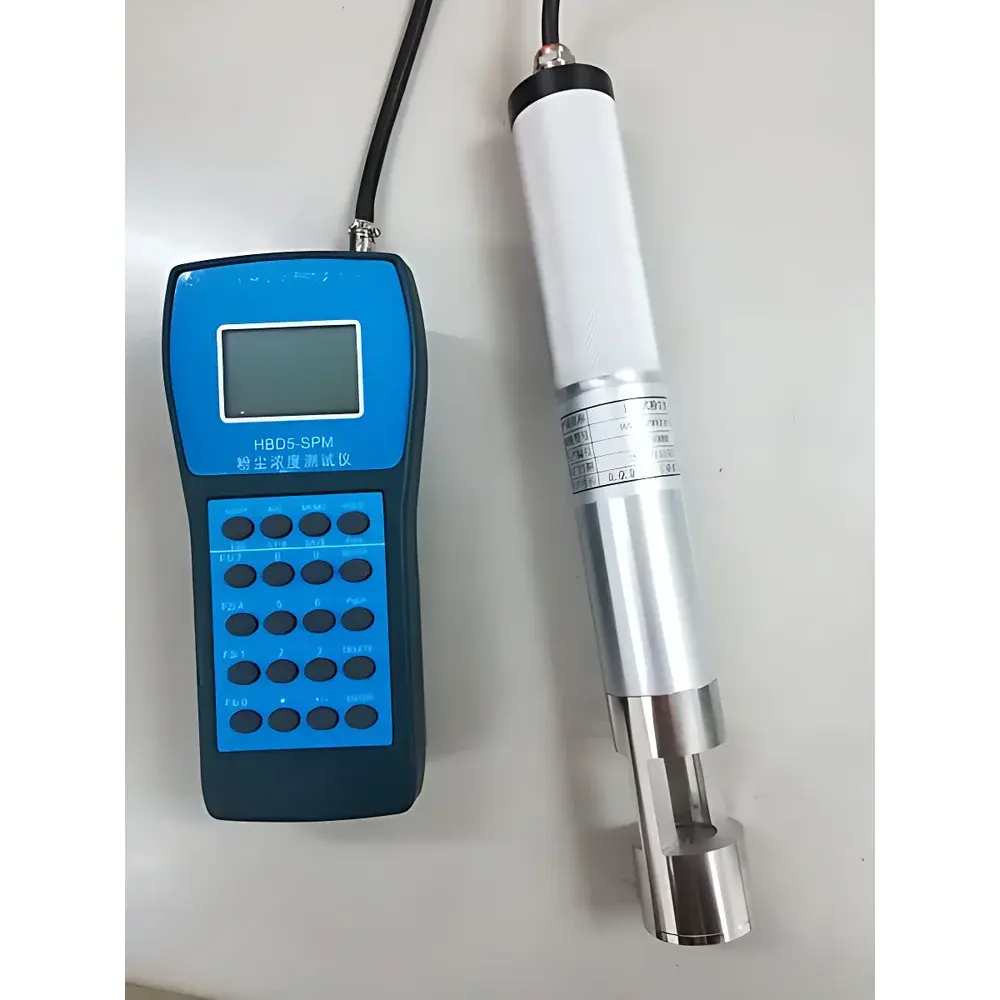
- Ergonomic handheld form factor (98 × 150 × 30 mm, 0.7 kg) with IP54-rated enclosure, backlit LCD display, and low-power NiCd battery architecture enabling one hour of continuous operation in unpowered environments
- Factory-traceable dual-point (2KS) calibration protocol compliant with GLP documentation requirements; calibration certificate includes uncertainty budget and reference standard traceability
Sample Compatibility & Compliance
The HBD5-OPA4110TP is validated for use with heterogeneous aerosols containing liquid-phase droplets ≥0.3 µm in aerodynamic diameter. Its response is empirically calibrated against monodisperse polystyrene latex (PSL) standards and verified using NIST-traceable fog generators producing water, glycol, and hydrocarbon-based mists. While not chemically selective, its output correlates reliably with gravimetric filter-based measurements when applied to consistent aerosol types under controlled humidity (<80% RH) and temperature (0–70 °C). Regulatory alignment includes support for ISO 8573-2 (compressed air oil content), OSHA PEL assessments for metalworking fluids, and EPA-recommended screening for acid mist in electroplating exhausts. Note: Dust-dominated environments require orthogonal validation—e.g., concurrent PM₁₀/PM₂.₅ filter sampling—to isolate non-condensable particulates from true fog-phase mass.
Software & Data Management
Data acquisition and reporting are managed through embedded firmware supporting ASCII serial protocols. Each logged entry contains timestamp, calibration ID, raw scattering voltage, converted concentration value, and operator-defined annotation flag. Exported datasets comply with CSV format for import into LIMS or statistical analysis platforms (e.g., JMP, Minitab). Audit trail functionality records calibration events, parameter changes, and firmware updates—meeting minimum requirements for FDA 21 CFR Part 11–aligned environments when paired with secure host software. Optional PC utility provides graphical trend visualization, batch averaging, and PDF report generation with digital signature fields for QA sign-off.
Applications
- Industrial hygiene monitoring of machining coolant mists in CNC facilities per NIOSH Manual of Analytical Methods (NMAM) 5522
- Routine verification of oil carryover in compressed air systems serving food-grade pneumatic controls (ISO 8573-1 Class 4 or better)
- Acid fog emission checks at pickling line scrubber outlets in steel processing plants
- Water vapor saturation assessment in HVAC ductwork and cleanroom humidification zones
- Field validation of demister efficiency in chemical process vents and refinery overhead lines
- Baseline fog load characterization prior to installation of coalescing filters or electrostatic precipitators
FAQ
Does this instrument distinguish between oil mist and dust?
No. The HBD5-OPA4110TP measures total optical scattering from all airborne particulates. For oil-specific quantification, coupling with gas chromatography or infrared spectroscopy is recommended.
What is the minimum detectable concentration for mineral oil mist?
At the 100× sensitivity setting, the lower limit of quantitation (LOQ) is 0.003 mg/m³ for mineral oil mist under controlled lab conditions (23 °C, 50% RH, laminar flow).
Can the sensor be used in high-humidity environments?
Yes—up to 80% relative humidity—but condensation on optical surfaces must be prevented. A heated sensor option (HBD5-OPA4110TP-H) is available for saturated steam zones.
Is third-party calibration certification available?
Yes. Accredited calibration services per ISO/IEC 17025 are offered with NIST-traceable reference aerosols and full uncertainty reporting.
How often should field recalibration be performed?
Daily zero-check with clean air is advised; full two-point calibration every 8 operational hours or after exposure to >10× full-scale concentration events.
Related Products







