
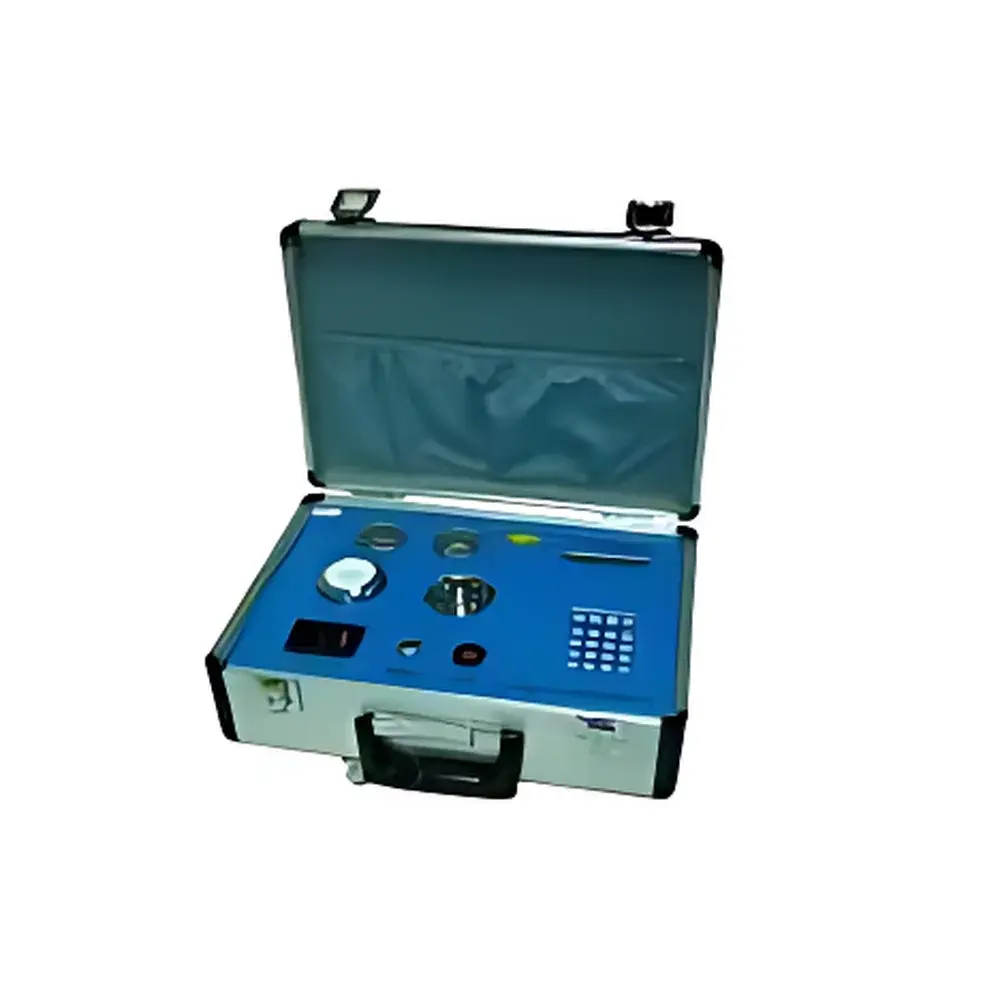
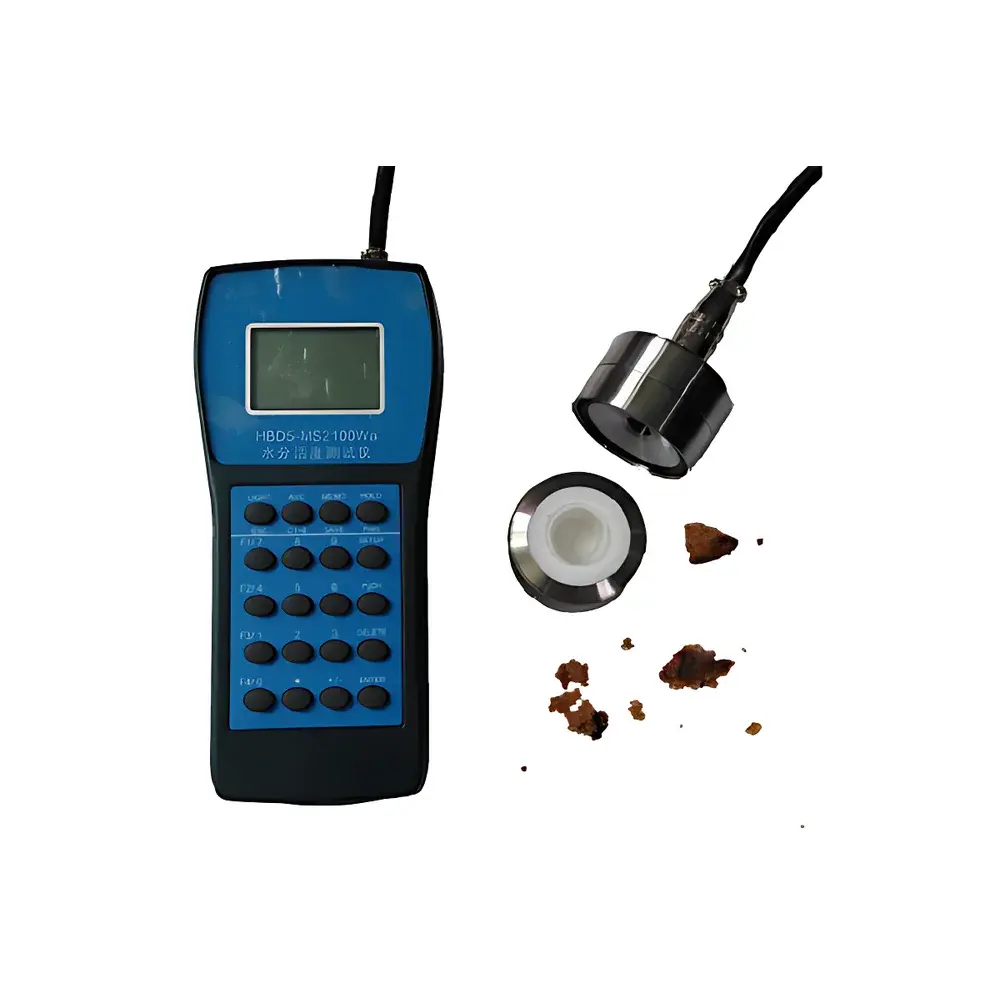
Bigdipper HBD5ms2100 sMS Handheld Water Activity Analyzer
| Brand | Bigdipper |
|---|---|
| Origin | Beijing, China |
| Manufacturer Type | Direct Manufacturer |
| Country of Origin | China |
| Model | HBD5ms2100 sMS |
| Water Activity Range | 0.000–1.000 aw |
| Accuracy | ±0.015 aw |
| Repeatability | ±0.005 aw |
| Resolution | 0.001 aw |
| Moisture Content Range | 0.0–100.0% (w/w) |
| Moisture Accuracy | ±2.0% abs |
| Moisture Repeatability | ±0.5% abs |
| Moisture Resolution | 0.1% |
| Operating Temperature | −20 to +85 °C (moisture extension up to 200 °C) |
| Environmental Operating Range | −10 to +60 °C, 0–99% RH |
| Test Modes | Rapid, Pre-cut, Equilibrium |
| Typical Rapid Test Time | 3–5 min |
| Power Supply | Rechargeable NiCd battery (HBD5 variant), 24 h continuous operation, 1 week standby |
| Intrinsic Safety Rating | Ia, suitable for Class 1, Groups A/B/C/D and Class 2, Groups E/F/G hazardous locations |
| Enclosure Rating | NEMA 2 |
| Data Storage | Non-volatile memory (2 MB), power-loss protected |
| Communication Interface | RS-232 / RS-485 |
| Sensor Architecture | Polymer-based capacitive humidity sensor with integrated temperature compensation |
| Calibration | Factory-calibrated |
Overview
The Bigdipper HBD5ms2100 sMS Handheld Water Activity Analyzer is a field-deployable, intrinsically safe instrument engineered for precise, on-site determination of water activity (aw) in food matrices and intermediate products. It operates on the fundamental principle of dew-point depression measurement via a high-stability polymer capacitive sensor, coupled with integrated Pt1000 temperature sensing and real-time thermodynamic compensation. Unlike chilled-mirror or chilled-hygrodeik systems, this design eliminates condensation-related drift and enables rapid equilibration—critical for routine QC in production environments where ambient conditions fluctuate. The device delivers traceable aw measurements compliant with ISO 21807:2022 (Food — Determination of water activity) and ASTM F1718–22 (Standard Guide for Measuring Water Activity of Food Products). Its dual-capability architecture supports simultaneous aw and moisture content estimation using empirically validated correlation algorithms embedded in firmware—eliminating reliance on external lookup tables or manual interpolation.
Key Features
- Intrinsically safe (Ia) certification for use in explosive atmospheres per IEC 60079-0/11, enabling deployment in grain silos, spice blending rooms, and solvent-based flavor extraction zones.
- Three adaptive test modes—Rapid (dynamic equilibrium detection), Pre-cut (user-defined time window), and Equilibrium (full thermodynamic stabilization)—each configurable via intuitive button navigation without software dependency.
- No field recalibration required: factory-traceable calibration against saturated salt standards (LiCl, MgCl₂, NaCl, KCl) ensures long-term stability exceeding 24 months under typical food plant conditions.
- Robust NEMA 2 enclosure with IP54-rated ingress protection, optimized for dust-laden, high-humidity processing floors and cold-storage staging areas (−20 °C to +85 °C operational range).
- Onboard non-volatile memory (2 MB) stores >10,000 test records with timestamp, operator ID, sample ID, and environmental metadata—fully compatible with GLP-compliant audit trails.
- RS-232/RS-485 serial interface supports direct integration into SCADA systems or LIMS platforms; optional Modbus RTU protocol implementation available for industrial automation compatibility.
Sample Compatibility & Compliance
The HBD5ms2100 sMS is validated for direct measurement across heterogeneous food substrates without grinding or homogenization—including intact cereal grains, shredded cheese, cured meats, dried herbs, roasted coffee beans, and viscous sauces. Its low thermal mass sensor head minimizes sample perturbation during contact measurement, preserving native microstructure critical for predictive microbiological modeling. All measurement protocols align with regulatory expectations outlined in FDA’s Preventive Controls for Human Food (21 CFR Part 117), EU Regulation (EC) No 2073/2005 on microbiological criteria, and Codex Alimentarius CAC/RCP 1-1969 (General Principles of Food Hygiene). Instrument qualification documentation includes IQ/OQ templates supporting GMP-aligned validation workflows.
Software & Data Management
Data export occurs via ASCII text files (.csv) or structured binary dumps readable by Bigdipper’s free PC utility (Windows/Linux/macOS). Each record contains raw sensor voltage, compensated aw, calculated moisture %, ambient T/RH, test mode identifier, and elapsed time. Firmware supports configurable data logging intervals (1–60 s), automatic pass/fail flagging against user-defined specification limits (e.g., aw ≤ 0.60 for shelf-stable bakery fillings), and alarm-triggered SMS/email notifications via connected gateway modules. Audit trail functionality meets FDA 21 CFR Part 11 requirements for electronic records and signatures when deployed with optional digital certificate authentication.
Applications
- Real-time verification of aw in ready-to-eat meals prior to metal detection and final packaging.
- In-process monitoring of drying kinetics in spray-dried dairy powders and instant beverage blends.
- Stability assessment of low-moisture snacks (e.g., extruded puffs, baked chips) during accelerated shelf-life studies.
- Raw material acceptance testing for spices, nuts, and dehydrated vegetables at receiving docks.
- Validation of modified atmosphere packaging (MAP) efficacy by tracking post-seal aw drift over time.
- Supporting HACCP Critical Control Point (CCP) documentation for moisture-sensitive processes such as caramelization, enzymatic browning inhibition, and lipid oxidation control.
FAQ
Does the HBD5ms2100 sMS require periodic recalibration?
No. The sensor is factory-calibrated against NIST-traceable saturated salt standards and exhibits <0.002 aw/year drift under normal operating conditions. Recalibration is only recommended after physical damage or exposure to extreme condensate events.
Can it measure water activity in frozen or refrigerated samples?
Yes—provided the sample surface temperature is above −20 °C during measurement. For frozen foods, allow surface equilibration to ≥−10 °C before testing to avoid frost formation on the sensor.
Is the moisture content reading gravimetrically validated?
Moisture % values are algorithmically derived from aw, temperature, and empirical water sorption isotherms (BET/GAB models) specific to food categories. These estimates correlate within ±2.0% abs to AOAC 950.46 oven-drying results for most matrices—but official compliance testing must use primary reference methods.
How is intrinsic safety maintained during battery charging?
Charging occurs exclusively via the certified external charger (model BD-CHG-IA); internal battery replacement requires authorized service personnel to preserve explosion-proof integrity of the sealed housing.
What environmental conditions invalidate measurement accuracy?
Measurements taken in ambient RH >95% with rapid air movement (>1 m/s) may induce transient boundary layer effects. Use the included draft shield accessory in such environments to ensure laminar airflow across the sensor aperture.






