
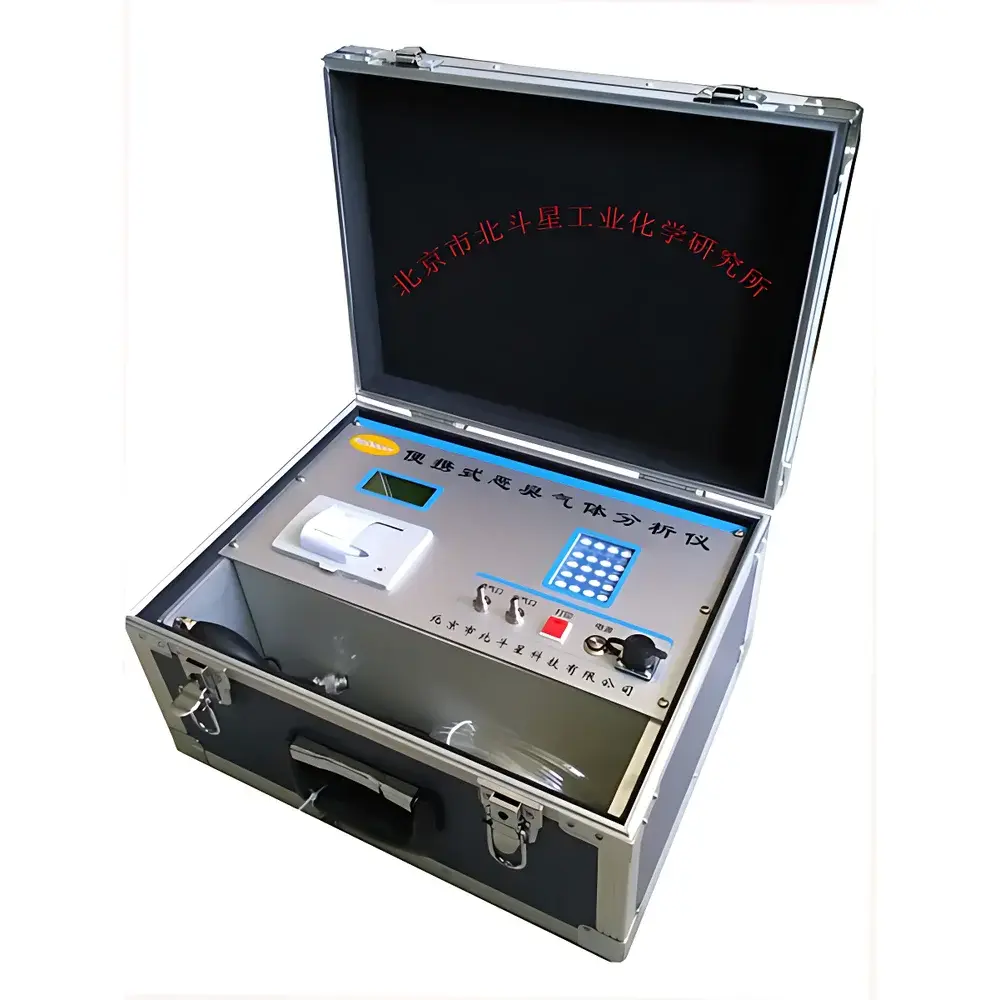
Bigdipper pAir2000-EFF-A1 Portable Odor Measurement Instrument
| Brand | Bigdipper |
|---|---|
| Origin | Beijing, China |
| Manufacturer | Bigdipper Instruments Co., Ltd. |
| Model | pAir2000-EFF-A1 |
| Instrument Type | Portable |
| Detection Principle | Multi-sensor array (electrochemical, metal oxide semiconductor, photoionization detection/PID) |
| Accuracy | ±1% of reading |
| Response Time | < 10 ms |
| Operating Temperature | -10°C to 60°C |
| Operating Humidity | 10–90% RH (non-condensing) |
| Gas Measurement Range | NH₃ (0.5–200 ppm), H₂S (0.3–100 ppm), ODU (0–10,000, unitless) |
| Resolution | 0.01 ppm (NH₃, H₂S), 0.1% FS (full scale) |
| Long-term Stability | ±10% per year |
| Power Supply | 12 V rechargeable battery |
| Dimensions | 400 × 300 × 200 mm |
| Weight | 4.5 kg |
| Compliance | NY/T 388–1999 (China Agricultural Standard for Odor Concentration Determination) |
Overview
The Bigdipper pAir2000-EFF-A1 Portable Odor Measurement Instrument is an engineered field-deployable solution for real-time quantification of odor-causing compounds at industrial emission sources. It operates on a multi-sensor fusion architecture—integrating electrochemical (EC), metal oxide semiconductor (MOS), and photoionization detection (PID) technologies—to simultaneously monitor key malodorous species including ammonia (NH₃), hydrogen sulfide (H₂S), low-molecular-weight amines, volatile organic compounds (VOCs), and sulfur-containing organics. Unlike olfactometric methods relying on human panel testing, the pAir2000-EFF-A1 delivers objective, repeatable, and traceable odor concentration values expressed in Odor Units (ODU), as defined by China’s agricultural standard NY/T 388–1999. Its sub-10-ms electronic response time enables high-frequency transient event capture—critical for characterizing intermittent emissions from process vents, wastewater treatment units, or chemical synthesis lines. Designed for compliance-driven environmental monitoring, it supports both regulatory screening and operational troubleshooting across sectors where odor nuisance and VOC co-emission are tightly coupled.
Key Features
- Multi-parameter detection capability: Simultaneous real-time measurement of up to seven target gases—including NH₃, H₂S, CH₃SH, C₂H₆S₂, CS₂, styrene, and total VOCs—with automatic ODU calculation per NY/T 388–1999.
- Hybrid sensor platform: Combines electrochemical cells for selective NH₃/H₂S detection, MOS sensors for broad-spectrum reducing gas sensitivity, and 10.6 eV PID for aromatic and aliphatic VOC quantification.
- Onboard temperature and humidity compensation: Integrated environmental sensors enable dynamic correction of cross-sensitivity and baseline drift under variable ambient conditions (-10°C to 60°C; 10–90% RH).
- Field-calibratable architecture: Supports zeroing with inert gas (e.g., N₂) and span calibration using certified standard gas mixtures or surrogate reference materials—no lab dependency required.
- Dual-mode sampling: Built-in diaphragm pump with adjustable flow rate (0.5–1.0 L/min) ensures representative sample draw from ducts, stacks, or ambient zones; optional heated probe available for condensable vapor applications.
- Embedded data logging: Stores >10,000 timestamped records with GPS-tagged location metadata (optional module), compliant with audit-ready documentation requirements.
- Intuitive human interface: 4×16-character LCD display cycles through real-time gas concentrations, ODU, temperature, humidity, battery status, and alarm thresholds—all navigable via tactile keypad without external software.
Sample Compatibility & Compliance
The pAir2000-EFF-A1 is validated for direct sampling of undiluted industrial exhaust streams and ambient air matrices encountered in electronics manufacturing (PCB etching, solvent cleaning), petrochemical refining, fine chemical synthesis, biopharmaceutical fermentation, and nitrogen-based fertilizer production. It meets the functional requirements of NY/T 388–1999 for odor concentration assessment and aligns with the technical intent of ISO 16000-29 (indoor air—measurement of odorants) and ASTM D5504 (determination of sulfur compounds in gaseous matrices). While not certified for intrinsic safety (e.g., ATEX/IECEx), its design conforms to IEC 61000-6-2 (immunity) and IEC 61000-6-3 (emissions) for electromagnetic compatibility in industrial settings. Data integrity is preserved via non-volatile memory with power-fail recovery and optional 21 CFR Part 11-compliant audit trail firmware (upgradeable).
Software & Data Management
Data export is supported via USB-C interface to Windows-compatible desktop software (pAirSuite v3.2), enabling spectral visualization, trend analysis, ODU correlation modeling, and automated report generation in PDF/CSV formats. The software enforces user-level access control (administrator/operator), session logging, and electronic signature workflows—facilitating GLP/GMP-aligned documentation practices. Raw sensor voltage outputs, temperature-compensated readings, and calibration history are retained with SHA-256 hash verification to ensure forensic traceability. Cloud synchronization (via optional LTE module) allows remote fleet monitoring and threshold-triggered SMS/email alerts for exceedance events.
Applications
- Source identification and prioritization at electronics fabrication facilities emitting NH₃, amines, and halogenated solvents during photolithography and solder paste reflow.
- Odor impact assessment downwind of wastewater equalization basins and anaerobic digesters in municipal and industrial treatment plants.
- Real-time stack monitoring during catalyst regeneration or amine scrubber breakthrough events in refineries and gas processing units.
- Process validation in pharmaceutical API synthesis where residual solvent odors (e.g., dichloromethane, toluene) must be verified below occupational exposure limits.
- Community complaint investigations requiring rapid deployment and legally defensible ODU documentation under local nuisance ordinances.
FAQ
What standards does the pAir2000-EFF-A1 comply with for odor quantification?
It implements the ODU calculation methodology specified in NY/T 388–1999 and is functionally aligned with ISO 16000-29 and ASTM D5504 for gas-phase odorant measurement.
Can the instrument measure odor concentration without laboratory olfactometry?
Yes—it provides instrumental ODU estimates based on calibrated multi-gas response models; however, regulatory submissions may require concurrent dynamic olfactometry for official compliance reporting.
Is cross-sensitivity between NH₃ and H₂S compensated in real time?
Yes—the firmware applies multivariate regression correction using simultaneous sensor outputs and environmental parameters to minimize interference artifacts.
What maintenance intervals are recommended for field operation?
Sensor modules require zero/span verification every 7 days under continuous use; full recalibration is advised quarterly or after exposure to >500 ppm H₂S or solvent saturation.
Does the device support external power for extended stationary deployment?
Yes—12 V DC input accepts external regulated power supplies (e.g., solar-charged battery banks), enabling unattended operation beyond onboard battery capacity (up to 8 hours typical).
Related Products







