
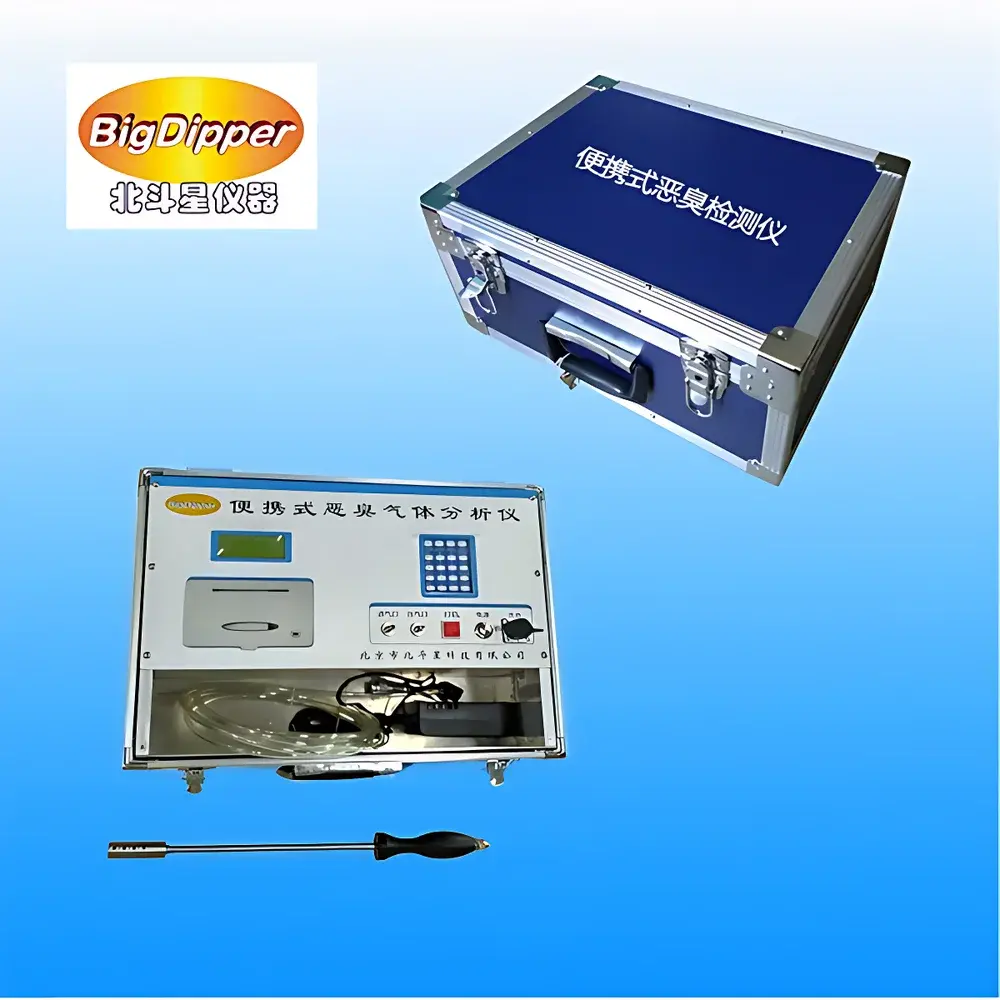
Bigdipper pAir2000-EFF-D Portable Landfill Gas & Odor Monitoring Analyzer
| Brand | Bigdipper |
|---|---|
| Origin | Beijing, China |
| Manufacturer Type | Direct Manufacturer |
| Country of Origin | China |
| Model | pAir2000-EFF-D |
| Instrument Type | Portable |
| Detection Principles | Electrochemical, Metal Oxide Semiconductor (MOS), Photoionization Detector (PID), Non-Dispersive Infrared (NDIR), UV-Vis Spectrophotometry |
| Accuracy | ±1–2% of reading |
| Flow Rate | 0.1 L/min |
| Response Time (T90) | <3 minutes |
| Operating Temperature | −10 °C to +60 °C |
| Operating Humidity | 10–90% RH (non-condensing) |
| Power Supply | 12 V rechargeable battery |
| Dimensions | 400 × 300 × 200 mm |
| Weight | 4.5 kg |
| Sensor Resolution | 0.1% FS |
| Long-Term Stability | ±10% per year |
| Display | 4×16-character LCD |
| Communication Interfaces | RS232 / RS485 |
| Calibration Options | Single-point inert gas zeroing, dual-standard (DKA) calibration with certified reference gases or traceable surrogates |
| Cross-Interference Compensation | Neural network-based multi-gas interference correction algorithm |
Overview
The Bigdipper pAir2000-EFF-D is a field-deployable, multi-sensor gas monitoring analyzer engineered for quantitative assessment of landfill gas (LFG) composition and odorant emissions in compliance with environmental regulatory frameworks including China’s GB 14554–93 *Emission Standard of Malodorous Pollutants*, EPA Method TO-15 and ASTM D6787–02 (Standard Guide for Sampling and Analysis of Odorous Compounds). It integrates parallel detection modalities—electrochemical cells for H2S, NH3, CO, and O2; metal oxide semiconductor (MOS) arrays for volatile sulfur compounds (VSCs); photoionization detectors (PID) for total VOCs and aromatic hydrocarbons; and NDIR modules for CO2 and CH4—enabling simultaneous, real-time quantification of up to 23 target analytes. The instrument operates on active pump-assisted sampling at a regulated flow rate of 0.1 L/min, ensuring representative gas-phase capture under variable site conditions. Its measurement architecture supports both direct concentration reporting (ppm, mg/m³, %vol) and derived odor units (OUE) via integrated odor dilution modeling aligned with EN 13725:2022 methodology.
Key Features
- Modular sensor configuration: Base platform supports 4–23 interchangeable electrochemical, PID, MOS, and NDIR sensors—each pre-calibrated and thermally stabilized for field durability.
- Neural network-driven cross-interference compensation: Embedded firmware applies real-time multivariate correction using reference gas response matrices, significantly reducing false positives from co-eluting VOCs and inorganic interferents (e.g., humidity-induced drift in MOS sensors).
- Dual-calibration protocol support: Compliant with GLP-aligned procedures via both single-point zeroing using ultra-high-purity nitrogen and two-point DKA (Dual-Known Analyte) calibration using traceable standard gas mixtures certified to ISO 6141 and ISO 6142.
- Onboard environmental compensation: Simultaneous temperature (−10 °C to +60 °C) and relative humidity (10–90% RH, non-condensing) measurement enables automatic signal normalization per ISO 16000-22 Annex B.
- Field-rugged design: IP54-rated enclosure, 4.5 kg mass, and 12 V Li-ion battery providing >8 hours continuous operation—validated for deployment across landfill surface surveys, leachate pond perimeters, and biogas flare stack monitoring points.
- Regulatory-ready data handling: All measurements timestamped, logged with sensor health diagnostics, and exportable in CSV/Excel format compliant with EPA QA/G-5 and ISO/IEC 17025 audit requirements.
Sample Compatibility & Compliance
The pAir2000-EFF-D is validated for direct analysis of undiluted landfill headspace gas, passive soil gas probes (via Tedlar bag interface), and extracted emissions from biofilters or activated carbon scrubbers. It meets performance criteria specified in China’s HJ 905–2017 *Technical Guidelines for Odor Monitoring*, as well as international benchmarks including EN 13725:2022 (odor concentration determination), ISO 16017-1:2000 (VOC sampling), and ASTM D5402–18 (solvent resistance testing for sensor housings). All sensor modules undergo factory calibration against NIST-traceable standards, with calibration certificates issued per ISO/IEC 17025:2017 Clause 6.6. Calibration validity is tracked internally with configurable expiration alerts and auto-flagging of out-of-tolerance readings.
Software & Data Management
Instrument control and data acquisition are managed through the proprietary AirTrack v3.2 software suite (Windows-compatible), supporting remote configuration, live telemetry streaming, and automated report generation in PDF/HTML formats. Raw sensor outputs—including analog voltage traces, T90 response curves, and drift-corrected concentration time-series—are stored with full metadata (GPS coordinates, operator ID, ambient T/RH, barometric pressure). Audit trails comply with FDA 21 CFR Part 11 requirements, featuring electronic signatures, role-based access control, and immutable log archiving. Data exports include structured fields compatible with LIMS integration (e.g., LabWare, Thermo Fisher SampleManager) and GIS mapping platforms (ArcGIS, QGIS) via standardized XML schema.
Applications
- Landfill operational monitoring: Real-time tracking of CH4, CO2, H2S, and NH3 gradients across daily cover, final cap, and gas extraction wells.
- Odor impact assessment: Quantitative mapping of odor units (OUE) and key odorants (e.g., dimethyl sulfide, skatole, indole) near community boundaries per EN 13725-compliant protocols.
- Biogas upgrading verification: Pre- and post-scrubbing analysis of H2S, siloxanes, and halogenated VOCs prior to CHP or RNG injection.
- Regulatory compliance reporting: Generation of quarterly emission inventories aligned with China’s MEP Order No. 39 and EU Directive 1999/31/EC Annex I.
- Remediation validation: Post-closure monitoring of anaerobic degradation byproducts during phytoremediation or aerobic biocover implementation.
FAQ
What gas standards are supported for field calibration?
Certified reference gases meeting ISO 6141 specifications—for example, H2S in N2 (±2% uncertainty), NH3 in air (±3%), and VOC blends in synthetic air (±5%)—are recommended. Surrogate calibration using inert zero gas (99.999% N2) is permitted for baseline verification.
Does the instrument meet explosion-proof requirements for landfill gas zones?
The pAir2000-EFF-D carries CE marking per ATEX Directive 2014/34/EU Category 3G (Zone 2), with intrinsic safety certification (IEC 60079-0, -11) for use in potentially explosive atmospheres containing CH4/air mixtures.
Can sensor modules be replaced in the field without returning to the manufacturer?
Yes—modular sensor cartridges feature hot-swappable connectors and auto-ID recognition. Replacement requires only user-performed functional verification using span gas, documented via built-in calibration log.
Is raw sensor output accessible for third-party modeling?
All analog and digital sensor signals (mV, µA, digital counts) are exposed via RS485 Modbus RTU protocol and can be ingested into MATLAB, Python (via PySerial), or SCADA systems without proprietary drivers.
How is long-term drift managed over extended deployments?
The firmware implements adaptive baseline trending algorithms that flag deviations exceeding ±10% annual stability threshold. Auto-compensation is disabled by default; corrective action requires manual recalibration logged with full traceability.
Related Products







