
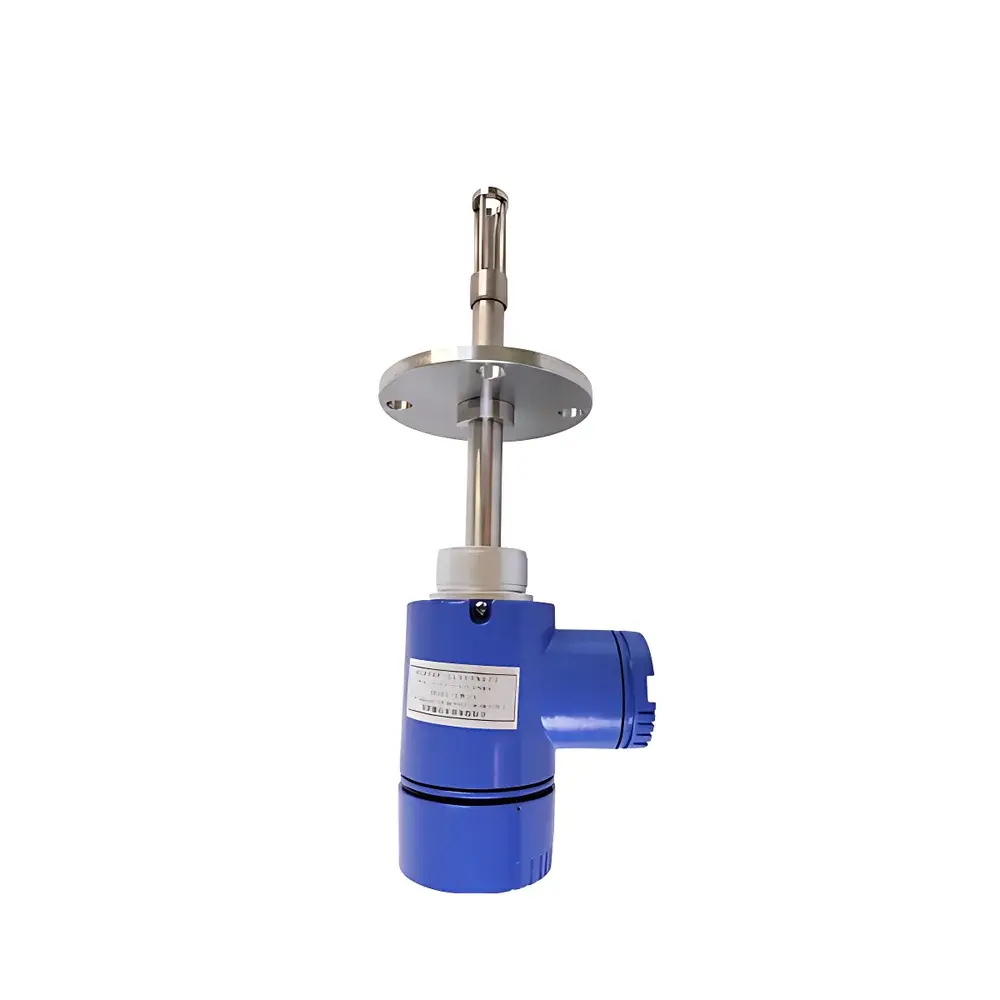
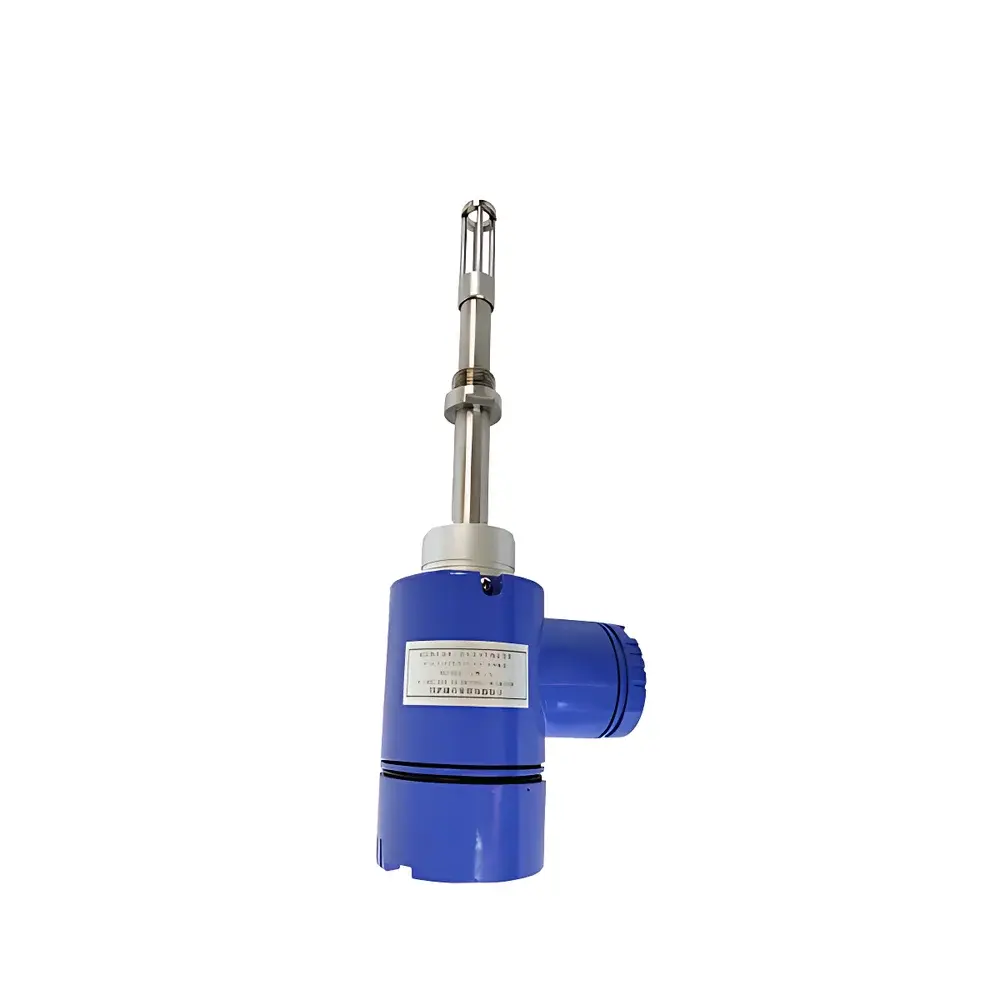
Bigdipper T-BD5IMD+MS1204pcR0.01-10T120 P1.6 High-Frequency In-Line Coal Tar Moisture Analyzer
| Brand | Bigdipper |
|---|---|
| Origin | Beijing, China |
| Manufacturer Type | Direct Manufacturer |
| Country of Origin | China |
| Model | T-BD5IMD+MS1204pcR0.01-10T120 P1.6 |
| Operating Pressure | 1.6 MPa (standard) |
| Temperature Range | -40°C to +100°C |
| Moisture Range | 0–100.0% w/w |
| Accuracy | ≤0.1% FS |
| Repeatability | ±0.1% FS |
| Resolution | 0.01% |
| Insertion Depth | 240 mm (standard, customizable) |
| Enclosure Rating | IP56 / NEMA 4X |
| Explosion Protection | Ex ia IIC T4 Ga |
| Wetted Materials | 1Cr18Ni9Ti (AISI 321 stainless steel) |
| Power Supply | 9–24 V DC @ 100 mA |
| Output Signal | 4–20 mA (configurable, full-scale) |
| Total Length | <700 mm |
| Weight | 2.5–5 kg |
Overview
The Bigdipper T-BD5IMD+MS1204pcR0.01-10T120 P1.6 is a high-frequency in-line moisture analyzer engineered for continuous, real-time quantification of water content in coal tar and related heavy hydrocarbon streams. It operates on the principle of high-frequency electromagnetic wave attenuation—specifically, differential dielectric absorption at frequencies where water exhibits significantly higher permittivity and loss tangent than organic matrices. With a dielectric absorption ratio of approximately 75:1 between water and typical coal tar fractions, the MS1204 sensor detects minute phase and amplitude shifts in a high-frequency electric field induced across the process stream. This physical response is linearly correlated to volumetric and gravimetric water concentration under controlled flow and mixing conditions. Unlike conventional oven-loss or Karl Fischer methods, this technique requires no sampling, reagents, or consumables, enabling true process-integrated measurement with minimal lag time and zero operational downtime.
Key Features
- True in-line operation: Designed for direct insertion into pressurized coal tar pipelines or storage vessel dip tubes without bypass loops or sample conditioning systems
- Robust mechanical architecture: All-welded 1Cr18Ni9Ti (AISI 321) probe body ensures compatibility with aggressive, high-viscosity, high-temperature coal tar at up to 1.6 MPa working pressure
- High metrological stability: Achieves ≤0.1% full-scale accuracy and ±0.1% FS repeatability across 0–100.0% water range—validated under variable tar composition, temperature, and mineral salt content
- Intrinsically safe design: Certified Ex ia IIC T4 Ga for installation in Class I, Div 1, Groups A/B/C/D and Class II, Div 1, Groups E/F/G hazardous locations per NEC/CEC standards
- Low-maintenance operation: No moving parts, optical windows, or replaceable electrodes; immune to fouling from coke precursors or suspended carbon particulates common in raw coal tar
- Wide environmental tolerance: Rated IP56/NEMA 4X; functional from –40°C to +85°C ambient, and –40°C to +100°C process fluid temperature
Sample Compatibility & Compliance
The analyzer is validated for use with coal tar, medium- and heavy-grade petroleum tars, pitch blends, and related aromatic-rich hydrocarbon liquids containing up to 30% heteroatom compounds (N, S, O) and trace inorganic salts. It complies with ISO 8502-9 (surface moisture assessment), ASTM D4057 (standard practice for manual sampling of petroleum products), and supports GLP/GMP data integrity requirements through configurable 4–20 mA output with HART-enabled diagnostics. While not a standalone regulatory compliance device, its measurement traceability aligns with QA/QC protocols required under EPA Method 1664B (oil and grease), ISO 12937 (water-in-crude oil), and internal process control limits defined in ISO 9001:2015 Clause 8.5.1.
Software & Data Management
The T-BD5IMD+MS1204pcR0.01-10T120 P1.6 integrates seamlessly into industrial SCADA and DCS environments via its isolated 4–20 mA analog output. Optional HART 7 protocol support enables remote configuration of zero/span, damping time, alarm thresholds, and diagnostic status reporting. All calibration parameters—including temperature compensation coefficients and material-specific permittivity offsets—are stored in non-volatile memory with write-protection. The system generates no raw digital data files; instead, it delivers continuously timestamped analog signals suitable for integration into historian platforms compliant with ISA-88/ISA-95 and FDA 21 CFR Part 11 when paired with validated data acquisition hardware and audit-trail-enabled software layers.
Applications
- Coal gasification and coking plants: Real-time monitoring of tar drum effluent moisture to prevent downstream condenser icing and corrosion in ammonia recovery units
- Catalytic upgrading facilities: Feedstock qualification prior to hydroprocessing—excess water causes catalyst deactivation and reactor pressure excursions
- Environmental compliance tracking: Continuous verification of tar dewatering efficiency against discharge limits per local wastewater regulations (e.g., China’s GB 8978-1996, EU BAT Reference Documents for Coke Production)
- Research & development labs: Kinetic studies of emulsion breaking, phase separation, and thermal dehydration behavior under controlled flow conditions
- Quality assurance in tar-based binder production: Ensuring consistent moisture specification (<0.5% w/w) for electrode paste and refractory applications
FAQ
Does the analyzer require periodic recalibration?
No scheduled recalibration is mandated under stable operating conditions. However, a two-point verification (dry tar and known aqueous standard) is recommended every 6 months or after major process changes affecting tar composition.
Can it measure water-in-tar emulsions?
Yes—provided the emulsion is homogenized upstream of the probe insertion point. The instrument responds to total free + dissolved water; stable microemulsions may yield slightly elevated readings due to bound water contribution.
Is the probe compatible with steam tracing or jacketed piping?
Yes. The 1Cr18Ni9Ti construction and ceramic-insulated electrodes tolerate conductive heating jackets and external steam tracing up to 150°C surface temperature, provided process-side temperature remains within the specified –40°C to +100°C range.
What failure modes are monitored internally?
The electronics continuously self-check sensor impedance, signal-to-noise ratio, temperature drift, and power supply voltage. Fault conditions trigger a 3.6 mA low-limit alarm output and disable the primary 4–20 mA channel until reset.
How is probe fouling mitigated during long-term operation?
The sensor’s planar electrode geometry and high-frequency excitation minimize electrochemical deposition and carbon adhesion. Field experience shows >18 months of uninterrupted service in primary tar lines without cleaning, assuming nominal particulate load <50 mg/L.




