
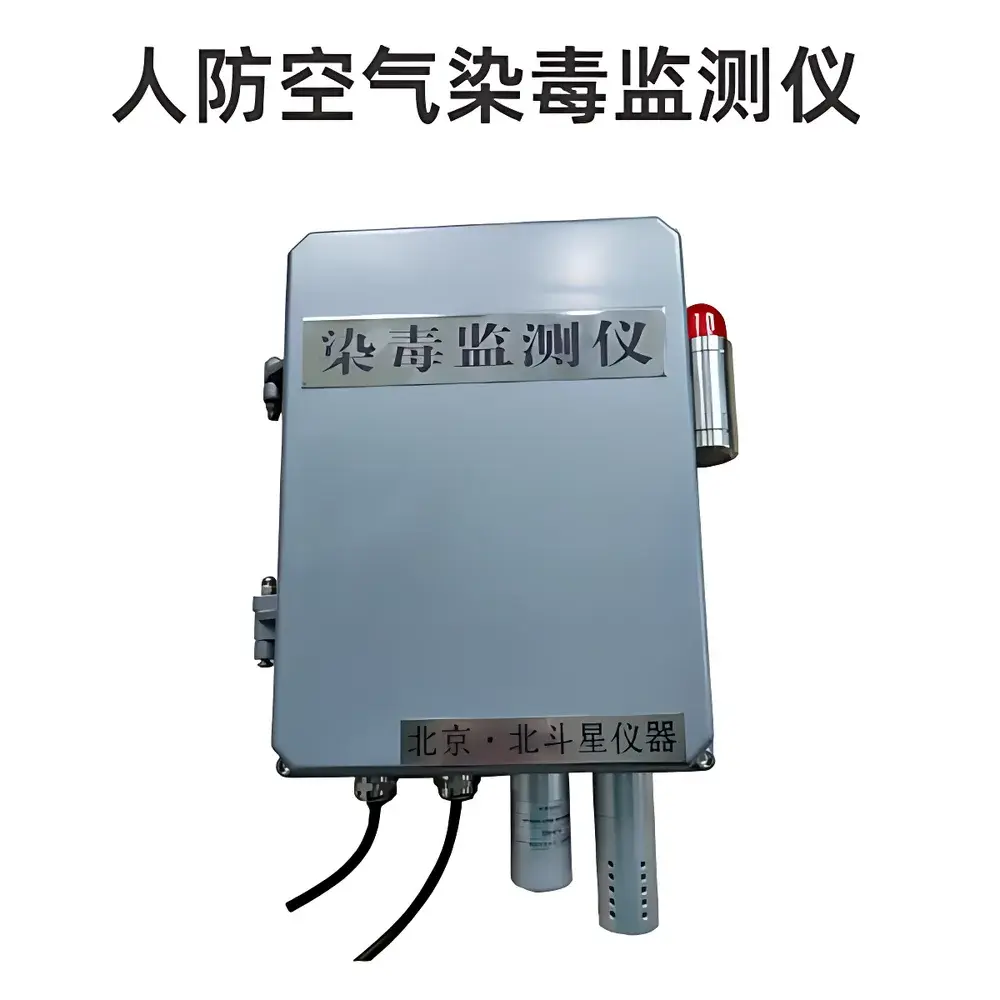
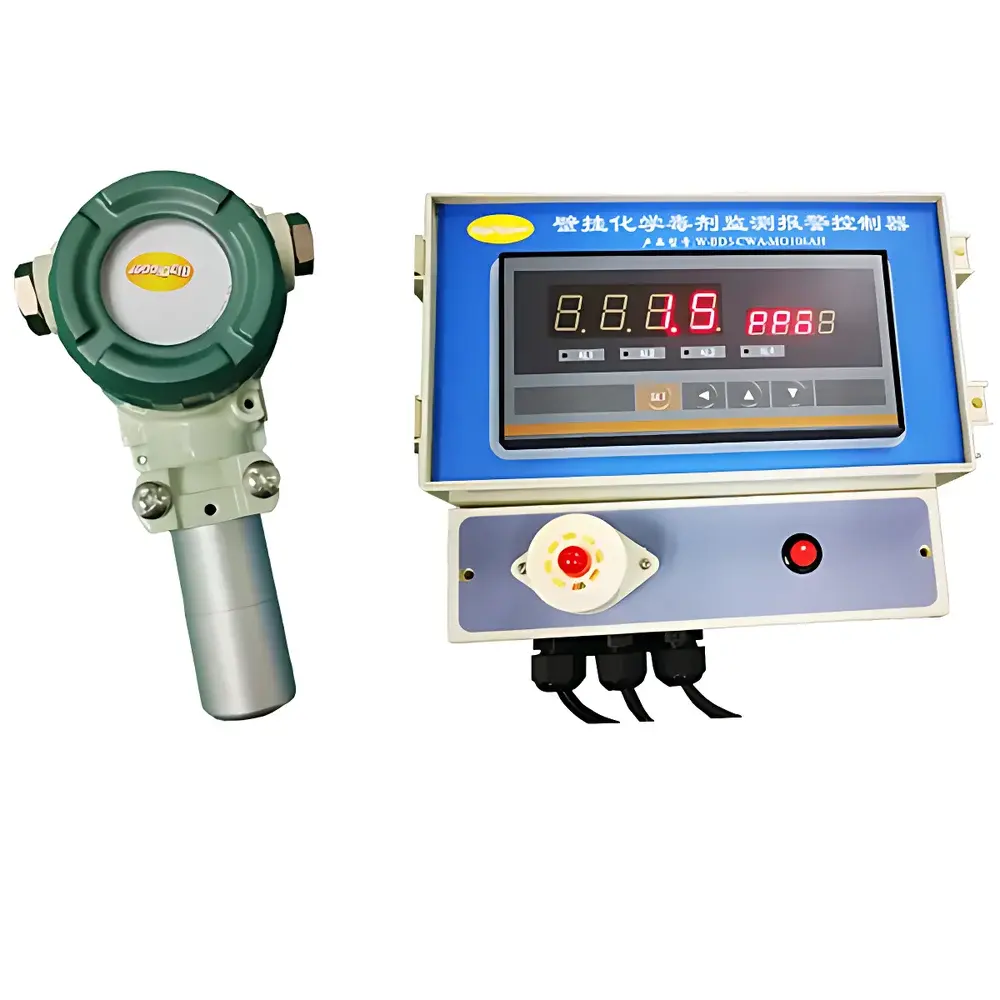
Bigdipper WBD5-CWA-MG02 Chemical Warfare Agent (CWA) Detection Alarm System
| Brand | Bigdipper |
|---|---|
| Origin | Beijing, China |
| Manufacturer Type | OEM/ODM Manufacturer |
| Country of Origin | China |
| Model | WBD5-CWA-MG02 |
| Detection Principle | Electrochemical & Metal Oxide Semiconductor (MOS) Sensor Array |
| Target Analytes | Organophosphorus agents (GA, GB, GD, GF, VX, VR, etc.), Mustard gas (HD), Lewisite (L), Blister agents (HN-1, HN-2, HN-3), Blood agents (HCN, CK), Nerve agents (G-series, V-series), Riot control agents (CN, CS, CR, DM, CN-PS), and common industrial toxics (Cl₂, H₂S, CO, CH₄, gasoline vapors) |
| Detection Range | 0.02–100 ppm (agent-specific) |
| Response Time | <10 ms |
| Accuracy | ≤±5% FS (toxic agents), ≤±0.5% (O₂) |
| Repeatability | ≤1% FS |
| Output Signal | 4–20 mA / 0–20 mA |
| Operating Voltage | 12–24 VDC (sensor module) |
| Environmental Operating Range | –20 °C to +40 °C, 0–95% RH, 86–106 kPa |
| Enclosure Rating | Ex ia IICT6 Gb (Intrinsically Safe for Zone 0/1 hazardous areas) |
| Weight | ≤5 kg |
| Continuous Operation | 24/7 |
| Sensor Lifetime | 12–24 months (12-month warranty against manufacturing defects) |
Overview
The Bigdipper WBD5-CWA-MG02 Chemical Warfare Agent (CWA) Detection Alarm System is an intrinsically safe, fixed-mount toxic gas monitoring instrument engineered for continuous real-time detection of military-grade chemical warfare agents and high-hazard industrial toxics in confined and semi-confined environments. Designed specifically for civil defense infrastructure—including underground bunkers, tunnel systems, command shelters, and hardened emergency response facilities—the system employs a multi-sensor architecture combining electrochemical cells and temperature-compensated metal oxide semiconductor (MOS) elements. Unlike broad-spectrum photoionization detectors (PID), the WBD5-CWA-MG02 utilizes agent-selective sensor chemistries calibrated to respond preferentially to known CWA molecular structures (e.g., P=O bond cleavage in organophosphates; S–Cl reactivity in sulfur mustard analogs), minimizing false positives from volatile organic compounds (VOCs) or ambient hydrocarbons. Its measurement principle adheres to IEC 60079-29-1 (gas detector performance standards) and supports integration into centralized building management systems (BMS) or civil defense command networks via standardized 4–20 mA current loop signaling.
Key Features
- Intrinsically safe certification per IEC 60079-0 and IEC 60079-11: Ex ia IICT6 Gb — certified for installation in Zone 0 (continuous hazard) and Zone 1 (intermittent hazard) classified areas.
- Dual-mode alarm activation: Audible alarm (≥85 dB at 1 m) with adjustable tone pattern + high-intensity visual strobe (red LED, ≥100 cd/m² luminance).
- Embedded microcontroller-based signal processing with auto-zero compensation, drift correction, and temperature/humidity cross-sensitivity compensation algorithms.
- Modular sensor design enabling field-replaceable cartridges for organophosphorus, blister, blood, and riot control agents—each calibrated traceably to NIST-traceable reference standards.
- Robust mechanical housing (IP65-rated front panel) with corrosion-resistant aluminum alloy chassis and EMI-shielded internal PCB layout for operation in electromagnetically noisy environments (e.g., near diesel generators or RF transmitters).
- Low-power standby mode (<1.2 W) and fail-safe relay output (NO/NC configurable) compliant with EN 50131-1 Grade 3 intrusion detection system interface requirements.
Sample Compatibility & Compliance
The WBD5-CWA-MG02 is validated for quantitative detection of over 30 priority chemical threat agents listed in the OPCW Annex on Chemicals and referenced in NATO AEP-88 (Allied Engineering Publication). It meets minimum performance criteria outlined in ASTM E2751-22 (Standard Practice for Detection of Chemical Warfare Agents in Air) for response time, recovery time, and interference rejection. The system complies with Chinese national standard GB/T 35213–2017 (Civil Defense Air Purification Equipment Technical Requirements) and supports GLP-aligned data integrity through non-volatile memory logging (timestamped event history retained for ≥12 months). While not FDA 21 CFR Part 11-certified (as it is not a medical device), its audit trail functionality satisfies ISO/IEC 17025 clause 7.7.1 for accredited environmental testing laboratories conducting CWA exposure assessments.
Software & Data Management
The unit operates autonomously without external software but supports optional RS-485 Modbus RTU or Ethernet TCP/IP gateway modules (sold separately) for integration with SCADA platforms such as Siemens Desigo CC, Honeywell Experion PKS, or custom-built civil defense dashboards. All alarm events, calibration logs, sensor health diagnostics, and zero-span verification records are stored internally with UTC timestamps and cryptographic checksums. Data export is supported via USB-C port in CSV format, compatible with MATLAB, Python pandas, or LabVIEW for post-event forensic analysis. Firmware updates follow secure signed-package protocol (SHA-256 + RSA-2048 signature verification) to prevent unauthorized modification—a requirement aligned with CNAS-CL01:2018 Annex A3 for measurement equipment integrity.
Applications
- Civil defense infrastructure monitoring: Real-time surveillance of air quality in blast shelters, metro emergency tunnels, and strategic command centers under NBC (Nuclear, Biological, Chemical) readiness protocols.
- Industrial hygiene compliance: Continuous monitoring in pesticide formulation plants, chemical storage depots, and chlorine-handling facilities where accidental release poses acute inhalation risk.
- Emergency response staging: Deployment in mobile command vehicles or rapid-deployment kits for HAZMAT teams operating in suspected contamination zones.
- Public facility safety: Integration into HVAC control logic for automatic damper closure and filtration activation upon CWA threshold breach in government buildings, hospitals, or transportation hubs.
- Research and training: Use in military CBRN schools for realistic agent-detection drills using simulants (e.g., DMMP for sarin, 2-chloroethyl ethyl sulfide for mustard gas), with configurable alarm thresholds per training scenario.
FAQ
What types of chemical warfare agents does the WBD5-CWA-MG02 detect?
It detects nerve agents (G-series, V-series), blister agents (mustard, lewisite, nitrogen mustards), blood agents (cyanides), choking agents (chlorine), and riot control agents (CS, CN, CR, DM) — all per OPCW Schedule 1–3 compound definitions.
Is the sensor array field-calibratable?
Yes. Calibration is performed using certified span gases traceable to NIST Standard Reference Materials (SRMs); zero calibration uses synthetic air (≤0.1 ppm total hydrocarbons). Full calibration requires proprietary calibration adapter kit (part no. CAL-KIT-WBD5-CWA).
Does the device comply with international explosion protection standards?
Yes. Certified to IEC 60079-0:2018 and IEC 60079-11:2011 for Ex ia IICT6 Gb — suitable for installation in Zone 0 gas atmospheres without additional barriers.
Can the alarm outputs interface with fire alarm control panels (FACP)?
Yes. The 4–20 mA analog output and dry-contact relay (SPDT, 250 VAC/3 A) are compatible with conventional FACP input modules meeting UL 864 9th Edition supervision requirements.
What is the recommended maintenance interval?
Sensor modules require replacement every 12–24 months depending on cumulative exposure; full functional verification (including response time and alarm threshold validation) is recommended quarterly per GB/T 35213–2017 Section 8.3.







