
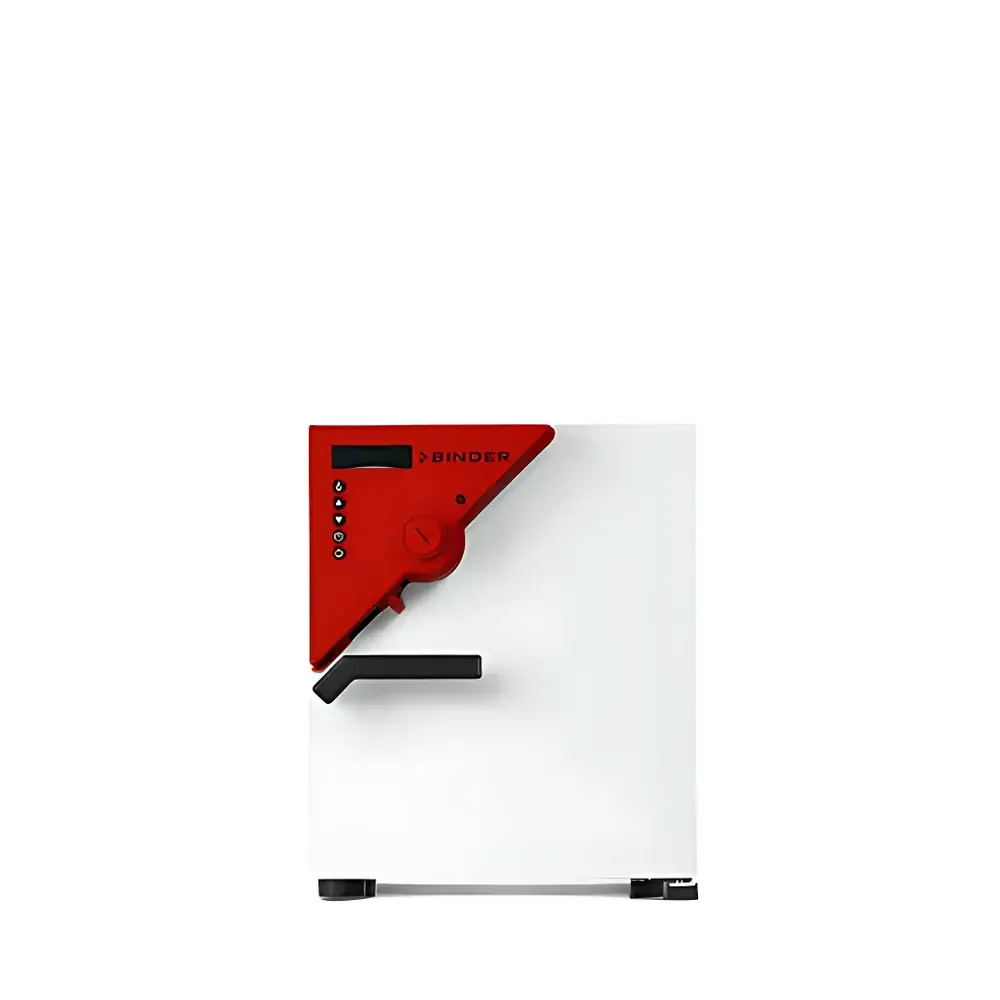
BINDER BD Series Classic.Line Biochemical Incubator
| Brand | BINDER |
|---|---|
| Origin | Germany |
| Model(s) | BD115, BD240, BD400 |
| External Dimensions (W×H×D mm) | 435×495×520 (BD115), 1235×1025×765 (BD400) |
| Internal Dimensions (W×H×D mm) | 222×330×277 (BD115), 1000×800×500 (BD400) |
| Internal Volume | 20 L (BD115), 400 L (BD400) |
| Net Weight (empty) | 27 kg (BD115), 135 kg (BD400) |
| Max. Total Load | 25 kg (BD115), 90 kg (BD400) |
| Max. Load per Shelf | 12 kg (BD115), 35 kg (BD400) |
| Temp. Range | Ambient +5 °C to 100 °C |
| Temp. Uniformity (±K @37°C) | 0.5 K |
| Temp. Stability (±K @37°C) | 0.2 K (BD115), 0.1 K (BD400) |
| Heating Time to 37°C | 59 min (BD115), 120 min (BD400) |
| Recovery Time after 30s Door Opening (@37°C) | 20 min (BD115), 10 min (BD400) |
| Rated Power (230 V) | 0.2 kW (BD115), 0.85 kW (BD400) |
| Standard/Max. Shelves | 2/4 (BD115), 2/9 (BD400) |
| Safety Class | Temperature Safety Device Class 3.1 (DIN 12880), Optical Alarm |
| Controller | Time-Programmable, RS 422 Interface |
| Construction | ESG (Tempered Safety Glass) Inner Door, Adjustable Exhaust Valve, Apt.line™ Preheating Chamber Technology, Natural Convection Design |
Overview
The BINDER BD Series Classic.Line Biochemical Incubator is a precision-engineered, natural convection incubation system designed for long-term, stable thermal conditioning of biological samples, cell cultures, microbiological media, and temperature-sensitive reagents. Developed and manufactured in Germany, the BD series adheres to stringent DIN 12880 standards for laboratory incubators and integrates BINDER’s proprietary Apt.line™ preheating chamber technology—ensuring uniform heat distribution, minimized thermal gradients, and exceptional reproducibility across the entire working volume. Unlike forced-air systems, the natural convection architecture eliminates mechanical airflow that could disturb delicate cultures or desiccate agar plates, making it ideal for applications requiring gentle, vibration-free thermal environments. The incubators operate within a broad temperature range—from ambient +5 °C up to 100 °C—enabling both routine culturing and high-temperature decontamination cycles without auxiliary equipment.
Key Features
- APT.line™ preheating chamber technology for homogeneous temperature distribution and rapid thermal recovery after door opening
- Natural convection design with no internal fans—preserves sample integrity and prevents cross-contamination
- Double-glazed inner door made of ESG (tempered safety glass) for continuous visual monitoring without compromising chamber stability
- Independent, adjustable temperature safety device (Class 3.1 per DIN 12880) with optical alarm for fail-safe operation
- Time-programmable digital controller with RS 422 interface for external data logging and integration into centralized lab management systems
- Manually adjustable exhaust valve for fine-tuning humidity retention and CO2-free atmospheric balance
- Chromium-plated, height-adjustable shelving (2 standard / up to 4 in BD115; 2 standard / up to 9 in BD400) supporting load capacities up to 35 kg per shelf
- Validatable 100 °C dry-heat decontamination cycle compliant with ISO 14644-1 cleanroom maintenance protocols
Sample Compatibility & Compliance
The BD Series accommodates a wide spectrum of life science workflows—including bacterial and fungal cultivation, enzyme activity assays, tissue storage, pharmaceutical stability testing (ICH Q1A–Q1E), and quality control of diagnostic reagents. Its chamber geometry and thermal performance meet critical requirements for GLP-compliant laboratories and support audit readiness under FDA 21 CFR Part 11 when paired with validated data acquisition software. All models are CE-marked and conform to IEC 61010-1 (Safety Requirements for Electrical Equipment for Measurement, Control, and Laboratory Use). The absence of internal circulation fans ensures compatibility with open Petri dishes, multi-well plates, and suspension cultures where airflow-induced evaporation or shear stress must be avoided.
Software & Data Management
Equipped with an RS 422 serial interface, the BD incubators enable bidirectional communication with external PCs or SCADA systems. When integrated with BINDER’s optional ecoControl software or third-party LabVIEW- or Python-based acquisition tools, users can implement automated temperature profiling, real-time deviation alerts, electronic audit trails, and PDF report generation—all traceable to user ID and timestamp. The controller supports time-based setpoint changes, enabling unattended overnight ramping or multi-stage incubation protocols. While the base unit does not include built-in data storage, its interface architecture satisfies essential criteria for 21 CFR Part 11 compliance when deployed within a validated IT infrastructure with appropriate access controls and electronic signature capabilities.
Applications
- Long-term microbial culture maintenance (e.g., E. coli, S. aureus, yeast strains)
- Thermal stability assessment of biologics, vaccines, and monoclonal antibodies
- Enzyme kinetics studies requiring precise, drift-free temperature control
- Pre-incubation of agar plates prior to streaking or colony isolation
- Conditioning of hygroscopic reagents and buffer solutions at defined thermal setpoints
- Supporting ISO 13485-certified medical device manufacturing QC processes
- Dry-heat sterilization of glassware and stainless-steel instruments (100 °C cycle)
FAQ
What distinguishes natural convection from forced-air incubation in the BD Series?
Natural convection relies on thermally driven air movement without fans—eliminating turbulence, noise, and mechanical wear. This preserves sample homogeneity and reduces evaporation rates in uncovered vessels.
Is the BD Series suitable for GMP-regulated environments?
Yes—when operated with documented procedures, calibrated sensors, and integrated into a validated data capture system, BD incubators support GMP Annex 11 and EU GMP Chapter 4 requirements for environmental monitoring equipment.
Can the BD400 accommodate standard ISO-sized trays?
The internal depth of 500 mm and width of 1000 mm allow full compatibility with ISO 7730-compliant 600 × 400 mm tray configurations across up to nine shelves.
Does the incubator support remote monitoring via Ethernet or Wi-Fi?
The standard interface is RS 422; Ethernet or Wi-Fi connectivity requires an external protocol converter or gateway device compatible with Modbus RTU or ASCII command sets.
How frequently should temperature mapping be performed?
Per ISO/IEC 17025 and ASTM E2874, initial qualification and annual requalification are recommended—with additional mapping after major maintenance, relocation, or process change.
Related Products



