
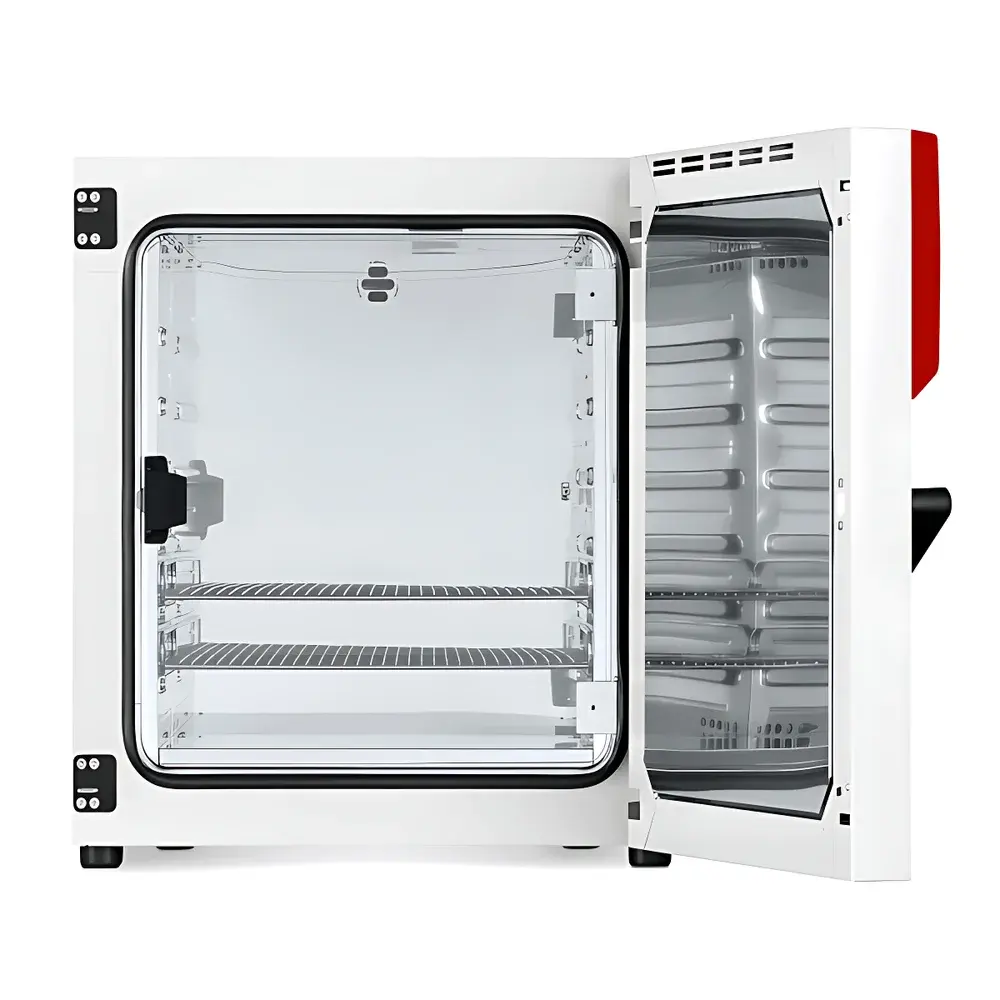
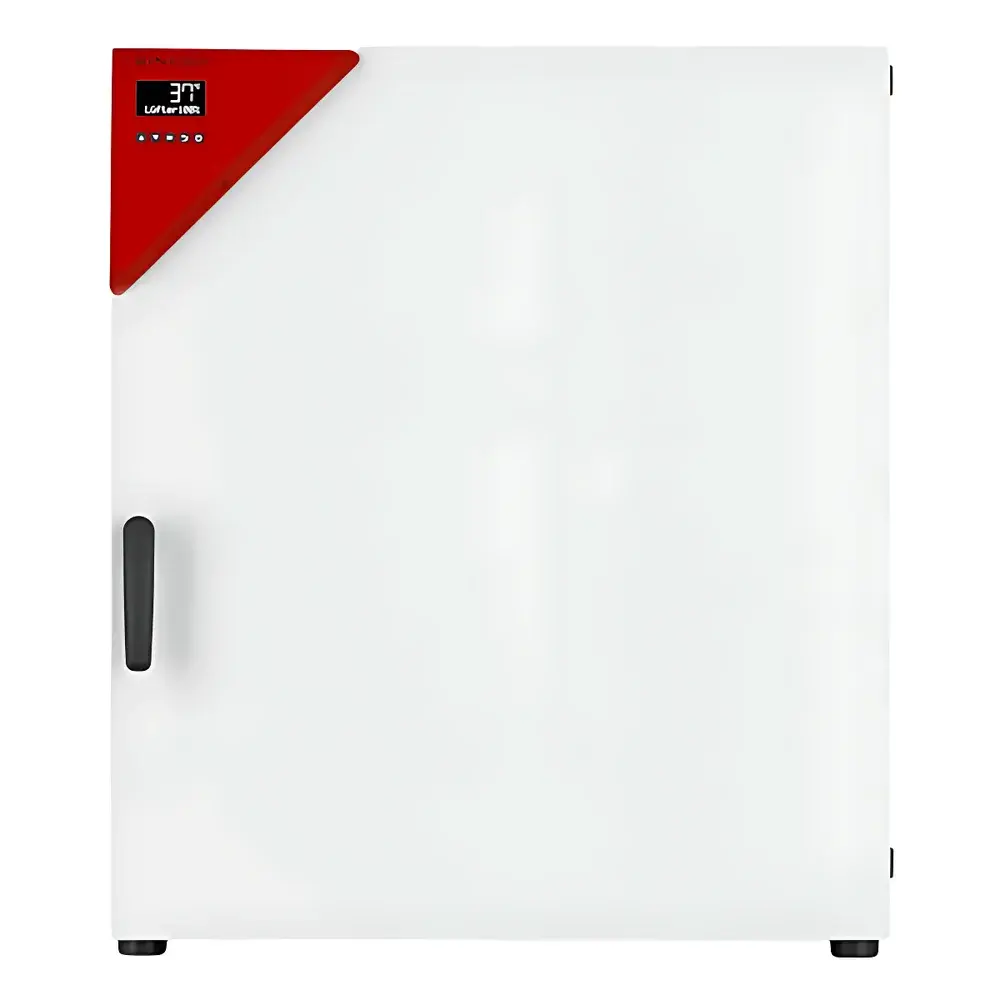
BINDER BF260 Biochemical Incubator with Forced-Air Circulation
| Brand | BINDER |
|---|---|
| Origin | Germany |
| Manufacturer | BINDER GmbH |
| Product Type | Imported Laboratory Incubator |
| Model | BF 260 |
| Heating Method | Water-Jacketed |
| Air Circulation | Forced Convection |
| Temperature Range | RT + 7 °C to 100 °C |
| Temperature Stability at 37 °C | ±0.1 °C |
| Temperature Uniformity at 37 °C | ±0.2 °C |
| External Dimensions (W×D×H) | 810 mm × 760 mm × 845 mm |
Overview
The BINDER BF260 Biochemical Incubator is a precision-engineered, water-jacketed forced-air incubation system designed for demanding life science applications requiring exceptional thermal stability, reproducibility, and long-term operational reliability. Built upon BINDER’s decades of German engineering expertise in environmental simulation, the BF260 employs a dual-wall water-jacketed heating architecture combined with a high-efficiency axial fan-driven forced convection system to ensure rapid temperature equilibration and minimal thermal gradients—even under full-load conditions. Unlike natural convection or air-jacketed alternatives, the water-jacket design delivers superior thermal mass and buffering capacity, minimizing sensitivity to ambient fluctuations and door-opening events. Its operating range spans from ambient +7 °C to 100 °C, making it suitable for both standard microbiological cultivation (e.g., E. coli, yeast, mammalian cell lines) and higher-temperature biochemical assays such as enzyme kinetics, protein denaturation studies, and accelerated stability testing per ICH Q1 guidelines.
Key Features
- Water-jacketed heating system providing stable, low-drift thermal control with inherent insulation and reduced energy consumption over extended operation cycles.
- Forced-air convection via a centrally mounted, brushless DC fan ensures uniform airflow distribution across all shelf levels—validated by DIN 12880 Class 3.1 certification for temperature uniformity (±0.2 °C at 37 °C).
- Dual-stage independent temperature safety system compliant with DIN 12880 Class 3.1: includes an electronic limit thermostat and a mechanical backup cut-off, both triggering optical and acoustic alarms upon deviation.
- Tempered safety glass (ESG) inner door minimizes condensation while enabling unobstructed visual monitoring without compromising thermal integrity.
- Ergonomically contoured handles and smooth-glide stainless-steel shelves with chrome-plated, height-adjustable supports facilitate safe, repeatable sample loading and ergonomic access.
- LCD controller with intuitive menu navigation, real-time parameter display (setpoint, actual value, elapsed time), and programmable ramp/soak profiles for multi-step incubation protocols.
Sample Compatibility & Compliance
The BF260 accommodates standard laboratory vessels including Petri dishes, flasks (Erlenmeyer and shake), multiwell plates, and roller bottles—compatible with ISO 8573-1 clean air classification requirements for non-sterile incubation environments. Its chamber construction uses electropolished stainless steel (AISI 304) interior surfaces, ensuring corrosion resistance against common culture media components and facilitating GLP-compliant cleaning validation. The unit meets essential international safety and performance standards, including EN 61000-6-3 (EMC), EN 61000-6-2 (immunity), and DIN 12880 Part 1 (incubator classification). While not certified for sterile processing, its design supports integration into ISO/IEC 17025-accredited laboratories where traceable temperature validation (e.g., using calibrated Pt100 sensors per ISO/IEC 17025 Clause 6.4.10) is required for QC/QA workflows.
Software & Data Management
The BF260 operates with BINDER’s proprietary C-Control™ microprocessor-based controller, supporting audit-trail-capable event logging (door openings, alarm triggers, setpoint changes) stored internally for up to 30 days. Optional analog output (0–10 V) and digital RS485 interface enable connection to centralized building management systems (BMS) or LIMS platforms. When paired with BINDER’s optional data logger module or third-party compliant software (e.g., LabVIEW-compatible drivers), users can export timestamped temperature datasets in CSV format for 21 CFR Part 11–aligned electronic records—supporting FDA-regulated environments where electronic signature and data integrity requirements apply.
Applications
- Mammalian and insect cell culture maintenance at 37 °C with CO₂-independent protocols.
- Bacterial and fungal growth studies requiring precise thermal control across physiological and supra-physiological ranges (e.g., 25–45 °C).
- Enzyme activity assays, ligand-binding kinetics, and thermal shift assays (TSA) requiring sub-0.2 °C uniformity.
- Stability testing of biopharmaceutical intermediates per ICH Q5C and Q1A(R3) guidelines.
- Environmental stress response modeling in plant tissue culture and algal biotechnology.
- Quality control incubation for pharmaceutical raw materials and excipients under GMP Annex 1-aligned environmental monitoring frameworks.
FAQ
Is the BF260 suitable for CO₂-controlled cell culture?
No—the BF260 is a standalone temperature-controlled incubator without integrated CO₂ regulation or humidity control. For CO₂-dependent applications, consider BINDER’s CB series CO₂ incubators.
Can the BF260 be validated for GxP compliance?
Yes—its Class 3.1 temperature performance, dual safety circuitry, and optional data logging support IQ/OQ/PQ execution per ASTM E2500 and EU GMP Annex 15 requirements.
What is the maximum load capacity for uniform temperature performance?
Validation data confirms ±0.2 °C uniformity at 37 °C with up to 12 standard 175 cm² flasks evenly distributed across three shelves.
Does the water jacket require deionized water?
Yes—BINDER specifies use of deionized or distilled water to prevent mineral deposition and ensure long-term jacket integrity and thermal efficiency.
How frequently should temperature mapping be performed?
Per ISO/IEC 17025 and FDA guidance, initial mapping is mandatory; re-mapping is recommended annually or after major maintenance, relocation, or protocol changes affecting chamber loading patterns.
Related Products



