
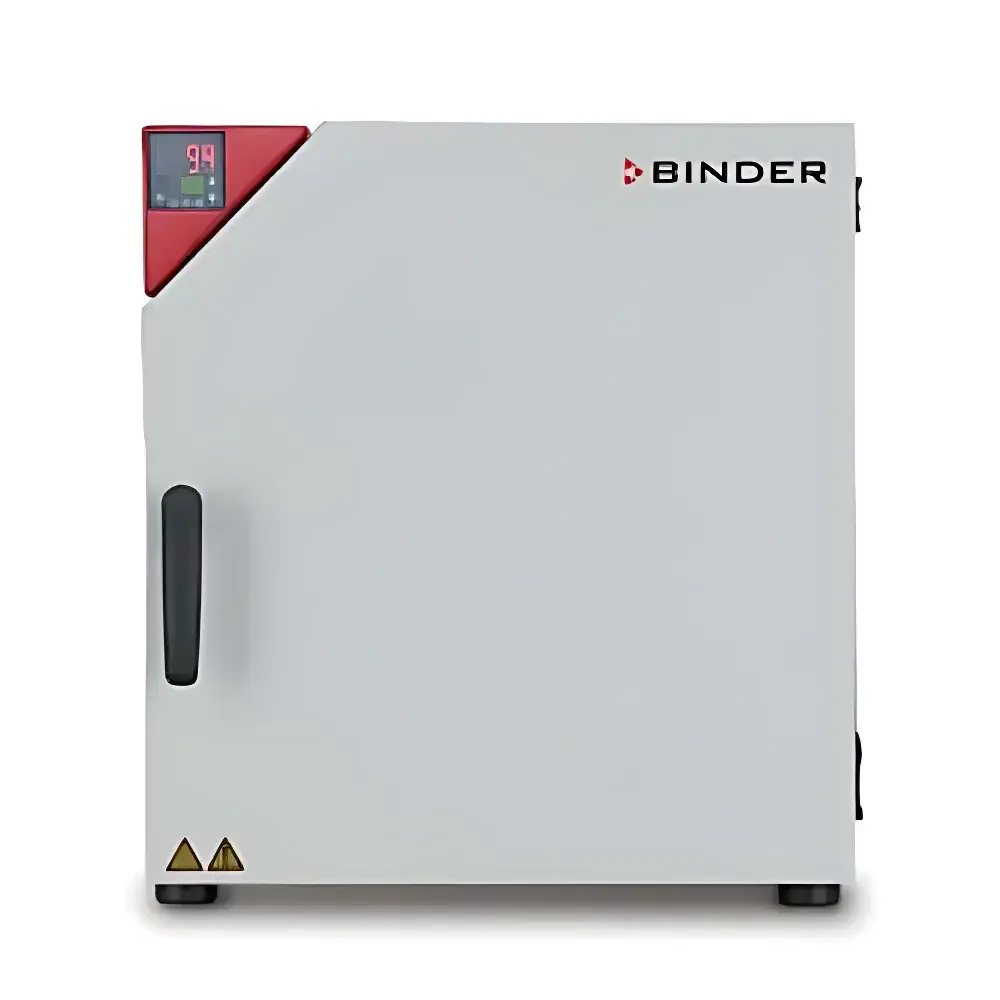
BINDER ED-S Solid.Line Natural Convection Drying Oven
| Brand | BINDER |
|---|---|
| Origin | Germany |
| Model | ED-S Solid.Line |
| Instrument Type | Standard Drying Oven |
| Temperature Range | Ambient +7 °C to 250 °C |
| Temperature Uniformity | ±0.8 °C |
| External Dimensions (W×H×D) | 614 × 625 × 577 mm |
| Internal Dimensions (W×H×D) | 400 × 440 × 350 mm |
| Internal Volume | 62 L |
| Chamber Material | Stainless Steel (AISI 304) |
| Heating Technology | APT.line™ Preheating Chamber Technology |
| Air Circulation | Natural Convection (Free Convection) |
| Safety | Independent Adjustable Temperature Safety Device, Class 2 (DIN 12880), Optical Alarm |
| Controller | Time-Programmable Digital Controller |
| Accessories | 2 Chrome-Plated Wire Shelving Inserts |
| Exhaust Valve | Adjustable |
Overview
The BINDER ED-S Solid.Line Natural Convection Drying Oven is a precision-engineered laboratory drying and conditioning system designed for applications requiring stable, uniform thermal environments without forced air movement. Operating on the principle of natural convection—relying on buoyancy-driven airflow rather than mechanical fans—the ED-S series ensures minimal sample disturbance, making it ideal for drying heat-sensitive materials, pre-conditioning filters or packaging components, stabilizing hygroscopic substances, and performing gentle moisture removal in quality control and R&D workflows. Its APT.line™ preheating chamber technology—a hallmark of BINDER’s thermal architecture—surrounds the inner chamber with a fully insulated heating jacket that maintains consistent wall temperatures, significantly reducing thermal gradients and improving temperature homogeneity across the entire working volume. The oven complies with DIN 12880 for laboratory drying equipment and meets essential requirements for GLP-compliant documentation when paired with optional data logging interfaces.
Key Features
- APT.line™ preheating chamber technology ensures superior temperature uniformity (±0.8 °C) and rapid recovery after door openings
- Natural convection design eliminates fan-induced turbulence, preserving delicate samples and preventing powder dispersion or particle migration
- Independent, adjustable temperature safety device (Class 2 per DIN 12880) with optical alarm provides redundant overtemperature protection
- Time-programmable digital controller enables precise start/stop scheduling and simple ramp-hold profiles
- Adjustable exhaust valve allows fine-tuned control of internal humidity and volatile compound evacuation
- Stainless steel interior (AISI 304) offers corrosion resistance, ease of cleaning, and long-term dimensional stability under repeated thermal cycling
- Two chrome-plated wire shelves included as standard; additional shelf kits available for vertical space optimization
Sample Compatibility & Compliance
The ED-S Solid.Line accommodates a broad range of sample formats—including Petri dishes, weighing boats, glassware, polymer films, ceramic substrates, and pharmaceutical packaging components—without risk of mechanical agitation. Its natural convection airflow profile is particularly suited for ASTM D1654 (corrosion testing specimens), ISO 5725 (precision testing of reference materials), and USP (sterile processing validation support). The unit is CE-marked and manufactured in accordance with EN 61000-6-3 (EMC) and EN 61000-6-2 (immunity). While not inherently 21 CFR Part 11 compliant, its controller supports external audit-trail-capable data loggers compatible with GMP/GLP environments when configured with appropriate validation protocols.
Software & Data Management
The ED-S operates via an intuitive front-panel interface with LED display and rotary encoder navigation. No proprietary software is required for basic operation; however, optional analog output (0–10 V or 4–20 mA) and RS485 Modbus RTU interface enable integration into centralized building management systems (BMS) or LIMS platforms. When connected to validated third-party data acquisition hardware, the oven supports electronic record generation with timestamped temperature logs, alarm event capture, and user-accessible configuration history—facilitating compliance with ALCOA+ data integrity principles in regulated laboratories.
Applications
- Drying of filter papers, gravimetric analysis crucibles, and moisture content reference standards
- Conditioning of test specimens prior to tensile, adhesion, or permeability measurements (e.g., ISO 291, ASTM D618)
- Pre-baking of electronic components and PCB assemblies before conformal coating
- Stabilization of hygroscopic reference materials in metrology labs
- Residual solvent removal from coated films and thin-film substrates in material science research
- Low-stress dehydration of botanical or food-grade samples where oxidation or structural collapse must be minimized
FAQ
Does the ED-S include a built-in data logger?
No—the ED-S Solid.Line does not feature integrated data logging. However, its analog and digital outputs allow seamless connection to external certified loggers for continuous monitoring and 21 CFR Part 11–compliant archiving.
Can the exhaust valve be closed completely during operation?
Yes, the manually adjustable exhaust valve can be fully closed, partially opened, or fully vented to manage internal vapor pressure and optimize drying kinetics for specific sample matrices.
Is the stainless steel chamber electropolished or passivated?
The interior uses standard AISI 304 stainless steel with a brushed finish. Electropolishing is not standard but can be specified as a custom option for enhanced cleanability in high-purity applications.
What is the maximum load capacity per shelf?
Each chrome-plated wire shelf is rated for 15 kg uniformly distributed load. Total chamber loading should not exceed 30 kg to maintain thermal performance and airflow integrity.
How frequently does the temperature safety device require calibration verification?
Per DIN 12880, periodic functional testing is recommended before each critical use cycle; full calibration against traceable standards is advised annually or per internal QA schedule.



