
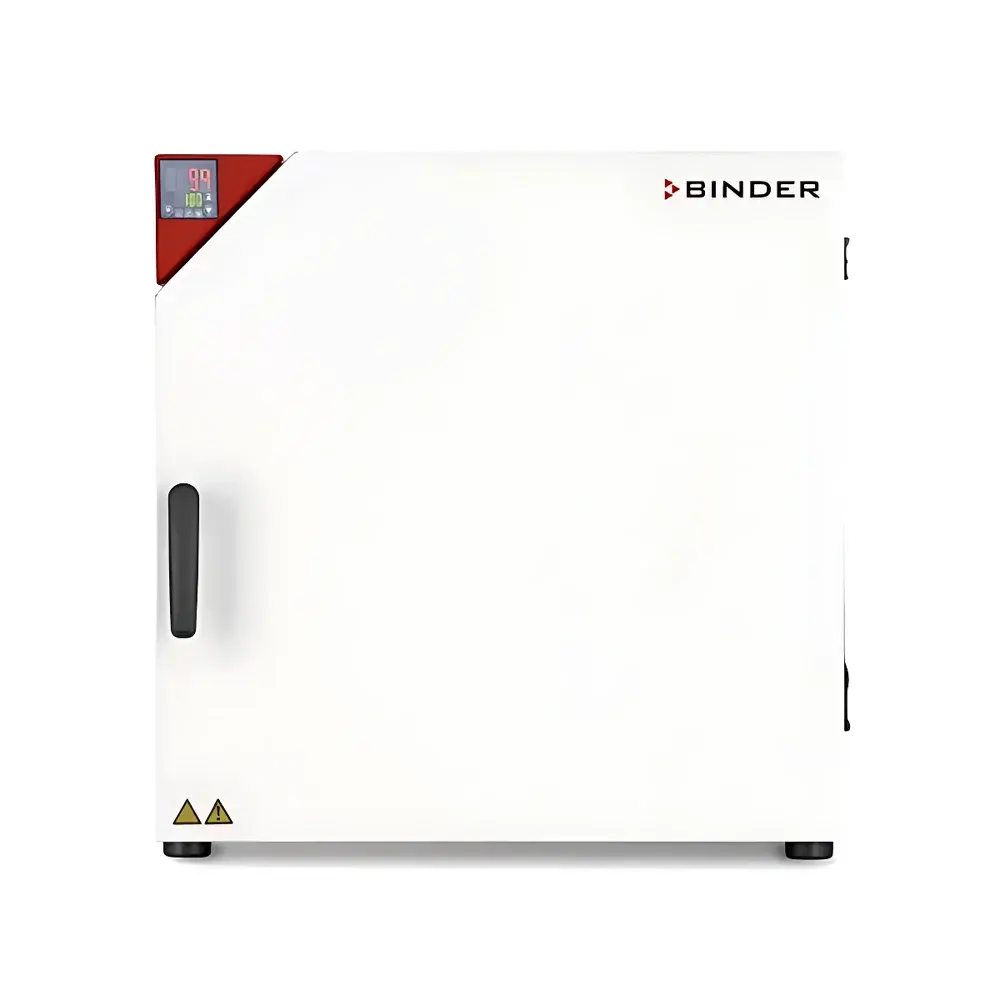
BINDER ED-S Solid.Line Series Drying and Heating Ovens
| Brand | BINDER |
|---|---|
| Origin | Germany |
| Model | ED-S 56 / ED-S 115 |
| External Dimensions (W×H×D, mm) | 590×580×515 (ED-S 56) / 740×790×555 (ED-S 115) |
| Internal Dimensions (W×H×D, mm) | 400×440×350 (ED-S 56) / 550×550×390 (ED-S 115) |
| Interior Volume | 62 L / 118 L |
| Net Weight (empty) | 41 kg / 57 kg |
| Temperature Range | Ambient +7 °C to 250 °C |
| Temperature Uniformity at 150 °C | ±2.8 K |
| Temperature Fluctuation at 150 °C | ±0.8 K |
| Heating Time to 150 °C | 60 min / 55 min |
| Power Consumption at 150 °C | 180 Wh/h / 310 Wh/h |
Overview
The BINDER ED-S Solid.Line Series drying and heating ovens represent a rigorously engineered class of laboratory thermal processing equipment designed for reproducible, stable, and contamination-controlled thermal treatment of samples in research, quality control, and routine analytical workflows. Built on BINDER’s longstanding heritage in precision climate instrumentation, the ED-S series employs natural convection airflow and APT.line™ preheating technology — a proprietary chamber wall preheating system that minimizes thermal gradients during ramp-up and stabilizes internal temperature distribution across the entire working volume. This architecture ensures compliance with critical performance criteria defined in DIN 12880 for laboratory ovens, particularly regarding temperature uniformity (±2.8 K at 150 °C) and stability (±0.8 K fluctuation), making it suitable for applications where thermal consistency directly impacts analytical validity — such as gravimetric moisture analysis, polymer curing validation, pharmaceutical stability testing per ICH Q1 guidelines, and residual solvent removal under GLP-compliant conditions.
Key Features
- APT.line™ preheating technology: Heats the inner chamber walls independently prior to and during operation, significantly reducing temperature overshoot and improving spatial uniformity.
- Natural convection design: Eliminates forced-air turbulence, preserving delicate sample integrity and avoiding particle resuspension — essential for powder drying, filter drying, or ceramic sintering pre-treatment.
- DIN 12880 Class II independent temperature safety device: Dual-stage hardware-based overtemperature protection with optical alarm, fully compliant with German and EU laboratory safety standards.
- Time-programmable digital controller: Enables precise multi-step thermal protocols, including hold times, ramp rates, and automatic shutdown — supporting ASTM E145 and ISO 17025 traceable process documentation.
- Adjustable exhaust valve: Allows fine-tuning of vapor evacuation rate to manage humidity buildup or volatile organic compound (VOC) accumulation during extended drying cycles.
- Ergonomic front-loading door with balanced hinge mechanism: Facilitates safe, repeatable access without compromising thermal seal integrity or operator posture during high-frequency use.
Sample Compatibility & Compliance
The ED-S series accommodates a broad range of sample formats — from Petri dishes and weighing boats to crucibles, glassware, and standardized test specimens — within its corrosion-resistant stainless-steel interior. Its absence of fan-driven air movement prevents cross-contamination between adjacent samples and eliminates mechanical stress on fragile materials. The ovens are certified to DIN EN 61000-6-3 (EMC) and DIN EN 61000-6-2 (immunity), and meet essential requirements of the EU Machinery Directive 2006/42/EC. For regulated environments, the time-programmable controller supports audit-ready event logging when integrated with external data acquisition systems; while not natively 21 CFR Part 11 compliant, its deterministic behavior and hardware safety interlocks make it suitable for GMP-aligned workflows when paired with validated SOPs and electronic lab notebook (ELN) integration.
Software & Data Management
The ED-S operates via an embedded microprocessor-based controller with intuitive membrane keypad interface and high-contrast LCD display. All operational parameters — setpoint, actual temperature, elapsed time, remaining time, and alarm status — are continuously visible. While the unit does not include built-in Ethernet or USB connectivity, its analog output (0–10 V) and relay contacts enable seamless integration with centralized building management systems (BMS), SCADA platforms, or third-party data loggers for continuous temperature monitoring and long-term trend analysis. Event logs (e.g., door openings, temperature deviations, safety cutoffs) are retained in non-volatile memory and can be manually reviewed on-device — supporting internal quality audits and CAPA investigations per ISO 9001 and ISO/IEC 17025 requirements.
Applications
- Moisture content determination per AOAC 950.46 and USP <731> using loss-on-drying methodology.
- Pre-conditioning of reference standards, filters, and desiccants prior to gravimetric calibration.
- Thermal stabilization of metal oxide catalysts and ceramic precursors before XRD or BET surface area analysis.
- Drying of biological tissue sections, chromatography plates, and electrophoresis gels without curling or cracking.
- Accelerated aging studies of packaging materials and medical device components under controlled thermal stress.
- Residual solvent removal from API intermediates in compliance with ICH Q3C thresholds.
FAQ
What is the maximum operating temperature of the ED-S series?
The ED-S ovens are rated for continuous operation from ambient +7 °C up to 250 °C.
Is the chamber interior made of stainless steel?
Yes — the working chamber is constructed from electropolished 1.4301 (AISI 304) stainless steel, ensuring corrosion resistance and ease of decontamination.
Does the ED-S support programmable ramp-and-soak cycles?
Yes — the time-programmable controller allows up to 10 segments with independent ramp rates and dwell times.
Can the exhaust valve be locked in a fixed position?
The valve is manually adjustable with detented positions; no locking mechanism is provided, but its setting remains stable under normal operation.
Is calibration certificate included with delivery?
No factory calibration certificate is supplied by default; however, the unit is designed to accept third-party thermocouple probes for on-site verification per ISO/IEC 17025-accredited procedures.



