
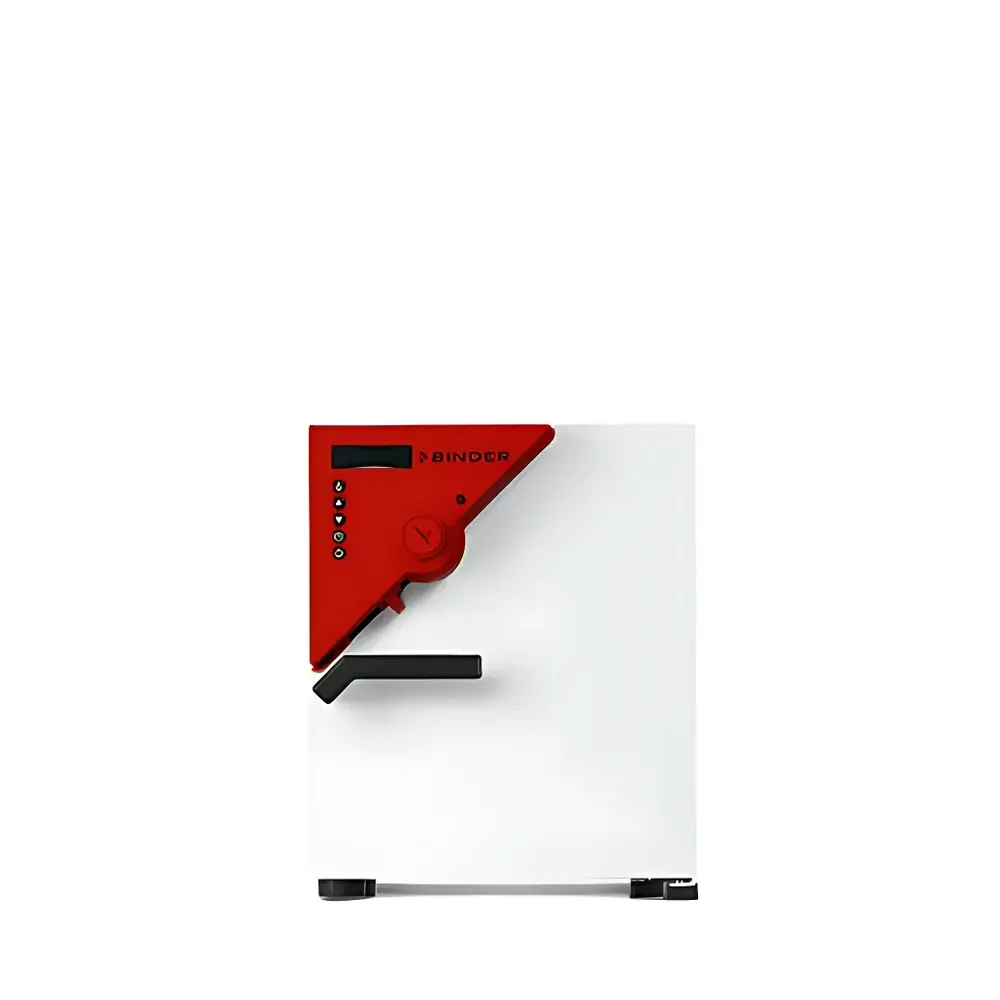
BINDER ED23 / ED400 Classic.Line Natural Convection Drying Oven
| Brand | BINDER |
|---|---|
| Origin | Germany |
| Model | ED23 / ED400 |
| External Dimensions (W×H×D, mm) | 435×495×520 (ED23) / 1235×1025×765 (ED400) |
| Internal Dimensions (W×H×D, mm) | 222×330×300 (ED23) / 1000×800×520 (ED400) |
| Interior Volume | 20 L (ED23) / 400 L (ED400) |
| Net Weight (empty) | 27 kg (ED23) / 125 kg (ED400) |
| Max. Load Capacity | 25 kg (ED23) / 90 kg (ED400) |
| Max. Load per Shelf | 12 kg (ED23) / 35 kg (ED400) |
| Temp. Range | +5 °C above ambient to 300 °C |
| Temp. Uniformity at 150 °C | ±2.8 K (ED23) / ±3 K (ED400) |
| Temp. Fluctuation at 150 °C | ±0.5 K |
| Heating Time to 150 °C | 28 min (ED23) / 71 min (ED400) |
| Recovery Time after Door Opening (150 °C) | 28 min (ED23) / 31 min (ED400) |
| Rated Power | 0.8 kW (230 V version, ED23) / 3.4 kW (400 V version, ED400) |
| Shelving | 2–4 chrome-plated shelves (ED23) / 2–10 chrome-plated shelves (ED400) |
| Safety | Dual-stage temperature safety device (DIN 12880), optical alarm |
Overview
The BINDER ED23 and ED400 Classic.Line natural convection drying ovens are precision-engineered laboratory instruments designed for reliable thermal processing in routine quality control, materials testing, and research applications. Operating on the principle of gravity-driven air circulation—without forced-air fans—these ovens eliminate turbulence-induced sample disturbance while ensuring stable, repeatable heat transfer across the entire chamber volume. The core innovation lies in BINDER’s proprietary APT.line™ preheating chamber technology: a thermally insulated jacket surrounding the main cavity maintains uniform wall temperatures, minimizing thermal gradients and enabling consistent internal conditions regardless of load configuration or chamber fill level. This architecture delivers high reproducibility in drying, conditioning, sterilization, and aging protocols where laminar thermal exposure is critical—especially for powders, granules, filter papers, ceramic precursors, and polymer samples sensitive to airflow-induced segregation or surface oxidation.
Key Features
- APT.line™ preheating chamber ensures temperature uniformity ≤ ±3 K across the full working volume at 150 °C, compliant with DIN 12880 Class 2 requirements for laboratory drying equipment.
- Natural convection design eliminates fan-induced particle displacement and vibration, preserving sample integrity during extended thermal treatment.
- Dual-stage independent temperature safety system (DIN 12880-compliant) with optical alarm provides fail-safe overtemperature protection—Stage 1 limits operational temperature; Stage 2 triggers shutdown if Stage 1 fails.
- Adjustable exhaust valve enables precise control of vapor removal rate and chamber atmosphere dynamics—critical for moisture-sensitive or solvent-based drying processes.
- Time-programmable digital controller supports multi-step ramp-hold cycles, enabling automated execution of standardized drying protocols (e.g., ISO 293, ASTM D2240, USP <641>).
- Robust stainless-steel interior and double-walled insulation minimize energy consumption and external surface temperatures—reducing lab HVAC load and enhancing operator safety.
Sample Compatibility & Compliance
The ED series accommodates a broad range of non-volatile, non-explosive solid and semi-solid specimens—including pharmaceutical excipients, geological aggregates, food matrices, textile fibers, and metal oxide powders. Its natural convection profile avoids mechanical stress on fragile or friable materials, making it suitable for GLP- and GMP-aligned environments where process consistency must be documented and auditable. The ovens comply with IEC 61010-1 (Safety Requirements for Electrical Equipment for Measurement, Control, and Laboratory Use), EN 60529 (IP20 enclosure rating), and support traceability through configurable controller logging (time-stamped setpoint, actual temperature, alarm events). Optional data export via RS232/USB allows integration into validated electronic lab notebooks (ELN) and satisfies FDA 21 CFR Part 11 requirements when paired with appropriate audit-trail software.
Software & Data Management
The integrated microprocessor controller features a high-contrast LCD display with intuitive menu navigation and password-protected parameter access. All operational parameters—including setpoint, ramp rates, hold durations, exhaust valve position, and safety thresholds—are fully programmable and stored in non-volatile memory. Event logs record timestamps for door openings, temperature deviations, safety interventions, and power interruptions—enabling root-cause analysis during process investigations. For laboratories requiring enhanced documentation, optional BINDER LabSoft software (v5.0+) enables remote monitoring, real-time graphing, automated report generation (PDF/CSV), and secure user-role management—supporting ISO/IEC 17025 accreditation workflows and internal quality audits.
Applications
- Moisture content determination per ISO 5513, AOAC 950.46, and USP <731>.
- Thermal conditioning of calibration standards, reference materials, and weighing vessels prior to gravimetric analysis.
- Pre-drying of filter media, crucibles, and glassware in environmental and wastewater testing labs.
- Accelerated aging studies for packaging materials, adhesives, and elastomers under controlled thermal stress.
- Low-risk sterilization of reusable glassware and metal tools using dry-heat protocols (e.g., 160 °C for 120 min, per ISO 17665-1).
- Residual solvent removal from coated substrates and composite laminates in R&D settings.
FAQ
What distinguishes natural convection from forced convection in drying ovens?
Natural convection relies on thermal buoyancy to circulate air without mechanical fans—yielding gentler, more uniform heat transfer ideal for delicate or particulate samples. Forced convection uses blowers that may disturb lightweight materials or create localized hot spots.
Can the ED series be used for sterilization validation?
Yes—when operated within validated time-temperature profiles (e.g., 180 °C for 30 min), the ED ovens meet dry-heat sterilization requirements per ISO 17665-1. Full validation requires IQ/OQ/PQ documentation and thermocouple mapping per ISO 14644-3.
Is the controller compatible with LIMS or SCADA systems?
Via optional RS232 or USB interface and BINDER LabSoft, the controller supports bidirectional communication with third-party laboratory information management systems and supervisory control platforms—subject to protocol configuration and network security policies.
How many shelves can be installed simultaneously in the ED400 model?
Up to 10 chrome-plated, height-adjustable shelves may be installed, with maximum individual load capacity of 35 kg per shelf and total chamber load limit of 90 kg.
Does the APT.line™ technology require additional maintenance or calibration?
No—the APT.line™ chamber is a passive thermal architecture with no moving parts or consumables. Routine calibration of the primary PT100 sensor (recommended annually per ISO/IEC 17025) ensures ongoing accuracy of temperature measurement and control.



