
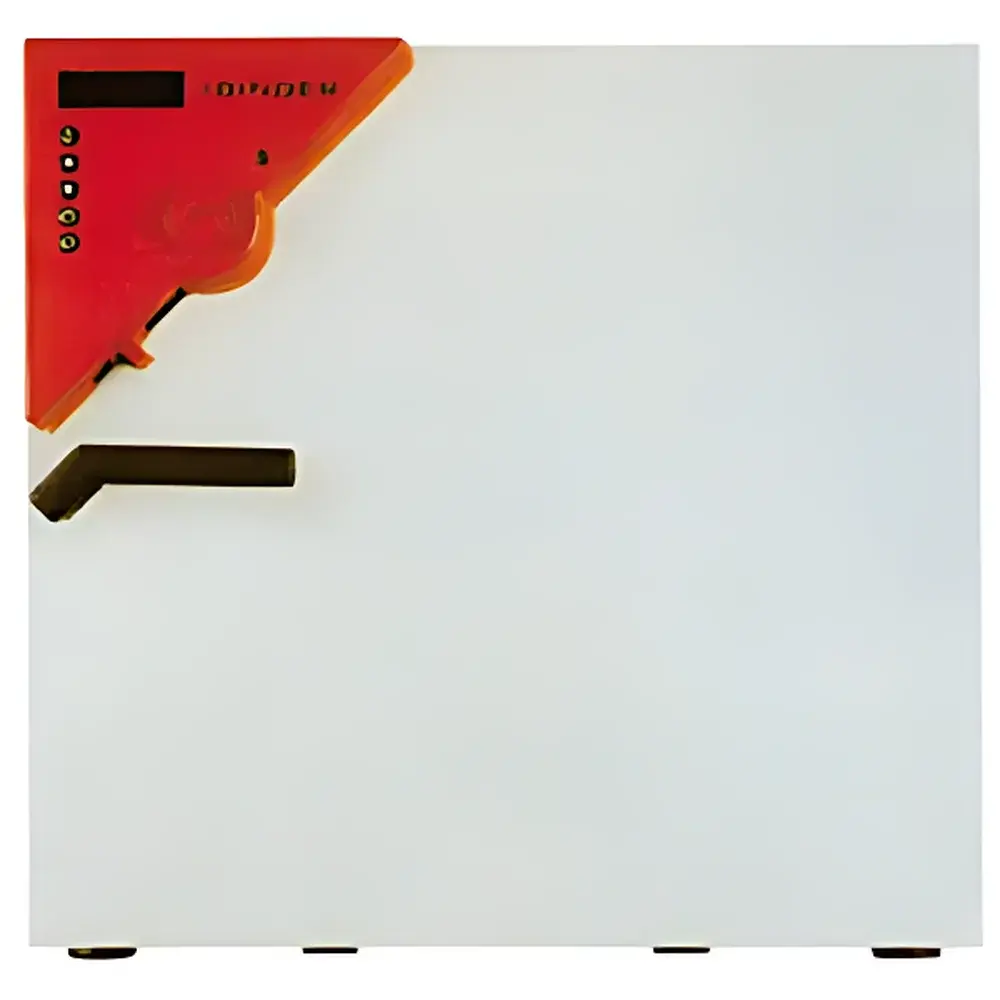
BINDER ED56 Precision Drying Oven
| Brand | BINDER |
|---|---|
| Origin | Germany |
| Model | ED56 |
| Temperature Range | Ambient + 5 °C to 300 °C |
| Temperature Accuracy | ≤ ±0.3 °C |
| Chamber Dimensions | 400 × 400 × 330 mm |
| Chamber Volume | 57 L |
| Interior Material | 1.4301 Stainless Steel (electropolished, corner-free) |
| Heating Method | Natural Convection |
| Insulation | Reflective mineral wool (full-cavity, low thermal conductivity) |
| Safety Certification | VDE-GS, CE |
| Compliance | FDA 21 CFR Part 11 (with APT-COM software) |
| Interface | RS422 (optional APT-COM), USB port ×2 |
| Timer | Digital electronic timer (0–99 h 59 min or continuous) |
| Air Exchange | Adjustable 50 mm damper (externally actuated via slide rod) |
| Exterior Finish | RAL 7035 powder-coated galvanized steel |
| Shelf Material | Chrome-plated stainless steel |
| Thermal Shielding | External surface temperature < 50 °C at 300 °C internal operation (no air conditioning required) |
Overview
The BINDER ED56 Precision Drying Oven is a German-engineered natural convection oven designed for applications demanding high thermal stability, repeatability, and regulatory compliance in laboratory and industrial quality control environments. Unlike forced-air ovens, the ED56 relies on buoyancy-driven heat transfer—eliminating airflow-induced sample disturbance, particle resuspension, or uneven drying gradients. This principle makes it especially suitable for sterilization validation, long-term stability storage of reference standards, residual solvent removal from heat-sensitive pharmaceutical intermediates, and moisture content determination per ISO 8573-3 and USP <1208>. Its chamber operates across a precisely controlled range from ambient +5 °C to 300 °C, with a certified accuracy of ≤ ±0.3 °C (measured at chamber center, per DIN 12880). The oven’s thermal architecture integrates full-cavity reflective mineral wool insulation, minimizing heat loss and enabling stable operation even in unconditioned rooms—external casing remains below 50 °C during continuous 300 °C runs, reducing facility HVAC load and improving operator safety.
Key Features
- Natural convection heating system—no internal fan, ensuring laminar thermal environment and eliminating cross-contamination risk between samples.
- PID-controlled digital temperature regulation with real-time LCD display and adjustable ramp rate (programmable heating profiles).
- Electropolished 1.4301 stainless steel interior with seamless, corner-free design—fully autoclavable and compliant with ISO 14644-1 Class 5 cleanroom maintenance protocols.
- Externally adjustable 50 mm air exchange damper operated via linear slide rod—enabling precise control over chamber atmosphere without opening the door.
- Dual chrome-plated stainless steel shelves included; additional shelf kits available (max. 3 levels); all hardware corrosion-resistant and non-magnetic.
- Electronic timer with dual-mode operation: fixed duration (0–99 h 59 min) or continuous mode; alarm-triggered shutdown upon completion.
- Twinsafe Class 2 independent overtemperature protection—hardware-based cut-off circuit meeting EN 61000-6-2/6-4 EMC and IEC 61000-4-2/4-3 immunity requirements.
- RS422 serial interface and two USB-A ports for data logging and remote supervision (APT-COM software optional, validated for 21 CFR Part 11 compliance).
Sample Compatibility & Compliance
The ED56 accommodates standard laboratory glassware (e.g., Petri dishes, weighing boats, volumetric flasks up to Ø150 mm), polymer test specimens (ASTM D618 conditioning), metal coupons (ISO 9223 corrosion testing), and pharmaceutical primary packaging components. Its chamber geometry supports uniform thermal exposure per ASTM E2209 and ISO 17025 clause 5.10.1 for equipment qualification. All materials contacting the chamber interior conform to USP Class VI biocompatibility and EU Regulation (EC) No. 1935/2004 for food-contact surfaces. The unit carries CE marking under the EU Machinery Directive 2006/42/EC and Low Voltage Directive 2014/35/EU, and meets VDE-GS safety certification criteria for laboratory appliances. When paired with APT-COM software, audit trails, user access controls, and electronic signatures satisfy FDA 21 CFR Part 11 and EU Annex 11 requirements for regulated GxP environments.
Software & Data Management
APT-COM (optional) provides full remote monitoring, parameter logging, and report generation via Windows-based interface. It supports configurable sampling intervals (1–600 seconds), real-time graphing of chamber temperature vs. setpoint, deviation alerts, and export to CSV/PDF formats. All data entries include timestamp, operator ID, and event type—enabling full traceability for GLP/GMP audits. The embedded USB ports allow local firmware updates and offline data backup without network dependency. RS422 communication ensures noise-immune transmission over distances up to 1,200 m, compatible with centralized lab infrastructure management systems (LIMS integration via OPC UA gateway available).
Applications
- Pharmaceutical: Stability testing (ICH Q1A–Q5C), residual solvent analysis (ICH Q3C), excipient drying, and lyophilization pre-conditioning.
- Chemical & Materials Science: Polymer curing verification, catalyst activation, gravimetric moisture analysis (ISO 760, ASTM D1732), and ash content determination (ASTM D3174).
- Academic & Research Labs: Biological sample desiccation (enzyme powders, DNA pellets), calibration standard storage, and thermal aging studies (IEC 60068-2-2).
- Food & Agriculture: Moisture content measurement (AOAC 950.46), fat extraction residue drying, and mycotoxin reference material conditioning.
- Electronics & Metrology: PCB baking prior to soldering, precision weight standard equilibration, and humidity sensor calibration.
FAQ
Does the ED56 support programmable temperature ramps?
Yes—the PID controller allows user-defined heating rates and multi-step profiles via front-panel programming or APT-COM.
Is the chamber volume verified per ISO 12780?
Yes—nominal volume (57 L) is determined by internal geometric dimensions and confirmed during factory calibration; certificate available upon request.
Can the ED56 be integrated into a 21 CFR Part 11-compliant workflow?
Yes—when used with validated APT-COM software, it fulfills electronic record and signature requirements including audit trail, role-based access, and data integrity controls.
What is the maximum permissible load mass for thermal uniformity?
For optimal performance per DIN 12880, total load should not exceed 30% of chamber volume (≤17 L equivalent solid mass); uniformity testing performed with empty and half-loaded configurations.
Are replacement shelves and insulation parts available as spare components?
Yes—BINDER offers genuine OEM spare parts including chrome-plated shelves (ref. 1101-0100), door gaskets (ref. 1101-0250), and certified insulation kits (ref. 1101-0400), all traceable to manufacturing batch.



