
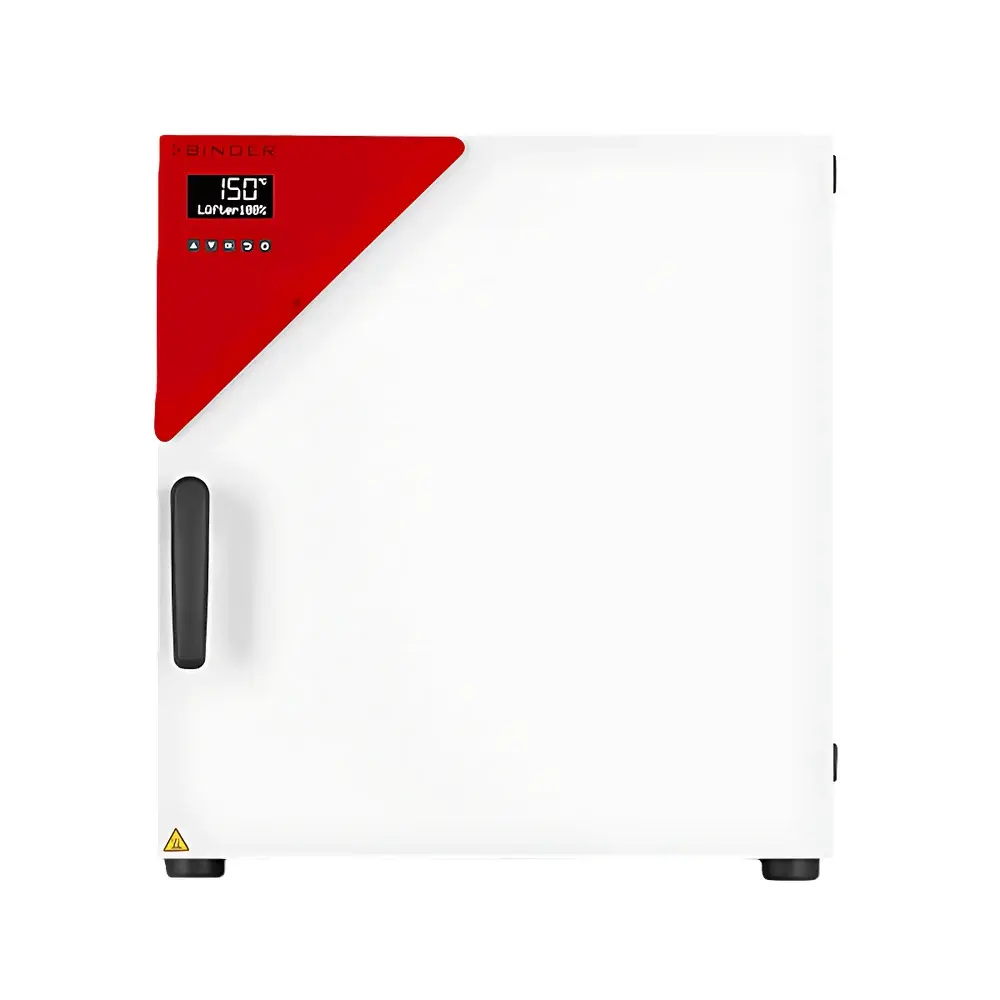
BINDER FD-S 56 Forced-Convection High-Temperature Drying Oven
| Brand | BINDER |
|---|---|
| Origin | Germany |
| Manufacturer Type | Original Equipment Manufacturer (OEM) |
| Product Category | Imported Laboratory Equipment |
| Model | FD-S 56 |
| Instrument Type | High-Temperature Forced-Convection Oven |
| Temperature Range | Ambient +10 °C to 250 °C |
| Temperature Uniformity | ±0.5 °C at 150 °C |
| External Dimensions | 590 × 580 × 515 mm (W × D × H) |
| Internal Chamber Dimensions | 400 × 440 × 350 mm (W × D × H) |
| Chamber Material | Stainless Steel (AISI 304) |
| Heating System | APT Line Preheating Chamber Technology |
| Air Circulation | Motorized Forced Convection with Adjustable Exhaust Valve |
| Safety | Dual-Stage Independent Temperature Limit Controller (DIN 12880 Class 2), Optical Alarm Indicator |
| Accessories | Chrome-Plated Adjustable Shelving, Timer-Controlled Operation |
Overview
The BINDER FD-S 56 is a precision-engineered forced-convection high-temperature drying oven designed for reproducible thermal processing in research laboratories, quality assurance environments, and regulated industrial settings. It operates on the principle of motor-driven air circulation—uniformly distributing heated air throughout the chamber via a rear-mounted fan and optimized duct geometry—to ensure minimal thermal gradients and high spatial temperature homogeneity. The integrated APT Line preheating chamber technology enables rapid thermal stabilization and exceptional setpoint accuracy, particularly critical during extended drying, curing, or conditioning protocols where deviations beyond ±0.5 °C at 150 °C are unacceptable per DIN 12880 compliance requirements. Its stainless steel (AISI 304) interior chamber resists corrosion from solvents, moisture, and residual process vapors, supporting long-term reliability under repeated thermal cycling between ambient +10 °C and 250 °C.
Key Features
- APT Line preheating chamber system for enhanced temperature stability and reduced overshoot during ramp-up phases
- Forced convection airflow with adjustable exhaust valve to manage humidity and volatile byproducts during drying cycles
- Dual-stage independent temperature safety controller (DIN 12880 Class 2) with optical alarm activation upon deviation or overtemperature event
- Timer-controlled operation with programmable dwell times, enabling unattended batch processing compliant with GLP workflows
- Chrome-plated, height-adjustable shelving system (standard configuration: 2 shelves) for flexible sample arrangement and optimal air distribution
- Robust stainless steel inner chamber (AISI 304) with seamless welded corners and smooth electropolished surfaces for ease of cleaning and contamination control
- Front-access door with double-glazed, thermally insulated glass window and silicone-sealed gasket for visual monitoring without thermal loss
Sample Compatibility & Compliance
The FD-S 56 accommodates a broad range of sample formats—including Petri dishes, weighing boats, crucibles, glassware, polymer films, and coated substrates—within its 61.6 L internal volume. Its uniform airflow profile and low thermal inertia support consistent drying of hygroscopic materials, thermal desorption of solvents, pre-conditioning of test specimens prior to mechanical testing (e.g., ASTM D618), and residue-free heat treatment of calibration standards. The unit complies with DIN 12880 for laboratory ovens, meets CE marking requirements under the EU Machinery Directive 2006/42/EC and Electromagnetic Compatibility Directive 2014/30/EU, and supports audit readiness for ISO/IEC 17025-accredited laboratories through documented temperature mapping and validation-ready operational parameters.
Software & Data Management
While the FD-S 56 features an intuitive analog/digital hybrid controller with manual setpoint adjustment and mechanical timer, it does not include embedded digital data logging or network connectivity. However, its stable thermal performance and repeatable ramp/soak profiles make it compatible with external validation systems—such as calibrated data loggers (e.g., Ellab, DeltaTRAK) or standalone chart recorders—for IQ/OQ/PQ documentation. Users may integrate the oven into centralized lab monitoring infrastructures via optional third-party analog output modules (0–10 V or 4–20 mA), facilitating traceability in GMP environments where 21 CFR Part 11-compliant electronic records are required for critical process steps.
Applications
- Drying of moisture-sensitive powders and granules in pharmaceutical excipient qualification (per USP & Ph. Eur. general chapters)
- Pre-drying of filter membranes and sampling media prior to gravimetric particulate analysis (EPA Method 201A, ISO 12103-1)
- Curing of epoxy-coated reference standards used in surface metrology and profilometry calibration
- Thermal aging of polymeric components per ASTM D573 and ISO 188 for accelerated life-cycle assessment
- Conditioning of ceramic substrates and metallurgical samples before SEM/EDS analysis to eliminate adsorbed water layers
- Residue removal from glassware and metal fixtures in analytical chemistry labs prior to trace-metal analysis (ICP-MS, AAS)
FAQ
What is the maximum permissible load weight per shelf?
The chrome-plated shelves are rated for up to 15 kg evenly distributed load per shelf; total chamber load must not exceed 30 kg to maintain airflow integrity and thermal uniformity.
Is the FD-S 56 suitable for sterilization applications?
No—this model is not validated for microbiological sterilization (e.g., steam or dry-heat sterilization per ISO 17665 or EN 285). It is intended for drying, heating, and conditioning only.
Can the exhaust valve be fully closed during operation?
The exhaust valve is manually adjustable but must remain partially open during operation to prevent pressure buildup and ensure continuous air exchange; complete closure is prohibited per safety guidelines.
Does the oven support ramp-and-soak programming?
No—the FD-S 56 uses a fixed-setpoint controller with mechanical timer; multi-step thermal profiles require external programmable controllers or sequential manual intervention.
How often should temperature uniformity mapping be performed?
Per ISO/IEC 17025 and internal QA policies, initial mapping is mandatory post-installation; routine re-mapping is recommended annually or after major maintenance, relocation, or process-critical changes.



