
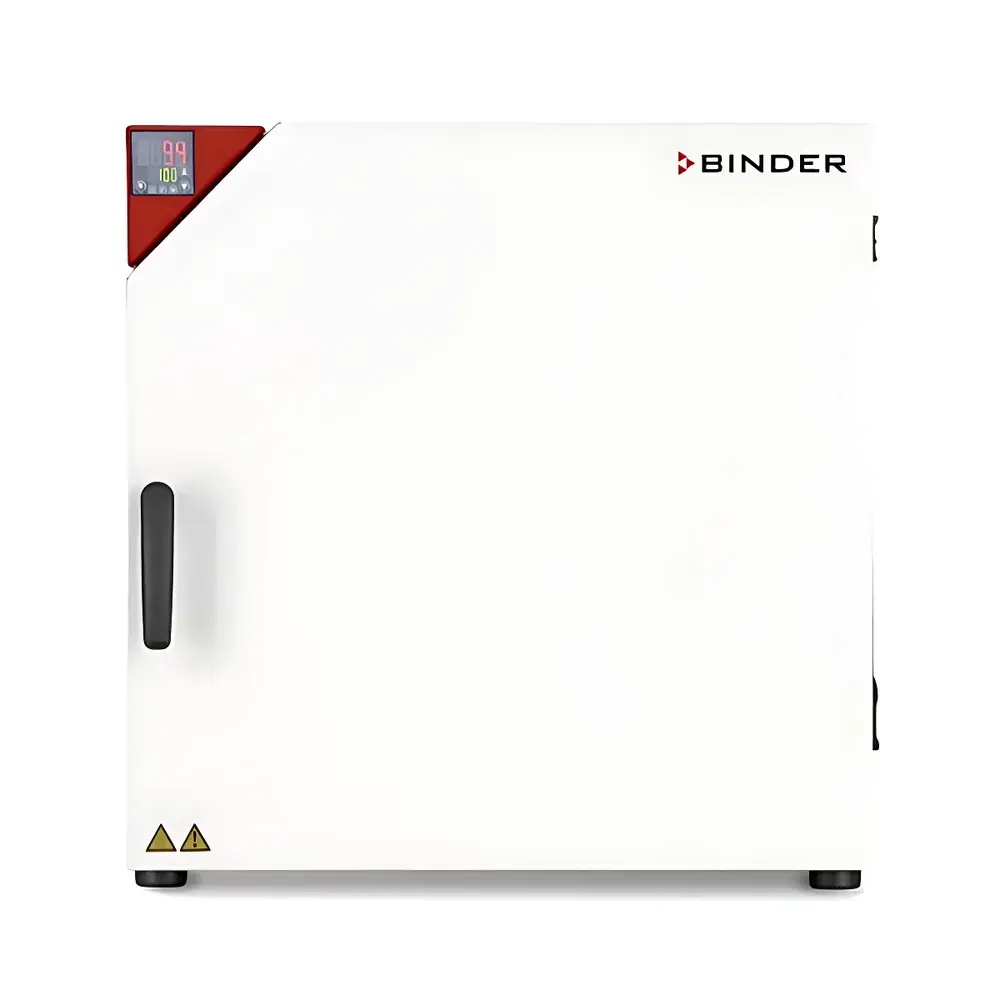
BINDER FD-S Solid.Line Series Drying and Heating Ovens
| Brand | BINDER |
|---|---|
| Origin | Germany |
| Model | FD-S 56 / FD-S 115 |
| External Dimensions (W×H×D, mm) | 590×580×515 (FD-S 56) / 740×790×555 (FD-S 115) |
| Internal Dimensions (W×H×D, mm) | 400×440×350 (FD-S 56) / 550×550×390 (FD-S 115) |
| Interior Volume | 55 L / 106 L |
| Net Weight (empty) | 41 kg / 57 kg |
| Temperature Range | Ambient +10 °C to 250 °C |
| Temperature Uniformity at 150 °C | ±2.6 K / ±2.4 K |
| Temperature Fluctuation at 150 °C | ±0.5 K |
| Heating Time to 150 °C | 20 min / 22 min |
| Power Consumption at 150 °C | 290 Wh/h / 340 Wh/h |
Overview
The BINDER FD-S Solid.Line Series drying and heating ovens are precision-engineered laboratory instruments designed for reliable thermal processing in research, quality assurance, and routine testing environments. Built upon BINDER’s decades-long heritage in climate-controlled instrumentation, the FD-S series implements forced-air convection with APT.line™ preheating technology — a patented inner chamber wall heating system that ensures rapid temperature ramp-up and exceptional spatial uniformity across the entire working volume. Unlike conventional ovens relying solely on rear-mounted heaters, the APT.line™ architecture actively preheats the inner chamber walls, minimizing thermal gradients during stabilization and significantly improving reproducibility of drying, curing, sterilization, and conditioning protocols. Operating from ambient +10 °C up to 250 °C, these ovens meet stringent requirements for ISO/IEC 17025-accredited laboratories and support GLP-compliant workflows where traceable thermal performance is mandatory.
Key Features
- APT.line™ preheating technology for enhanced temperature homogeneity and reduced overshoot during setpoint transitions
- Forced-air convection system with adjustable exhaust valve to optimize moisture removal and prevent vapor accumulation
- Time-programmable digital controller with intuitive interface and real-time display of setpoint, actual temperature, and elapsed time
- Dual-stage independent temperature safety device (DIN 12880 Class 2) featuring optical alarm and automatic cut-off at user-defined threshold
- Ergonomically optimized door mechanism with balanced hinge design and secure sealing for consistent chamber integrity
- Chrome-plated shelf with floor support included as standard; additional shelves and accessories available per DIN EN 61000-6-3 EMC compliance
- Energy-efficient thermal insulation and low-standby power consumption (≤1.2 W), supporting sustainability targets in modern lab infrastructure
Sample Compatibility & Compliance
The FD-S 56 (55 L) and FD-S 115 (106 L) models accommodate a broad range of sample formats including Petri dishes, weighing boats, glassware, polymer specimens, pharmaceutical excipients, and metal components. The stainless-steel interior (AISI 304) resists corrosion from solvents and saline residues, while smooth weld-free corners facilitate cleaning and reduce microbial retention. All units comply with IEC 61010-1 (Safety Requirements for Electrical Equipment for Measurement, Control, and Laboratory Use) and carry CE marking under the EU Machinery Directive 2006/42/EC. Optional documentation packages include Factory Acceptance Test (FAT) reports and IQ/OQ templates aligned with FDA 21 CFR Part 11 data integrity expectations for regulated industries.
Software & Data Management
While the FD-S series operates via standalone microprocessor-based control, optional integration with BINDER’s ecoLINK software enables remote monitoring, data logging, and export of temperature profiles in CSV or PDF format. The controller supports up to 10 programmable ramps and holds, with timestamped event logging (e.g., door opening, alarm activation, safety cutoff). Audit trail functionality meets basic ALCOA+ principles for raw data attribution and retention. For fully validated environments, the unit can be configured with an external Pt100 sensor port for independent verification — a prerequisite for USP and ASTM E2877-21 thermal mapping studies.
Applications
These ovens serve critical roles across multiple disciplines: moisture content determination per AOAC 950.46 and ISO 5516; residual solvent analysis in polymer films; thermal stability testing of APIs per ICH Q1A(R2); glass transition assessment of amorphous solids; pre-conditioning of test specimens prior to tensile or impact evaluation (ASTM D618); and controlled drying of filter papers, chromatography media, and biological substrates. Their stable thermal field and low fluctuation (<±0.5 K at 150 °C) make them suitable for gravimetric analysis requiring high repeatability over extended dwell periods.
FAQ
What standards does the FD-S series comply with for laboratory accreditation?
The FD-S ovens conform to IEC 61010-1, DIN 12880 (temperature safety), and EN 60529 (IP20 ingress protection). Full compliance documentation, including calibration certificates traceable to DKD/DAkkS, is available upon request.
Can the FD-S be used for sterilization applications?
No — the FD-S series is not validated for microbiological sterilization (e.g., depyrogenation or dry-heat sterilization per ISO 17665). It is intended for drying, heating, and thermal conditioning only.
Is the exhaust valve adjustable during operation?
Yes — the manually operated exhaust valve allows continuous modulation of airflow to balance drying efficiency and chamber humidity without interrupting the thermal cycle.
Does the oven support external data recording?
Yes — via analog output (0–10 V) or optional RS485 interface, enabling connection to SCADA systems or centralized lab data management platforms.
What maintenance is required for long-term reliability?
Routine inspection of door gasket integrity, periodic cleaning of air intake filters, and annual verification of temperature uniformity using NIST-traceable sensors are recommended per BINDER’s Maintenance Schedule M-007.



