
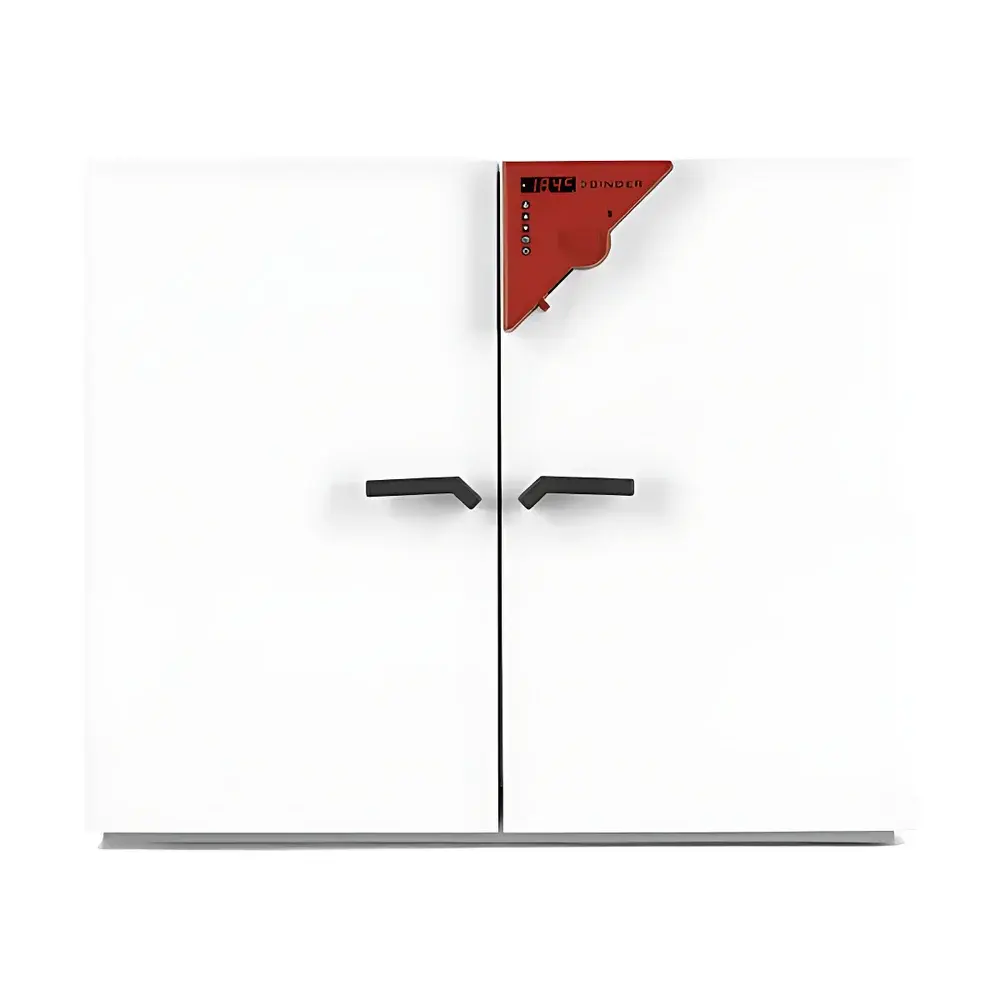
BINDER FED400 Classic.Line Drying Oven
| Brand | BINDER |
|---|---|
| Origin | Germany |
| Model | FED400 |
| External Dimensions (W×H×D, mm) | 1235 × 1025 × 765 |
| Internal Dimensions (W×H×D, mm) | 1000 × 800 × 510 |
| Internal Volume | 400 L |
| Net Weight (empty) | 145 kg |
| Max. Total Load | 90 kg |
| Max. Load per Shelf | 35 kg |
| Temperature Range | Ambient +5 °C to 300 °C |
| Temperature Uniformity at 150 °C | ±3.8 K |
| Temperature Fluctuation at 150 °C | ±0.7 K |
| Heating Time to 150 °C | 29 min 30 s |
| Recovery Time after 30-sec Door Opening at 150 °C | 6 min |
| Rated Power (208 V / 400 V) | 3.4 kW |
| Shelf Quantity (standard / max) | 2 / 10 |
| Fan Speed | Adjustable |
| Exhaust Valve | Continuously Adjustable |
| Controller | Advanced Timer Functionality with Optical Overtemperature Alarm |
| Safety | Dual-stage Independent Temperature Limitation (DIN 12880 Class 2) |
| Interface | RS 422 |
| Insulation | High-efficiency Mineral Wool |
| Shelves | 2 Chrome-plated, Height-adjustable |
Overview
The BINDER FED400 Classic.Line Drying Oven is a precision-engineered, German-manufactured convection drying and heating system designed for demanding laboratory and quality control environments. Operating on forced-air convection with APT.line™ preheating chamber technology, the oven ensures exceptional thermal uniformity and stability across its 400 L working chamber—regardless of sample mass, configuration, or shelf loading. Unlike conventional ovens that rely solely on rear-wall heating elements, the APT.line™ architecture isolates the heating zone from the active chamber via an insulated preheating duct, enabling rapid heat transfer while minimizing thermal gradients and wall-induced stratification. This design delivers reproducible, traceable drying, conditioning, and stabilization results in compliance with ISO 17025-accredited workflows and GLP/GMP-aligned process validation requirements.
Key Features
- APT.line™ preheating chamber technology for uniform temperature distribution (±3.8 K at 150 °C) and minimal spatial deviation
- Adjustable fan speed and continuously variable exhaust valve for precise control of air exchange rate and moisture removal kinetics
- Dual-stage independent temperature safety system (DIN 12880 Class 2) with optical alarm—separate from main controller for fail-safe overtemperature protection
- High-efficiency mineral wool insulation reducing standby energy consumption and enhancing thermal retention
- RS 422 digital interface for integration into centralized lab automation systems and external data logging platforms
- Two height-adjustable, chrome-plated stainless steel shelves (expandable up to 10), each rated for 35 kg load capacity
- Advanced timer functionality supporting multi-step programs, delayed start, and automatic shutdown sequences
Sample Compatibility & Compliance
The FED400 accommodates diverse sample formats—including Petri dishes, weighing boats, glassware, polymer sheets, metal coupons, and pharmaceutical blister packs—within its spacious, corrosion-resistant interior chamber (1000 × 800 × 510 mm). Its validated temperature performance meets critical regulatory benchmarks: DIN 12880 for laboratory drying ovens, ASTM E145–22 for gravity and forced-convection oven classification, and ISO 5725–2 for measurement repeatability assessment. The dual-limit safety architecture satisfies IEC 61010–1 requirements for electrical safety in laboratory equipment. While not inherently 21 CFR Part 11 compliant, audit-ready operation is achievable when paired with validated third-party data acquisition software supporting electronic signatures and immutable audit trails.
Software & Data Management
The integrated controller provides local parameter setting, real-time temperature monitoring, and programmable time-based profiles—but does not include onboard data storage or graphical display. For full traceability, the RS 422 serial interface enables bidirectional communication with external SCADA systems, LIMS, or dedicated BINDER software suites (e.g., BINDER CLOUD or ecoLINK, sold separately). When connected to compliant data loggers, the oven supports long-term trending of chamber temperature, fan status, and door-open events—enabling root-cause analysis during stability studies or drying protocol optimization. All temperature setpoints, alarms, and safety thresholds are user-configurable and retained during power interruption.
Applications
The FED400 serves as a core platform for gravimetric moisture analysis (e.g., AOAC 950.46, USP <731>), residual solvent determination in APIs, accelerated aging per ICH Q1A(R3), desiccant regeneration, pre-conditioning of composites prior to mechanical testing, ash content determination (ASTM D3174), and thermal stabilization of reference standards. Its stable 300 °C upper limit supports ceramic sintering pre-bake cycles and catalyst activation protocols where controlled ramp rates and dwell consistency are essential. The adjustable airflow and exhaust modulation make it equally suitable for low-moisture-content food samples requiring gentle dehydration without case hardening.
FAQ
Does the FED400 support Ethernet or USB connectivity?
No—the standard interface is RS 422 only. Ethernet or USB requires optional gateway hardware or external protocol converters.
Can the oven be validated for IQ/OQ/PQ protocols?
Yes—BINDER provides Factory Acceptance Test (FAT) documentation and supports site-specific qualification with calibrated PT100 sensors and NIST-traceable thermocouples.
Is the internal chamber stainless steel?
The chamber walls and door liner are electropolished stainless steel (1.4301/AISI 304); corners are radiused for cleanability and reduced contamination trapping.
What is the maximum allowable ambient temperature for continuous operation?
The unit is rated for ambient conditions up to 30 °C; operation above this requires derating of maximum temperature setpoint per DIN EN 61000–6–3.
Are calibration certificates included with shipment?
A factory calibration certificate (temperature uniformity and deviation at 100 °C and 150 °C) is provided; full metrological certification requires third-party calibration post-installation.



