
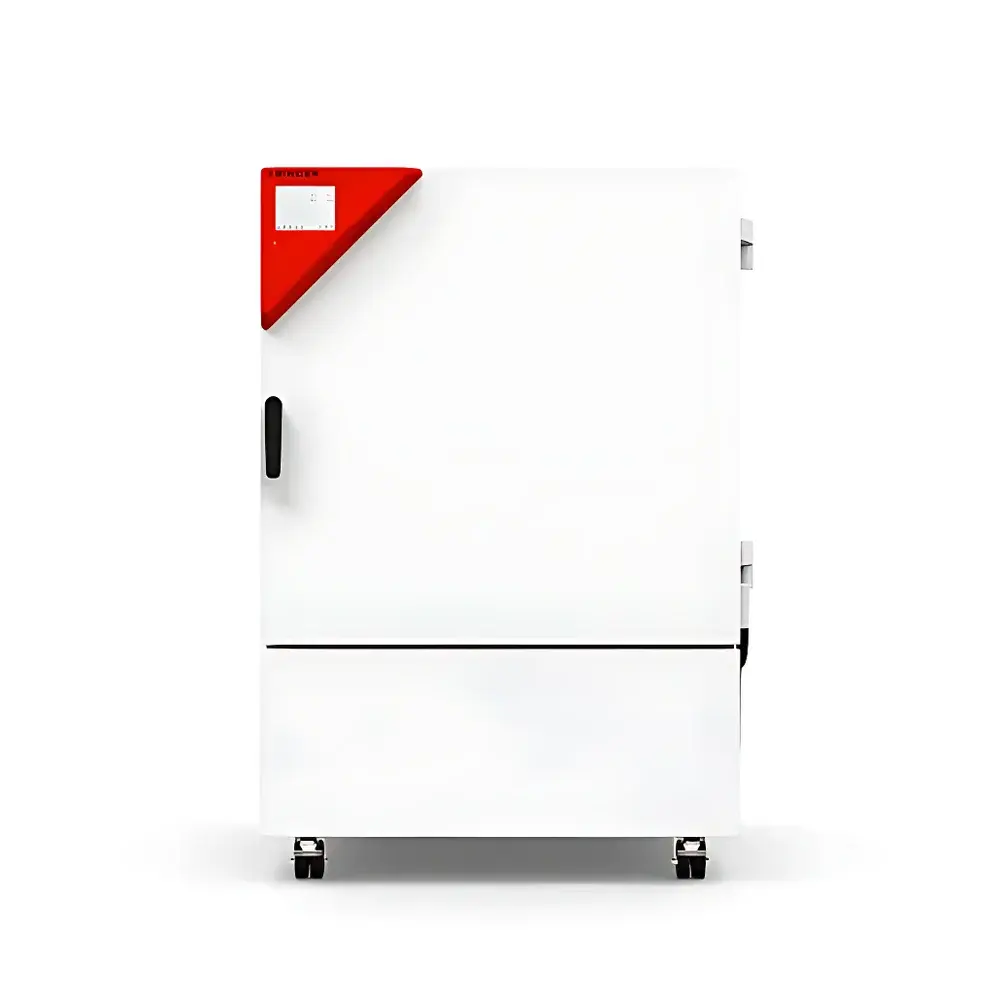
BINDER KBF Series Temperature and Humidity Controlled Chamber
| Brand | BINDER |
|---|---|
| Origin | Germany |
| Model | KBF Series |
| Type | Benchtop Environmental Test Chamber |
| Temperature Range | 0–70 °C |
| Humidity Range | 10–80 % RH |
| Temp. Uniformity (25 °C / 60 % RH) | ±0.1–0.4 K |
| Humidity Stability (25 °C / 60 % RH) | ±1.5 % RH |
| Recovery Time (25 °C / 60 % RH, 30 s door open) | 1–3 min |
| Power Consumption | 1.3–1.7 kW |
| Internal Volume | 127–1610 L |
| Refrigerant | R-600a |
| Compliance | DIN 12880, ICH Q1–Q5, GLP/GMP-ready |
Overview
The BINDER KBF Series is a precision-engineered benchtop and floor-standing temperature and humidity controlled chamber designed for long-term stability testing in pharmaceutical, biotechnology, and materials science laboratories. Operating on a dual-climate control principle—combining high-efficiency variable-speed refrigeration with capacitive humidity sensing and steam-based humidification—the KBF series delivers exceptional thermal and hygrometric reproducibility under dynamic load conditions. Its APT.line™ preheating technology ensures uniform heat distribution across the entire chamber volume, eliminating cold spots and minimizing thermal gradients during ramp-and-soak cycles. All models meet the stringent spatial and temporal requirements of ICH Q1A(R3), Q1B, Q5C, and USP , supporting both real-time and accelerated stability protocols required for drug substance and product registration dossiers.
Key Features
- APT.line™ convection chamber architecture with forced-air circulation and adjustable fan speed for optimized climate homogeneity—even at full load
- Stainless steel interior (AISI 304) and double-glazed inner door with metal oxide coating for corrosion resistance and condensation suppression
- Energy-efficient variable-frequency compressor system using eco-friendly refrigerant R-600a; up to 40% lower power consumption versus prior-generation units
- Capacitive humidity sensor coupled with rapid-response steam humidifier for precise RH control between 10–80 % RH
- DIN 12880-compliant temperature safety device (Class 3.3) with optical/audible alarm and independent overtemperature cut-off
- Touchscreen controller with ergonomic tilt-adjustable terminal (models KBF 470 and above), featuring time-segmented and real-time programming
- Signal triangle status indicator with color-coded LED feedback for immediate operational diagnostics
- USB and Ethernet interfaces for data export, remote monitoring, and integration into laboratory information management systems (LIMS)
- Standard stainless steel telescopic shelves (2 included; up to 16 optional), each rated for 25–40 kg load capacity
- HIT-insulated chamber walls and large-diameter access ports with silicone plugs for sensor or cable routing without compromising seal integrity
Sample Compatibility & Compliance
The KBF series accommodates diverse sample formats—including vials, blister packs, syringes, petri dishes, and plant growth trays—within its standardized internal dimensions and adjustable shelf configurations. Its validated climate performance meets ISO 17025 traceability requirements when operated with calibrated reference sensors. The chamber supports full audit trails per FDA 21 CFR Part 11 when paired with BINDER’s APT-COM™ Professional software (optional upgrade). All models are designed for GLP and GMP environments: temperature and humidity logs are stored internally with timestamping, and the controller enables user-level access control, electronic signatures, and change history tracking. Optional LED light modules (ICH-compliant UV-A/visible spectrum) enable concurrent photostability testing per ICH Q1B, while plant growth variants support controlled-environment botany studies.
Software & Data Management
The embedded controller records all critical parameters—including chamber setpoints, actual values, alarm events, door openings, and recovery metrics—at user-defined intervals (default: 1-minute resolution). Data is exportable via USB in CSV format for offline analysis or direct ingestion into statistical process control (SPC) platforms. APT-COM™ Basic (included) provides local visualization and basic report generation; APT-COM™ Professional (optional) adds multi-chamber synchronization, automated PDF reporting, electronic signature workflows, and cloud-enabled data backup. All firmware updates are delivered through secure BINDER update channels and validated against version-controlled release notes. Raw measurement files retain unaltered timestamps and metadata, ensuring compliance with ALCOA+ principles (Attributable, Legible, Contemporaneous, Original, Accurate, Complete, Consistent, Enduring, Available).
Applications
- ICH-guided stability studies: long-term (25 °C / 60 % RH), intermediate (30 °C / 65 % RH), and accelerated (40 °C / 75 % RH) storage condition testing
- Accelerated aging of polymers, adhesives, packaging materials, and medical devices per ASTM F1980 and ISO 11607
- Biological sample conditioning prior to analytical testing (e.g., dissolution, HPLC, spectroscopy)
- Environmental stress screening of electronic components and PCB assemblies
- Controlled-humidity incubation for microbiological culture media preparation and fungal growth assessment
- Plant phenotyping and seed germination assays under programmable diurnal humidity/temperature cycles
FAQ
What ICH guidelines does the KBF series support?
The KBF series is engineered to comply with ICH Q1A(R3), Q1B (photostability), Q5C (biotechnological product stability), and Q5D (cell substrate stability), including specified temperature/humidity tolerances, uniformity criteria, and data integrity requirements.
Is the chamber suitable for GMP-regulated environments?
Yes—when configured with APT-COM™ Professional and operated under documented SOPs, the KBF series supports 21 CFR Part 11 compliance, including electronic signatures, audit trails, and role-based access control.
Can humidity be maintained at low temperatures?
The operational humidity range is 10–80 % RH within the temperature band of 10–70 °C; below 10 °C, condensation risk limits RH control capability—consistent with DIN 12880 and industry best practices.
How is temperature uniformity verified?
Uniformity is measured per DIN 12880 at nine defined points (center + eight corners) across chamber height, width, and depth, with 10% clearance from walls and full fan speed—results reflect typical batch production performance.
What refrigerant is used, and why?
R-600a (isobutane) is employed for its zero ozone depletion potential (ODP = 0) and very low global warming potential (GWP = 3), aligning with EU F-Gas Regulation (EU) No 517/2014 and sustainable lab infrastructure goals.



