
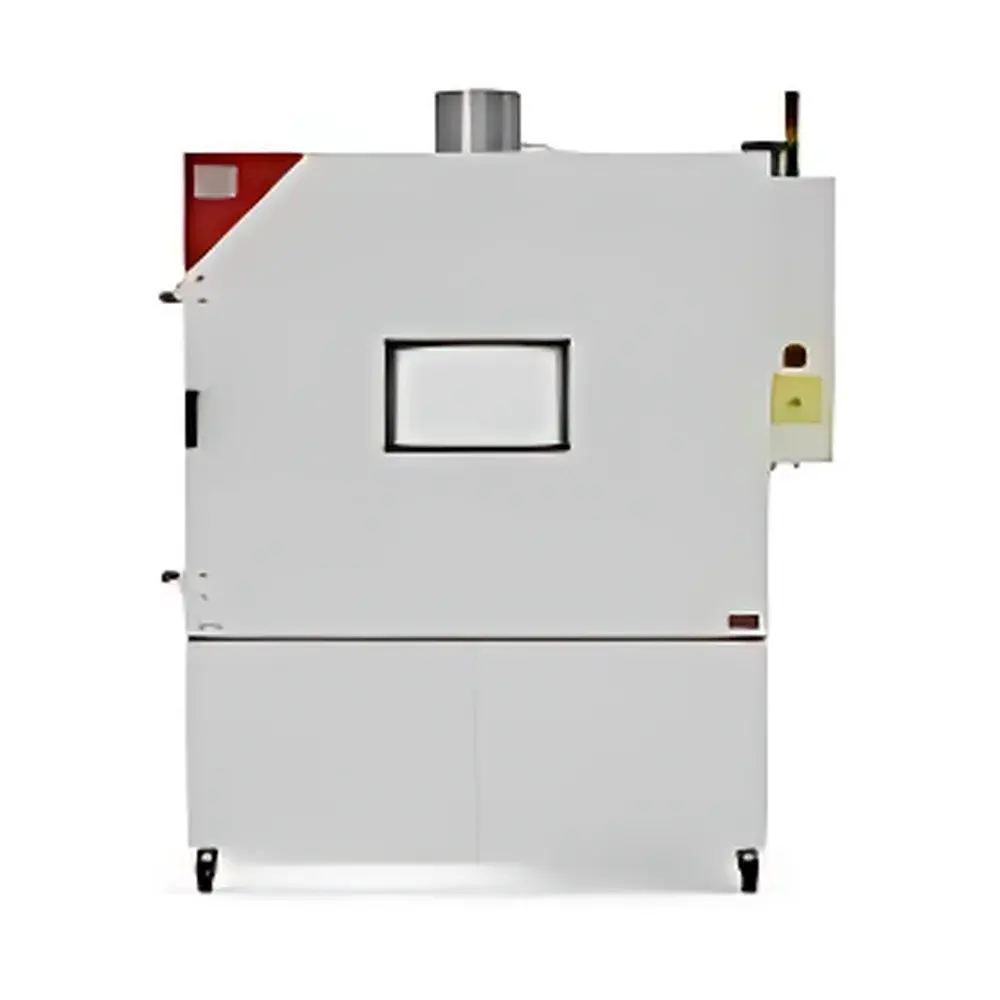
BINDER LIT MK 720 Battery Environmental Test Chamber
| Brand | BINDER |
|---|---|
| Origin | Germany |
| Model | LIT MK 720 |
| Temperature Range | –40 °C to +110 °C |
| Temperature Uniformity (±K) | 0.1–0.5 |
| Temperature Stability (±K) | 0.3–2.0 |
| Avg. Heating Rate (IEC 60068-3-5) | 4 K/min |
| Avg. Cooling Rate (IEC 60068-3-5) | 3.4 K/min |
| Internal Volume | 734 L |
| Max. Load Capacity | 160 kg |
| Net Weight | 570 kg (LIT MK 720-400V) / 522 kg (LIT MK 720-480V-C) |
| Power Supply | 400 V, 3~ |
| Refrigerant | R-452A |
| Sound Pressure Level | 65–67 dB(A) |
Overview
The BINDER LIT MK 720 is a high-integrity environmental test chamber engineered specifically for the safe, repeatable, and standards-compliant evaluation of lithium-ion and other advanced battery cells, modules, and packs under dynamic thermal stress conditions. It operates on a dual-zone thermodynamic architecture—integrating APT.line™ preheating chamber technology with a hermetically sealed test compartment—to ensure exceptional temperature homogeneity (±0.1 K to ±0.5 K), precise ramp control (4 K/min heating, 3.4 K/min cooling per IEC 60068-3-5), and robust thermal inertia management across its full operating range of –40 °C to +110 °C. Designed in accordance with DIN 1280 and aligned with critical safety frameworks including UN 38.3, IEC 62133, UL 1642, and ISO 12405, the LIT MK 720 provides a controlled physical environment where thermal runaway initiation, propagation resistance, and off-gas behavior can be systematically characterized under reproducible laboratory conditions.
Key Features
- APT.line™ preheating chamber technology ensures uniform heat distribution and eliminates thermal gradients during ramp phases, significantly improving test repeatability and reducing dwell-time uncertainty.
- Dual independent, DIN 12880 Class 2 adjustable temperature safety devices provide redundant overtemperature protection—critical for battery testing where thermal excursion must be contained within strict failure thresholds.
- Integrated gas monitoring system continuously measures CO, H₂, O₂ concentration and ambient temperature inside the test chamber, enabling real-time detection of electrolyte decomposition or cell venting events.
- CO₂ suppression and inerting capability allows controlled atmosphere conditioning—essential for evaluating fire suppression efficacy or mitigating combustion risk during abuse testing.
- Reversible stainless steel pressure relief valve centrally mounted on the chamber roof enables safe venting of overpressure while maintaining structural integrity and containment compliance.
- Reinforced door locking mechanism with reinforced support frame meets mechanical load requirements for high-risk operational scenarios and facilitates secure access control during extended test cycles.
- Heated, LED-illuminated observation window (508 mm × 300 mm) permits visual inspection without compromising thermal stability or introducing cold bridges.
- Compressor-based cooling using low-GWP refrigerant R-452A supports sustainable lab operations without sacrificing cooling performance or temperature recovery fidelity.
Sample Compatibility & Compliance
The LIT MK 720 accommodates battery samples up to 160 kg total load across its 734 L internal volume (1200 mm W × 1020 mm H × 600 mm D), with flexible shelving (1 × stainless steel rack, 40 kg max per shelf) and standardized mounting interfaces compatible with common fixture systems used in automotive and grid-scale battery qualification labs. Its design satisfies mechanical and environmental requirements defined in ISO 16750-4 (road vehicles), IEC 60068-2 series (environmental testing), and SAE J2464 (electric vehicle battery safety). The chamber’s gas-tight construction, combined with optional inerting and CO₂ injection, supports testing protocols aligned with UL 9540A (thermal runaway propagation) and IEEE 1679.2 (battery safety data reporting). All electrical interfaces—including the integrated 230 V AC outlet on the right-side control panel—are isolated and rated for use in potentially hazardous atmospheres.
Software & Data Management
Control and documentation are managed via an intuitive touchscreen interface supporting both time-segmented and real-time programming, with built-in logging of all process variables (temperature, gas concentrations, pressure, alarm states) at user-defined intervals. Measurement data are stored internally and exportable via USB in open CSV format—ensuring full traceability and compatibility with LIMS, MES, and statistical analysis platforms. The included APT-COM™ Basic software enables remote monitoring, multi-chamber synchronization, and automated report generation compliant with GLP and GMP documentation standards. Optional APT-COM™ Professional adds FDA 21 CFR Part 11–compliant electronic signatures, audit trail functionality, and role-based access control—meeting stringent regulatory expectations for validation-driven battery development workflows.
Applications
- Thermal abuse testing per UN 38.3 Section 5.2 (high/low temperature storage and cycling)
- Accelerated life cycle validation under variable temperature profiles (e.g., EV battery pack preconditioning)
- Thermal runaway initiation studies using controlled ramp-and-hold protocols
- Off-gas composition analysis during venting events using integrated CO/H₂/O₂ sensors
- Fire suppression system validation under inert or CO₂-enriched atmospheres
- Environmental stress screening (ESS) for battery management systems (BMS) and sensor assemblies
- Pre-certification testing for OEM Tier-1 suppliers requiring ISO/TS 16949 or IATF 16949 traceability
FAQ
What safety certifications does the LIT MK 720 meet?
The chamber complies with DIN 12880 (Class 2 safety devices), EN 61000-6-4 (EMC), EN 61000-6-2 (immunity), and carries CE marking per the EU Machinery Directive 2006/42/EC. Optional configurations support ATEX Zone 2 compliance for gas-monitoring applications.
Can the LIT MK 720 be integrated into an existing lab automation network?
Yes—via standard Ethernet interface with Modbus TCP and OPC UA protocol support (optional), enabling seamless integration with SCADA, PLC, and centralized test orchestration platforms.
Is the internal data logger validated for GxP environments?
When used with APT-COM™ Professional and enabled audit trail settings, the system meets ALCOA+ principles and supports 21 CFR Part 11 compliance for electronic records and signatures.
What maintenance intervals are recommended for long-term reliability?
BINDER recommends biannual calibration verification of temperature and gas sensors, annual refrigerant pressure checks, and quarterly inspection of door seals and pressure relief valve function—documented in accordance with ISO/IEC 17025 internal calibration procedures.
Does the chamber support custom test profiles beyond preloaded standards?
Yes—the controller accepts user-defined multi-step profiles with up to 99 segments, each configurable for ramp rate, dwell time, setpoint, and conditional triggers (e.g., initiate cooling upon H₂ threshold exceedance).



