
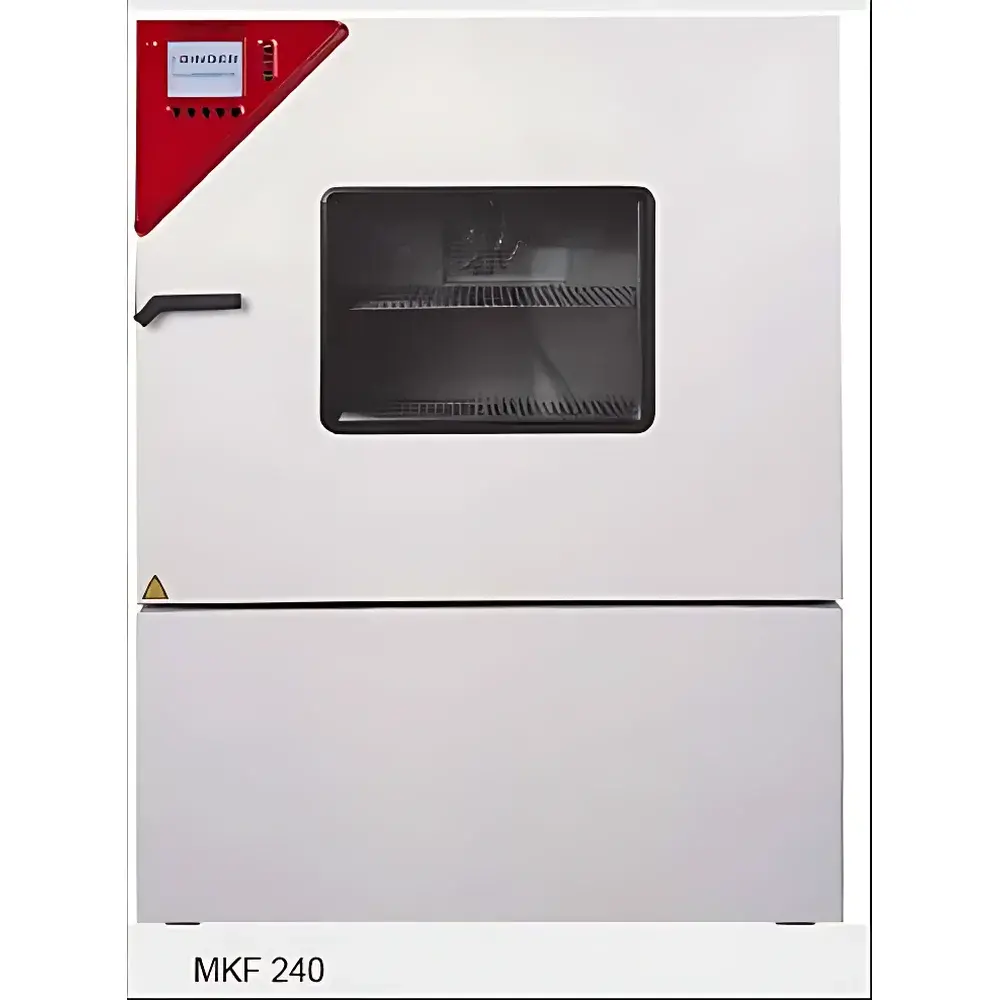
BINDER MKF/MK/MKT Series Environmental Test Chambers
| Brand | BINDER |
|---|---|
| Origin | Germany |
| Model Series | MKF / MK / MKT |
| Internal Volume Options | 53 L, 115 L, 240 L, 400 L, 720 L |
| Temperature Range | MK/MKF: −40 °C to +180 °C |
| MKT | −70 °C to +180 °C |
| M-Series | +5 °C above ambient to +300 °C |
| Humidity Range (MKF only) | 10–98 % rH |
| Control System | MB1 4-channel touchscreen controller (25 programs × 100 segments) |
| Cooling Technology | DCT® Direct Cooling Technology |
| Preconditioning Chamber | APT-Line® |
| Air Circulation | Digitally adjustable high-power turbine |
| Compliance | DIN EN 60068-3-5, IEC 60068-3-6, ISO 16750-4, ASTM D4329, USP <1151> (environmental stress testing), GLP-compliant data logging via APT-COM software |
| Interface | RS422 for APT-COM v3.x integration |
| Insulation | High-efficiency vacuum-insulated door & polyurethane foam walls |
Overview
The BINDER MKF, MK, and MKT series environmental test chambers are precision-engineered instruments designed for rigorous physical property testing under controlled thermal and climatic conditions. Based on the fundamental principles of convective heat transfer and psychrometric control, these chambers enable reproducible simulation of real-world environmental stresses—including extreme temperature cycling, humidity exposure, and combined temperature-humidity profiles—critical for reliability validation in materials science, electronics, automotive components, and pharmaceutical packaging development. Manufactured in Tuttlingen, Germany, each unit adheres to stringent DIN EN 60068-3-5 and IEC 60068-3-6 standards for environmental testing equipment, ensuring metrological traceability and long-term stability across operational lifecycles exceeding 15 years under continuous laboratory use.
Key Features
- APT-Line® Preconditioning Chamber Technology: A thermally isolated outer jacket preheats incoming air before entry into the main chamber, eliminating thermal gradients and enabling ±0.3 °C temperature uniformity (at 100 °C) across the full working volume per DIN 12880.
- DCT® (Direct Cooling Technology): Dual-circuit refrigeration system with independent evaporator and condenser paths minimizes thermal inertia, achieving ramp rates up to 10 K/min (depending on load and volume) without compressor overload or condensate accumulation.
- Digitally Adjustable Air Turbine: High-torque axial fan with 0–100% RPM modulation ensures homogeneous airflow distribution (≤1.5 K deviation at 150 °C, per ISO 16750-4 validation protocol), critical for testing stacked PCB assemblies or multi-layer polymer laminates.
- Vacuum-Insulated Door & Polyurethane Core Walls: 120 mm thick cavity walls with CFC-free rigid foam and double-glazed vacuum-sealed door reduce heat loss to <0.8 W/K·m², supporting energy-efficient operation during extended 168-hour thermal soak tests.
- MB1 Touchscreen Controller: Four-channel PID-based interface with 25 programmable profiles (100 segments each), event-triggered alarms, and real-time deviation monitoring compliant with FDA 21 CFR Part 11 audit trail requirements when paired with APT-COM software.
Sample Compatibility & Compliance
The MKF/MK/MKT platform accommodates diverse sample geometries—from 25 mm³ microelectronics substrates to full-size automotive ECUs (up to 720 L chamber volume). All models support standardized test fixtures per ISO 16750-4 (road vehicles), ASTM D4329 (plastics UV/weathering), and IEC 60068-2-1/2/14 (cold/dry heat/temperature change). Humidity-controlled MKF variants meet USP criteria for accelerated stability studies of hygroscopic excipients and blister-packaged dosage forms. Chamber interiors feature electropolished stainless steel (1.4404/316L) construction with rounded corners to prevent condensate pooling and facilitate cleaning under GMP Annex 1 guidelines.
Software & Data Management
Integrated RS422 serial interface enables bidirectional communication with APT-COM v3.5 software for remote programming, real-time data acquisition (sampling interval: 1–60 s), and automated report generation in PDF/XLSX formats. The system supports electronic signatures, user-level access control (admin/operator/viewer), and immutable audit trails meeting GLP and ISO/IEC 17025 documentation requirements. Raw sensor data—including Pt100 resistance values, compressor duty cycles, and humidity transducer output—is stored locally on SD card and synchronized to network drives via FTP(S) or SMB protocols.
Applications
- Accelerated aging of lithium-ion battery electrolytes under −40 °C to +85 °C thermal cycling (per UN 38.3 Section 38.3.4)
- Thermal shock validation of aerospace-grade composites using MKT’s −70 °C to +180 °C range
- Humidity-induced delamination testing of multilayer flexible circuits (MKF 10–98 % rH, 40 °C hold)
- Stability chamber qualification for pharmaceutical secondary packaging per ICH Q1A(R2)
- Pre-conditioning of optical coatings prior to laser damage threshold measurement (M-series 300 °C capability)
FAQ
What standards do BINDER environmental chambers comply with for calibration and validation?
All MKF/MK/MKT units ship with factory calibration certificates traceable to DKD/DAkkS-accredited laboratories. IQ/OQ protocols conform to ASTM E2500, EU GMP Annex 15, and VDI/VDE 2655 Part 4 for thermal mapping and performance qualification.
Can the MB1 controller operate without APT-COM software?
Yes—the MB1 is fully functional as a standalone controller. APT-COM adds remote supervision, batch reporting, and 21 CFR Part 11 compliance features but is not required for basic profile execution.
Is humidity control available on MK and MKT models?
No—only the MKF series includes integrated steam humidification and refrigerative dehumidification systems. MK and MKT models are dry-thermal chambers optimized for extreme low-temperature or high-temperature applications.
How is thermal uniformity verified across large-volume chambers (e.g., MKF720)?
BINDER performs 9-point thermal mapping per ISO 16750-4 using NIST-traceable Class A Pt100 sensors during final inspection. Uniformity data is provided in the delivery dossier and remains valid for 12 months post-installation.
What maintenance intervals are recommended for the DCT® refrigeration system?
Compressor oil and filter replacement every 24 months; annual verification of refrigerant charge and expansion valve response time by BINDER-certified service engineers. No user-serviceable parts exist within the sealed DCT® module.



