
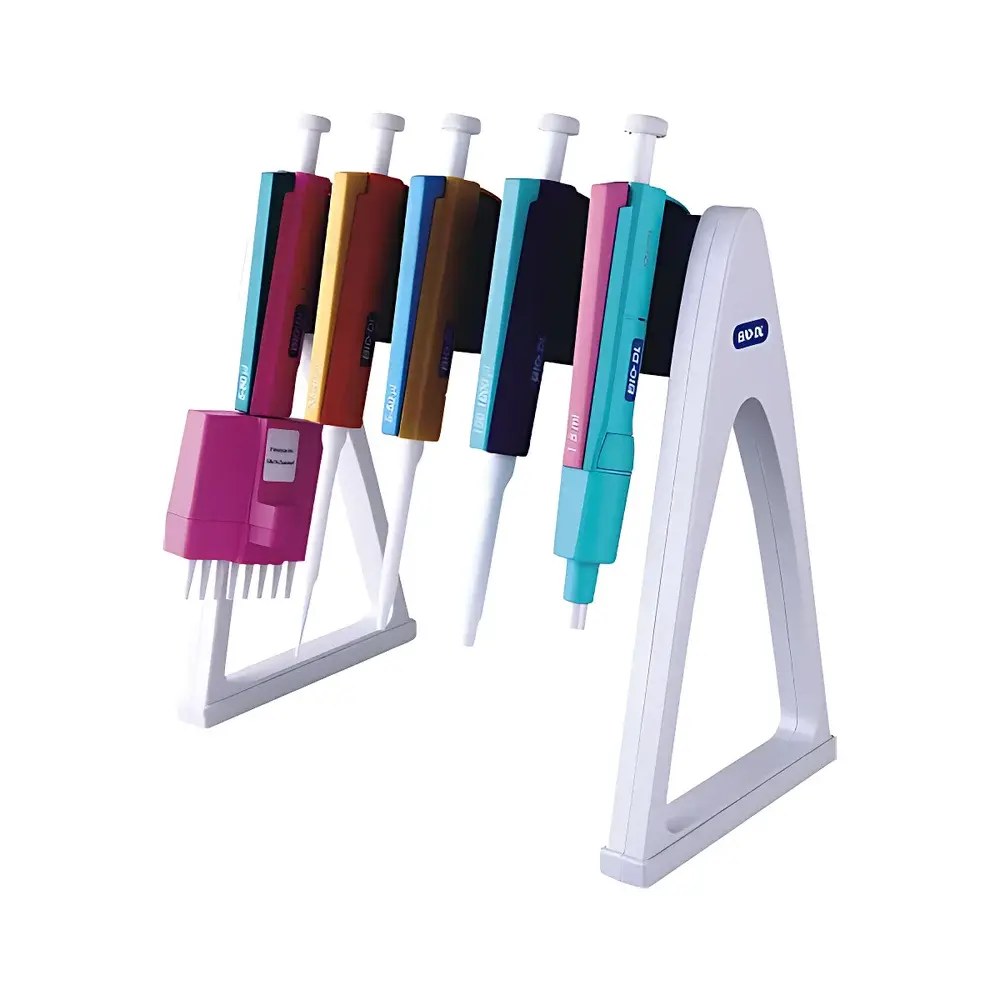
BIO-DL Colour Series Adjustable-Volume Pipettes
| Brand | BIO-DL |
|---|---|
| Origin | Shanghai, China |
| Model | Colour Series |
| Volume Range | 0.5–1000 µL (single-channel micro), 1–5 mL (single-channel macro), 5–300 µL (multi-channel) |
| Piston Material | PEI (Polyetherimide) |
| Handle Material | PA6 + 30% GF (Polyamide 6 reinforced with 30% glass fiber) |
| Tip Cone | Autoclavable, universal-fit |
| Compliance | ISO 8655-compliant design principles |
| Sterilization | Fully autoclavable at 121°C for 20 min (tip cone and body) |
Overview
The BIO-DL Colour Series Adjustable-Volume Pipettes are precision-engineered liquid handling instruments designed for high-reproducibility volumetric transfer in academic, clinical, and industrial laboratories. Built upon ISO 8655-aligned mechanical architecture, these pipettes employ air displacement principle to deliver accurate and consistent aspiration and dispensing across defined volume ranges. The series integrates ergonomic engineering with material science—leveraging thermally stable polyetherimide (PEI) for the internal piston assembly and reinforced polyamide (PA6 + 30% GF) for the housing—to ensure dimensional stability under repeated thermal cycling, chemical exposure, and mechanical stress. Unlike disposable or low-tolerance alternatives, the Colour Series is engineered for long-term calibration retention, supporting routine use in GLP- and GMP-aligned workflows where traceability and inter-operator consistency are critical.
Key Features
- Color-coded volume identification: Each pipette model is assigned a standardized chromatic identifier (e.g., yellow for 10–100 µL, blue for 100–1000 µL), enabling rapid visual recognition and minimizing protocol errors in multi-user environments.
- Autoclavable tip cone assembly: Fully compatible with standard 121°C, 20-minute steam sterilization cycles without disassembly; maintains seal integrity and dimensional accuracy post-sterilization.
- Chemical- and heat-resistant materials: PEI piston exhibits continuous-use thermal stability up to 170°C and resistance to common laboratory solvents including ethanol, isopropanol, and diluted acids/bases; PA6+30%GF handle provides UV resistance, abrasion tolerance, and mechanical damping over >10,000 actuation cycles.
- Universal tip compatibility: Conforms to ISO 8655-3 tip fit specifications, ensuring secure, leak-free engagement with major third-party and OEM pipette tips (including low-retention, filtered, and sterile variants).
- Multi-range configuration: Three functional subfamilies—micro-volume single-channel (0.5–1000 µL), macro-volume single-channel (1–5 mL), and 8-/12-channel multi-channel (5–300 µL)—cover >95% of routine aqueous and viscous liquid handling tasks in molecular biology, cell culture, and QC testing.
Sample Compatibility & Compliance
The Colour Series demonstrates validated performance with aqueous buffers (PBS, Tris-HCl), glycerol-containing solutions (<30% v/v), and serum-supplemented media. It is not recommended for highly volatile solvents (e.g., chloroform, acetone) or viscous liquids exceeding 100 mPa·s without gravimetric verification. All models adhere to fundamental metrological requirements outlined in ISO 8655 Parts 1–5 (volumetric performance, testing methods, and uncertainty evaluation). While not certified to ISO/IEC 17025, the design supports integration into accredited lab quality systems through documented calibration intervals, service history logs, and user-adjustable calibration protocols per manufacturer guidelines.
Software & Data Management
As a mechanical, non-electronic instrument, the Colour Series does not incorporate onboard software or digital connectivity. However, its design facilitates full alignment with electronic lab notebook (ELN) and LIMS workflows: calibration certificates include unique serial numbers and date-stamped performance data; maintenance logs can be exported in CSV format via BIO-DL’s optional Calibration Manager desktop utility (Windows/macOS); and all models support audit-trail-compatible calibration entries compliant with FDA 21 CFR Part 11 when paired with validated ELN platforms.
Applications
- Quantitative preparation of PCR master mixes and NGS library dilutions
- Serial dilution series in ELISA and cytotoxicity assays
- Cell seeding and medium exchange in adherent and suspension cultures
- Standardized reagent dispensing in high-throughput screening (HTS) plate setups
- Calibration transfer between reference standards and working solutions in analytical chemistry labs
FAQ
Can the entire pipette body be autoclaved?
Yes—the complete unit, including shaft, plunger, and tip cone—is rated for full-cycle autoclaving at 121°C for 20 minutes. Repeated sterilization does not compromise piston seal integrity or volume accuracy.
What is the recommended recalibration interval?
Under typical usage (≤500 operations/week), annual calibration is advised; in high-frequency or regulated environments (e.g., QC release testing), semi-annual verification against traceable weights is recommended.
Does the colour coding comply with any international standard?
While no global standard mandates specific hues for volume ranges, BIO-DL’s palette follows widely adopted conventions in North America and EU labs (e.g., yellow = 10–100 µL, blue = 100–1000 µL), facilitating cross-platform operator training and SOP harmonization.
Are replacement parts available separately?
Yes—O-rings, piston assemblies, tip cones, and ergonomic grips are stocked as individual SKUs with documented part numbers and shelf-life tracking.
How does the PEI piston compare to stainless steel or ceramic alternatives?
PEI offers superior thermal expansion matching with the polymer housing, reducing hysteresis during ambient temperature fluctuations; it also eliminates galvanic corrosion risk in humid or saline environments where metal pistons may degrade over time.



