
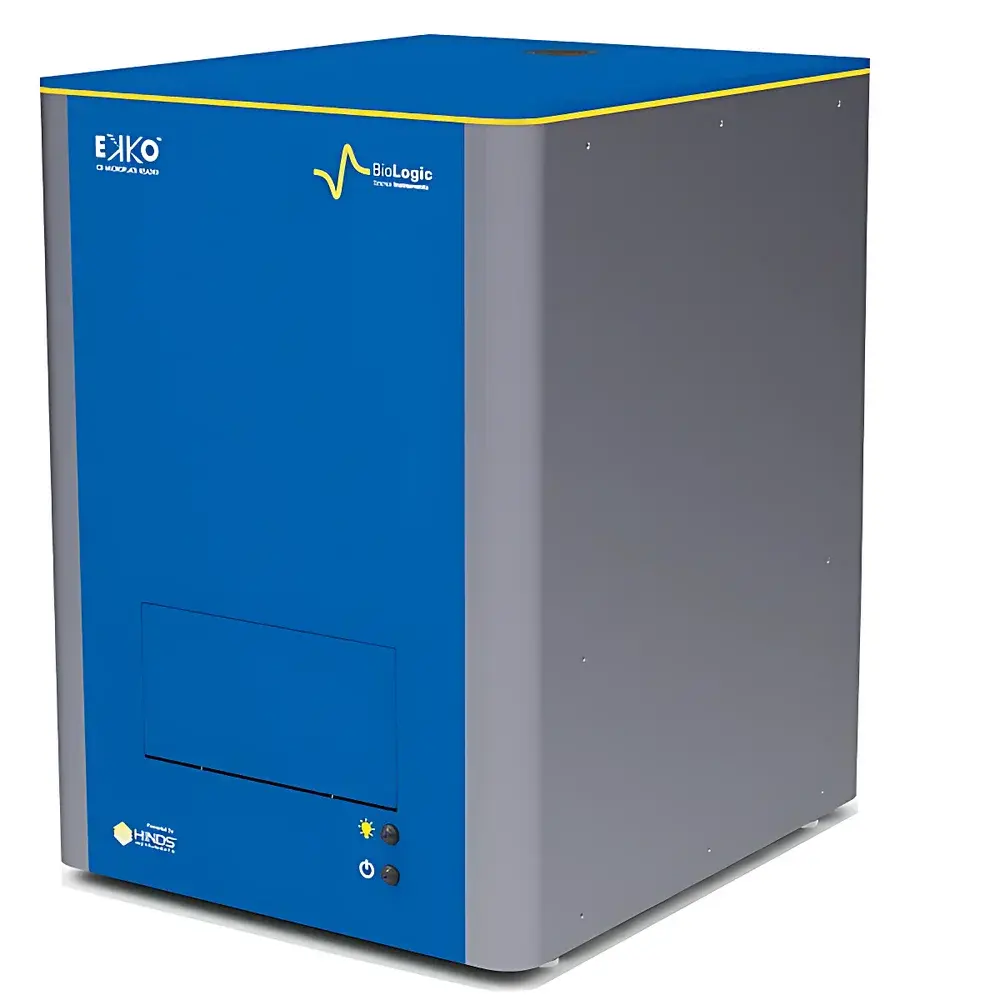
Bio-logic EKKO CD Microplate Reader
| Brand | Bio-logic |
|---|---|
| Origin | France |
| Manufacturer Type | Authorized Distributor |
| Origin Category | Imported |
| Model | EKKO |
| Price Range | USD 68,000 – 136,000 (est.) |
| Instrument Type | Circular Dichroism (CD) Spectrometer |
| Wavelength Range | 185–850 nm |
| Spectral Bandwidth | 1 nm (full range) |
| Noise Level | ≤ 0.05 mdeg |
| Plate Formats | Standard 96-well microplates (optional 384-well support) |
| Modulation Frequency | 50 kHz |
| Single-Wavelength Throughput | ~2 min per 96-well plate |
| Multi-Wavelength Scan (e.g., 210–350 nm, 5 nm step) | ~30 sec per well (~50 min total) |
| Full-Spectrum Scan (185–850 nm, 1 nm step) | ~11 min per well (~18 h total) |
Overview
The Bio-logic EKKO CD Microplate Reader is a purpose-engineered circular dichroism (CD) spectrometer designed for high-throughput chiral analysis directly in standard microtiter plates. Unlike conventional CD instruments—where samples must be manually transferred into quartz cuvettes and measured one at a time—the EKKO employs a vertically oriented optical path optimized for through-well transmission measurement. This architecture enables direct acquisition of CD signals from liquid-phase samples contained in 96-well (or optionally 384-well) plates without sample transfer, cuvette handling, or post-measurement cleaning cycles. The system operates on the principle of differential absorption of left- and right-circularly polarized light, quantified as ellipticity (in millidegrees, mdeg), and delivers quantitative enantiomeric excess (ee) determination across large compound libraries—critical for asymmetric synthesis, chiral catalyst screening, and biopolymer conformational studies.
Key Features
- Vertical optical configuration enabling direct CD measurement in microplates—eliminating manual pipetting, cuvette loading, and cleaning steps
- High-sensitivity detection with baseline noise ≤ 0.05 mdeg, ensuring reliable ee quantification even at low concentrations (e.g., sub-mM chiral analytes)
- Full spectral coverage from 185 nm to 850 nm with 1 nm resolution, supporting far-UV protein secondary structure analysis, near-UV aromatic side-chain monitoring, and visible-region metalloprotein characterization
- 50 kHz photoelastic modulator (PEM) frequency for robust signal-to-noise performance and minimized thermal drift during extended scans
- Integrated XY motorized stage with precise well-to-well positioning (±2 µm repeatability) and auto-focus capability for consistent pathlength normalization
- Compact footprint (54 × 59 × 74 cm) suitable for standard laboratory benchtop integration, including fume hood or glovebox installation
- Pre-configured hardware and software bundle—including control PC, high-resolution display, and dedicated acquisition suite—requiring zero third-party dependencies
Sample Compatibility & Compliance
The EKKO accommodates aqueous and organic solvent-based samples in standard polystyrene, cyclic olefin copolymer (COC), or UV-transparent quartz-bottom microplates. It supports typical assay volumes (100–300 µL/well) and tolerates common additives (e.g., DMSO ≤10%, salts ≤150 mM). All optical components comply with ISO 17025 calibration traceability requirements, and spectral accuracy is verified against NIST-traceable quartz standards. The instrument meets CE marking directives for electromagnetic compatibility (EMC) and low-voltage safety (LVD). For regulated environments, audit trail functionality, user access levels, and electronic signature support are embedded in firmware to align with FDA 21 CFR Part 11 and GLP/GMP documentation expectations.
Software & Data Management
Control and analysis are executed via Bio-logic’s proprietary CD Workbench software, a Windows-based application featuring intuitive plate mapping, real-time spectral preview, batch processing workflows, and automated ee calculation using reference spectra or calibration curves. Raw data are stored in vendor-neutral ASCII format (.dat) with full metadata (wavelength, temperature, slit width, PEM voltage, integration time), enabling seamless import into MATLAB, Python (NumPy/Pandas), or commercial cheminformatics platforms. The software includes built-in tools for baseline correction, smoothing (Savitzky-Golay), secondary structure deconvolution (using CONTIN/LL or SELCON3 algorithms), and statistical comparison across plate rows/columns. All user actions—including parameter changes, plate re-scans, and data exports—are logged with timestamps and operator IDs for full traceability.
Applications
- High-throughput screening (HTS) of chiral catalysts and ligands in asymmetric C–C bond formation, epoxidation, and hydrogenation reactions
- Rapid ee determination of reaction aliquots from parallel synthesis arrays—bypassing HPLC method development and column equilibration delays
- Concentration-dependent folding/unfolding studies of peptides and engineered proteins across multi-well thermal or chemical denaturation gradients
- Quality control of chiral active pharmaceutical ingredients (APIs) and intermediates during process development
- Binding stoichiometry and conformational change analysis in host–guest systems (e.g., cyclodextrin inclusion complexes) using titration-mode plate scanning
- Validation of enantioselective enzyme variants in directed evolution campaigns, where >1,000 variants per day can be profiled for structural integrity and chiral discrimination
FAQ
Can the EKKO measure samples in 384-well plates?
Yes—optional high-density plate adapters and refined optics modules support 384-well formats with adjusted pathlength compensation and reduced per-well integration times.
Is temperature control available?
The base system operates at ambient temperature; an optional Peltier-controlled plate holder (−5 °C to +80 °C, ±0.2 °C stability) is available for thermodynamic studies.
How does the EKKO handle absorbance artifacts in colored or turbid samples?
The instrument applies real-time linear dichroism (LD) correction algorithms and offers dual-beam referencing modes to suppress scattering-induced ellipticity bias.
Does it support kinetic CD measurements?
Yes—time-resolved mode enables sequential single-wavelength acquisition across up to 96 wells with millisecond temporal resolution, suitable for stopped-flow coupled assays.
What maintenance is required?
Annual PEM alignment verification and lamp intensity calibration are recommended; no routine optical cleaning or fluidic servicing is needed due to the solid-state, cuvette-free design.



