
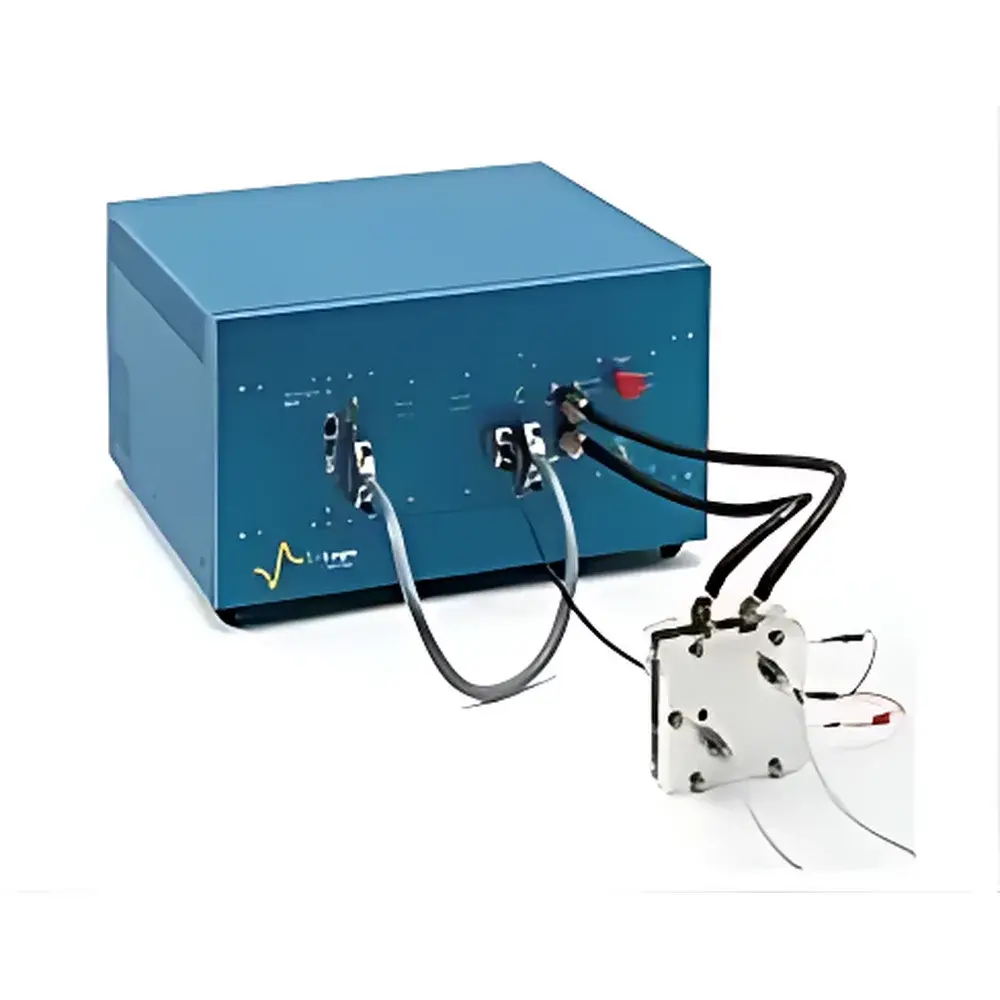
Bio-Logic HCP-803 High-Current Electrochemical Workstation
| Brand | Bio-Logic |
|---|---|
| Origin | France |
| Model | HCP-803 |
| Current Range | ±80 A |
| Current Resolution | 760 pA (1 nA–400 nA range) |
| Current Accuracy | ±20 nA on 10 μA range |
| Potential Accuracy | <5 mV on ±2.5 V range |
| Potentiostatic Range | ±10 V |
| Dynamic Potential Resolution | 300 µV (adjustable down to 5 µV) |
| EIS Frequency Range | 10 µHz–1 MHz (standard), 10 µHz–10 kHz (with 80 A booster) |
| Booster Module | Removable high-current extension unit |
Overview
The Bio-Logic HCP-803 High-Current Electrochemical Workstation is a research-grade potentiostat/galvanostat engineered for demanding electrochemical applications requiring both precision at low currents and robust power delivery at high current densities. Based on a dual-channel, modular architecture, the HCP-803 integrates a high-fidelity main control unit with an optional, field-detachable 80 A current booster—enabling seamless transition between microampere-scale kinetic studies and ampere-to-kiloampere-level durability testing. Its core measurement principle relies on four-quadrant bipolar operation with real-time digital feedback control, supporting potentiostatic, galvanostatic, zero-resistance ammetry (ZRA), and hybrid modes. Designed specifically for accelerated lifetime evaluation of energy storage and conversion devices, the system complies with fundamental electrochemical standards including ASTM G102 (calculation of corrosion rates), ISO 17475 (electrochemical impedance spectroscopy for coatings), and IEC 62660-2 (performance testing of traction batteries).
Key Features
- Modular high-current architecture: Standard unit delivers ±10 V / ±1 A; optional 80 A booster extends current capability to ±80 A while maintaining full potentiostatic control and synchronization.
- Ultra-low noise current measurement: 760 pA resolution in the 1 nA–400 nA range ensures accurate detection of faradaic processes in corrosion inhibition or catalyst layer characterization.
- Dynamic potential resolution: 300 µV base resolution, adjustable down to 5 µV via dynamic range optimization—critical for resolving subtle redox transitions in multi-electron transfer reactions.
- Wide electrochemical impedance spectroscopy (EIS) bandwidth: 10 µHz–1 MHz without booster; extended to 10 µHz–10 kHz when operating with the 80 A module—enabling low-frequency degradation analysis of fuel cell membranes and solid-electrolyte interphases (SEI).
- True four-quadrant operation: Enables simultaneous anodic/cathodic polarization without polarity switching delays—essential for bidirectional battery cycling and electroplating reversal protocols.
- Hardware-based real-time control loop: Sub-millisecond response time ensures stability during fast transient measurements such as pulse plating or load-step testing in PEM electrolyzers.
Sample Compatibility & Compliance
The HCP-803 supports a broad spectrum of electrochemical cells—from standard three-electrode laboratory cells (e.g., rotating disk electrodes, microelectrodes) to large-format pouch and cylindrical battery cells, flow-through fuel cell test stations, and industrial electroplating baths. Its isolated analog front-end and reinforced safety interlocks meet IEC 61010-1 requirements for measurement category CAT II 1000 V. The system is compatible with common reference electrodes (Ag/AgCl, Hg/Hg₂SO₄, SCE) and accommodates floating ground configurations required for grounded industrial reactors. For regulated environments, firmware supports audit-trail logging and user-access controls aligned with GLP and GMP principles. While not inherently 21 CFR Part 11 compliant, the MTS software platform allows configuration of electronic signatures and change-controlled method templates upon customer-specific validation.
Software & Data Management
Controlled via Bio-Logic’s EC-Lab® v12.x software suite, the HCP-803 provides intuitive experiment sequencing, real-time parameter monitoring, and automated data export in HDF5 and ASCII formats. EC-Lab includes preconfigured methods for cyclic voltammetry (CV), chronoamperometry (CA), galvanostatic intermittent titration technique (GITT), incremental capacity analysis (ICA), and multi-sine EIS. All raw data are timestamped with hardware-synced UTC clocks, and metadata—including instrument ID, calibration history, and environmental sensor inputs (optional)—are embedded directly into binary files. Batch processing tools support statistical comparison across electrode batches or aging cycles, while Python and MATLAB APIs enable integration into automated lab workflows and digital twin modeling pipelines.
Applications
- Fuel cell stack and MEA lifetime testing under realistic load profiles (e.g., automotive drive cycles, start-stop stress tests)
- Supercapacitor capacitance retention and equivalent series resistance (ESR) evolution over >100,000 cycles
- Lithium-ion and solid-state battery formation cycling, overcharge/overdischarge safety margin assessment
- Electrodeposition kinetics and morphology control in additive manufacturing and PCB metallization
- Corrosion rate quantification via linear polarization resistance (LPR) and electrochemical noise (EN) in aggressive media
- Electrocatalyst stability evaluation under high-current-density water splitting conditions
FAQ
Can the 80 A booster be used simultaneously with all electrochemical techniques?
Yes—the booster maintains full compatibility with CV, CA, CP, EIS, and ZRA when engaged. However, EIS bandwidth is limited to 10 kHz in booster mode due to power-stage bandwidth constraints.
Is external cooling required for continuous 80 A operation?
The booster module includes integrated forced-air cooling and thermal shutdown protection. Sustained 80 A output requires ambient temperature ≤25°C and unobstructed airflow; liquid-cooled variants are available under custom configuration.
How is current accuracy verified across the full ±80 A range?
Bio-Logic supplies NIST-traceable calibration certificates covering five decades (1 nA to 80 A) using metrology-grade shunts and reference meters. Factory calibration includes linearity, offset, and thermal drift compensation at multiple load points.
Does the HCP-803 support multi-channel synchronization with other Bio-Logic units?
Yes—via the optional SyncBox interface, up to eight HCP-803 units can be phase-locked for distributed battery pack testing or parallel electrode array studies with sub-microsecond timing alignment.
What maintenance is required to ensure long-term measurement integrity?
Annual verification of analog front-end gain/offset and EIS phase response is recommended. Bio-Logic offers remote diagnostic support and on-site recalibration services through its global network of certified service engineers.





