
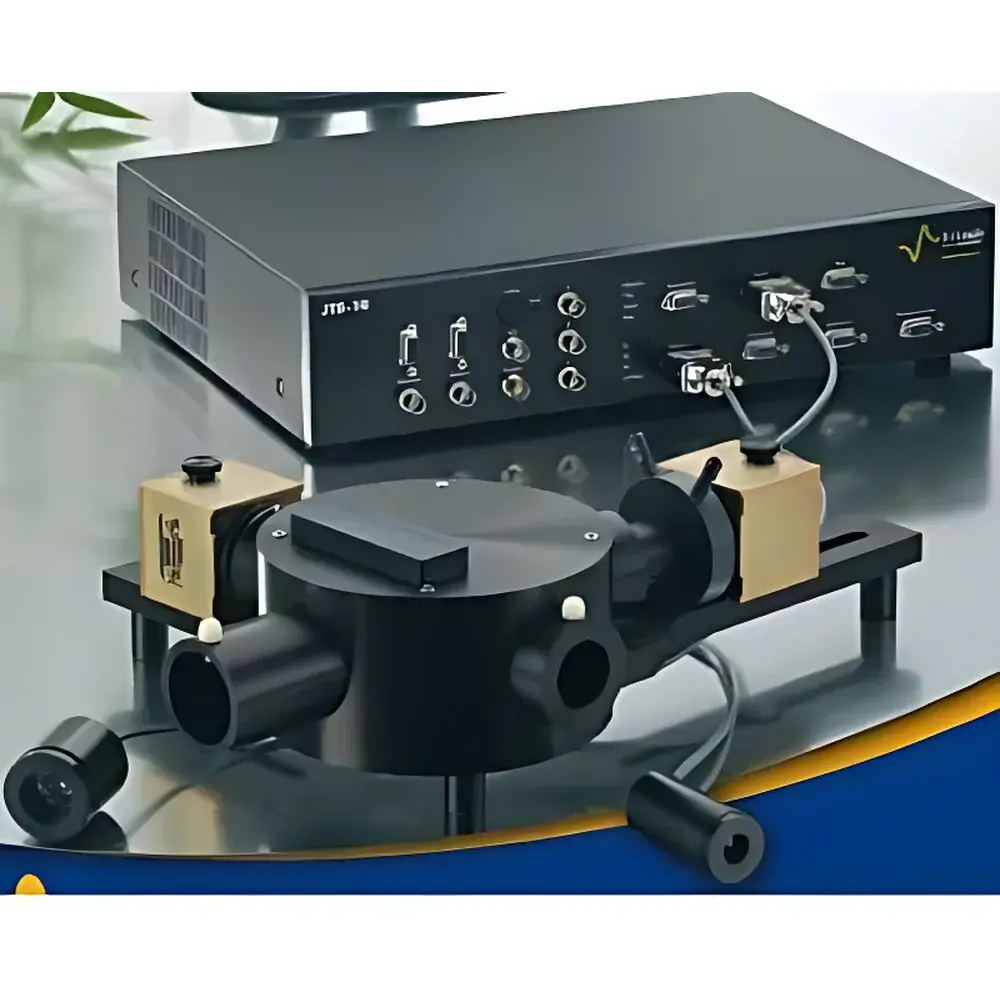
Bio-Logic JTS-150 Chlorophyll Fluorescence & Absorption Photosynthesis Analyzer
| Brand | Bio-Logic |
|---|---|
| Origin | France |
| Model | JTS-150 |
| Excitation & Detection Wavelength Range | 320–1120 nm |
| Detector | Si PIN Photodiode |
| Optical Density (OD) Sensitivity | 1×10⁻⁵ OD (OD 0–2 range) |
| Time Resolution | 10 µs to minutes |
| Optional Flash Sources | Laser or Xenon Flash Lamp |
Overview
The Bio-Logic JTS-150 is a research-grade, dual-mode chlorophyll fluorescence and absorption photosynthesis analyzer engineered for high-temporal-resolution interrogation of photosynthetic electron transport dynamics in vivo. Designed and manufactured in France, the instrument operates on the principle of time-resolved optical spectroscopy—simultaneously monitoring modulated chlorophyll a fluorescence emission and differential absorbance changes across the visible and near-infrared spectrum (320–1120 nm). Its core capability lies in resolving sub-millisecond photochemical events—including charge separation in PSII, plastoquinone pool redox state transitions, cytochrome b6f complex turnover, and P700+ formation kinetics—enabling quantitative dissection of linear vs. cyclic electron flow, non-photochemical quenching (NPQ) components, and photoprotective mechanisms under controlled or dynamic light regimes.
Key Features
- Dual operational mode: seamless switching between chlorophyll fluorescence detection (e.g., OJIP transient analysis, ΦPSII quantification) and differential absorption spectroscopy (e.g., ΔA820, ΔA520, ΔA440) without hardware reconfiguration.
- Modular LED architecture: fully externalized, user-replaceable excitation and detection LEDs—allowing wavelength customization per experimental requirement (e.g., 450 nm/620 nm for PSII, 705/740 nm or 810/870 nm for P700, 440 nm for cytochrome b, 520 nm for cytochrome f).
- Ultrafast temporal resolution: 10 µs minimum sampling interval, programmable up to multi-minute averaging—optimized for capturing rapid induction kinetics (O-J-I-P), flash-induced redox transients, and relaxation phases post-illumination.
- High-sensitivity optical detection: Si PIN photodiode with calibrated responsivity across 320–1120 nm; capable of resolving absorbance changes as low as 1×10⁻⁵ OD within the linear OD 0–2 range.
- Flexible sample handling: interchangeable holders for intact leaves (standard leaf clip with pressure-controlled contact) and liquid-phase samples (quartz cuvettes with 1 mm or 10 mm pathlength options), ensuring compatibility with higher plants, algae, cyanobacteria, and isolated thylakoids.
- Expandable configuration: optional high-intensity flash sources—including pulsed laser diodes and xenon flash lamps—for saturating pulse delivery, PAM-like actinic illumination, or ultrafast pump-probe experiments.
Sample Compatibility & Compliance
The JTS-150 supports a broad spectrum of photosynthetic specimens: vascular plant leaves (including shade- and sun-adapted species), bryophytes, macro- and microalgae (e.g., Chlamydomonas, Dunaliella), cyanobacterial cultures (Synechocystis, Anabaena), and purified photosynthetic membrane preparations. All optical modules comply with IEC 61000-6-3 (EMC emission standards) and IEC 61000-6-2 (immunity requirements). Data acquisition adheres to GLP-compliant metadata tagging (timestamp, instrument ID, operator, protocol version), and raw signal files are stored in open-format HDF5 with embedded calibration coefficients—ensuring traceability for regulatory submissions under ISO 17025-accredited laboratories.
Software & Data Management
Controlled via Bio-Logic’s proprietary Clarity software (v5.2+), the JTS-150 provides real-time visualization, protocol scripting, and automated kinetic analysis. The software includes built-in algorithms for NPQ coefficient calculation (qN, qE, qI), ΦPSII derivation from steady-state and pulse-amplitude-modulated signals, OJIP parameter extraction (VJ, MO, ABS/RC), and multi-wavelength deconvolution of overlapping redox signals (e.g., P700+ vs. cyt f oxidation). Export formats include CSV, MATLAB (.mat), and standardized PSI-MI XML for integration into LIMS or ELN systems. Audit trail functionality satisfies FDA 21 CFR Part 11 requirements for electronic records and signatures when configured with user authentication and session logging.
Applications
- Quantitative assessment of PSII photochemical efficiency under abiotic stress (drought, heat, heavy metals, UV-B).
- Dissection of NPQ components (energy-dependent, state-transition, photoinhibitory) using kinetic modeling and spectral deconvolution.
- Simultaneous tracking of PSII electron transport (via Chl a fluorescence) and PSI acceptor-side limitation (via P700+ kinetics) to evaluate photosystem balance.
- In vivo characterization of cytochrome b6f complex activity through 520 nm absorbance kinetics in eukaryotic and prokaryotic systems.
- Time-resolved analysis of carotenoid bandshift (CBS) at ~505 nm as a proxy for thylakoid lumen pH and ΔpH-dependent regulation.
- Validation of genetic modifications (e.g., knockout lines of NPQ-related proteins, PGR5, PGRL1) using comparative kinetic fingerprinting.
FAQ
What is the minimum detectable absorbance change (ΔA) for cytochrome f oxidation at 520 nm?
The system achieves a noise floor of ≤1×10⁻⁵ OD at 520 nm under standard averaging (100 flashes, 1 ms integration), sufficient to resolve physiological cytochrome f redox changes in intact leaves.
Can the JTS-150 be used for dark-interval relaxation analysis (DIRK)?
Yes—its 10 µs time resolution and programmable dark-phase timing enable precise measurement of P700+ and cyt b6 re-reduction kinetics during millisecond-to-second dark intervals.
Is third-party software integration supported?
Raw data streams (via TCP/IP) and HDF5 exports support custom Python/MATLAB analysis pipelines; API documentation is available under NDA for OEM and academic development partners.
Does the instrument meet ISO 14040/14044 requirements for environmental life cycle assessment studies?
While not an LCA tool per se, its high reproducibility (CV < 2.3% across inter-laboratory trials) and traceable calibration protocols support robust primary data generation aligned with ISO 14040-compliant experimental design.
Are firmware updates provided free of charge during the warranty period?
Yes—Bio-Logic offers complimentary firmware and software updates for the duration of the 24-month standard warranty, including new protocol templates and compliance patches.




