
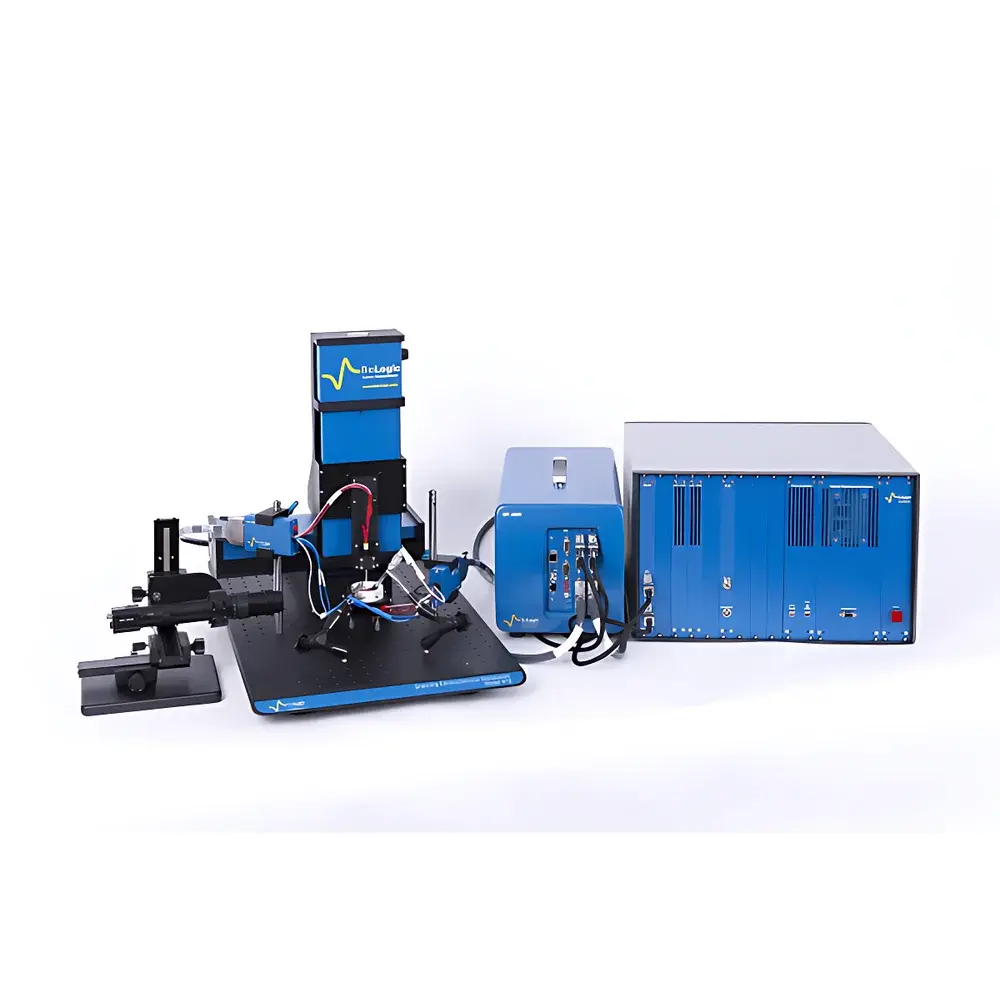
Bio-Logic M470 Micro-Region Scanning Electrochemical Workstation
| Brand | Bio-Logic |
|---|---|
| Origin | France |
| Model | M470 |
| Instrument Type | Scanning Electrochemical Workstation |
| Current Range | 1 pA – 10 A |
| Current Accuracy | ±0.0033% of reading |
| Potential Accuracy | ±1 µV |
| Potentiostatic Range | ±30 V |
| EIS Frequency Range | 10 µHz – 7 MHz |
| Scan Range (X/Y/Z) | >100 mm |
| Closed-Loop Positioning Resolution | 0.1 nm |
| Spatial Resolution (X/Y/Z) | 20 nm |
| Max Scan Speed | 12.5 mm/s |
| ADC/DAC Resolution | 32-bit @ up to 40 MHz |
| Piezo Vibration Range | 20 nm – 2 µm (peak-to-peak, 1 nm step) |
| Piezo Minimum Vibration Resolution | 0.12 nm (16-bit DAC, 4 µm range) |
| Piezo Extension | 100 µm |
| Piezo Positioning Resolution | 0.09 nm (20-bit DAC, 100 µm range) |
Overview
The Bio-Logic M470 Micro-Region Scanning Electrochemical Workstation is a fourth-generation scanning probe platform engineered for high-precision, multi-modal electrochemical surface characterization at the micro- and nanoscale. Developed by Uniscan Instruments and distributed globally by Bio-Logic SAS (France), the M470 integrates a modular potentiostat/galvanostat with a high-stability, closed-loop mechanical scanning system capable of sub-nanometer positioning fidelity. Its core architecture supports nine distinct scanning electrochemical techniques—including Scanning Electrochemical Microscopy (SECM), ac-SECM, intermittent contact SECM (ic-SECM), Localized Electrochemical Impedance Spectroscopy (LEIS), Scanning Vibrating Electrode Technique (SVET), Scanning Droplet Cell (SDS), ac-SDS, Scanning Kelvin Probe (SKP), and Non-Contact Surface Topography (OSP)—all under unified hardware control and synchronized data acquisition. The system operates on a hybrid 32-bit DAC architecture, enabling simultaneous high-resolution potential/current control and real-time position feedback across all axes. Designed for fundamental research in corrosion science, battery electrode interfaces, catalytic activity mapping, bioelectrochemistry, and functional material screening, the M470 meets the stringent requirements of GLP-compliant laboratories and advanced academic facilities.
Key Features
- Closed-loop linear encoders with zero-hysteresis feedback on X, Y, and Z axes—delivering real-time displacement readout with 0.1 nm resolution and 20 nm spatial reproducibility.
- Integrated 32-bit high-speed DAC/ADC subsystem operating up to 40 MHz, ensuring minimal phase lag and precise waveform generation for dynamic techniques such as ac-SECM and LEIS.
- Programmable piezoelectric actuation module supporting vibration amplitudes from 20 nm to 2 µm (1 nm increments) and sub-angstrom positioning resolution (0.09 nm with 20-bit DAC).
- Graphical Experiment Sequencing Engine (GESE) enabling automated multi-region scanning, conditional parameter adjustment, and hierarchical experimental workflows.
- Advanced post-processing suite featuring 2D/3D FFT analysis, polynomial baseline subtraction (up to 5th order), tilt correction, peak identification, and cross-sectional profile extraction.
- Modular front-end design accommodating seven optional hardware modules, three interchangeable electrolyte cells (including thin-layer, droplet, and flow-cell configurations), and a wide selection of microelectrode probes (Pt, Au, carbon fiber, Ag/AgCl, vibrating wire, Kelvin probe tips).
Sample Compatibility & Compliance
The M470 accommodates solid electrodes (metals, semiconductors, conductive polymers), biological samples (tissue sections, biofilms, single cells), coated substrates, and heterogeneous catalyst layers—without requiring conductive backing or vacuum environments. All electrochemical measurements comply with ASTM G102 (standard practice for calculating corrosion rates), ISO 16773-1 (LEIS methodology), and ASTM D7238 (SVET for localized corrosion assessment). The system supports audit-trail-enabled operation per FDA 21 CFR Part 11 when paired with Bio-Logic’s EC-Lab® software v12+, including electronic signatures, user access levels, and immutable raw-data archiving. Full traceability of instrument calibration logs, experiment parameters, and metadata is maintained for GMP/GLP documentation workflows.
Software & Data Management
EC-Lab® software (v12.x or later) serves as the unified interface for instrument control, real-time visualization, and quantitative analysis. It provides native support for all nine scanning modes, including automatic curve fitting for SECM approach curves, user-defined convolution modeling, and phase-sensitive detection for ac-SECM. Data export is available in HDF5, ASCII, and MATLAB-compatible formats; batch processing scripts can be written in Python via the EC-Lab® SDK. All datasets are timestamped, georeferenced with absolute XYZ coordinates, and annotated with environmental metadata (temperature, humidity, electrolyte composition). Software validation packages—including IQ/OQ documentation and traceable calibration certificates—are available upon request for regulated environments.
Applications
- Mapping local corrosion activity on coated steel or aluminum alloys using SVET and LEIS.
- Quantifying oxygen reduction kinetics and proton transport resistance across PEM fuel cell catalyst layers via SECM feedback mode.
- Imaging redox-active biomolecules (e.g., cytochrome c, NADH) on living cell membranes with sub-micron spatial resolution.
- Characterizing ion flux heterogeneity in solid-state battery cathodes during in-situ cycling using SDS and ac-SDS.
- Measuring work function gradients on organic photovoltaic films via SKP, correlated with surface morphology from OSP.
- Validating protective self-assembled monolayers (SAMs) through localized impedance spectroscopy at defect sites.
FAQ
What scanning probe techniques does the M470 support natively?
The M470 supports nine techniques: SECM, ac-SECM, ic-SECM, LEIS, SVET, SDS, ac-SDS, SKP, and OSP—all controlled through a single firmware layer and EC-Lab® interface.
Is the M470 compatible with third-party microscopes or AFM systems?
Yes—the M470 scanning stage features standardized optical breadboard mounting (M6 threaded holes) and TTL/USB synchronization ports, enabling integration with inverted optical microscopes, confocal Raman systems, or hybrid AFM-SECM platforms.
Can the M470 perform true in-situ electrochemical measurements during mechanical loading?
While not a dedicated in-situ mechanical tester, the M470’s open-frame design allows integration with external tensile stages or nanoindenters; its fast sampling rate (up to 40 MHz) and low-latency triggering ensure temporal alignment between electrochemical transients and mechanical events.
How is calibration traceability ensured for quantitative SECM imaging?
Each M470 shipment includes NIST-traceable calibration certificates for current/potential accuracy, piezo displacement linearity, and encoder resolution—validated against primary standards at Bio-Logic’s Grenoble metrology lab.
Does the system meet electromagnetic compatibility (EMC) requirements for use in shielded laboratory environments?
Yes—the M470 complies with IEC 61326-1:2013 (industrial EMC) and carries CE, UKCA, and FCC Class A certification; optional RF-shielded enclosures are available for ultra-low-noise measurements.






