
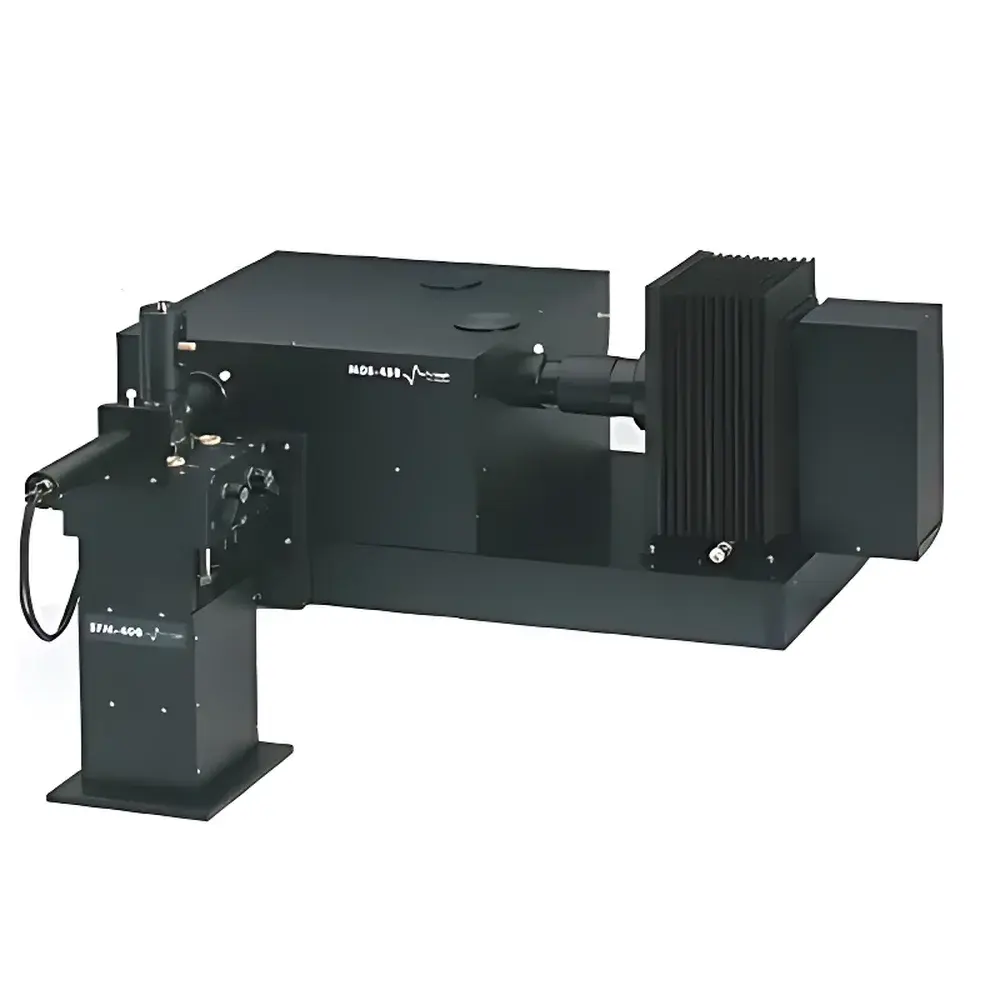
Bio-Logic MOS-450 Advanced Circular Dichroism Spectrometer
| Brand | Bio-Logic |
|---|---|
| Origin | France |
| Model | MOS-450 |
| Instrument Type | Circular Dichroism (CD) Spectrometer |
| Light Sources | 150 W Xenon Lamp + 150 W Mercury-Xenon Lamp |
| Wavelength Range | 165–900 nm |
| Wavelength Accuracy | ±0.1 nm (165–900 nm) |
| Optical System | Dual Grating (1200 grooves/mm) |
| Stray Light | < 2 × 10⁻⁴ % (at 200 nm) |
| Noise Level (CD) | 0.01 mdeg |
| Baseline Stability | < 0.01 mdeg/hr |
| Data Acquisition Rate | 10 µs to 1000 s per point |
| Stopped-Flow Unit | Triple-/Quadruple-Channel Mixing, Independent Stepper-Motor Control per Channel |
| Minimum Injection Volume | 10 µL |
| Flow Rate per Channel | 0.01–1.0 mL/s |
| Mixing Ratio Range | Continuously Adjustable from 1:1 to 1:100 |
| Minimum Dead Time | 0.25 ms (with micro-volume detection cell) |
| Expandable Modules | Cryo-Quench, Sub-Zero Stopped-Flow, Temperature-Jump (T-Jump), Auto-Titration, In-Situ Micro-Conductivity Detection |
Overview
The Bio-Logic MOS-450 Advanced Circular Dichroism Spectrometer is a high-performance, modular optical instrument engineered for quantitative analysis of chiral molecular structure and conformational dynamics in solution. Based on the physical principle of differential absorption of left- and right-circularly polarized light, CD spectroscopy provides direct, label-free insight into secondary and tertiary structural features of biomacromolecules—including proteins, peptides, nucleic acids, and chiral synthetic compounds—under native or controlled environmental conditions. The MOS-450 integrates dual high-intensity light sources (150 W xenon and 150 W mercury-xenon lamps), enabling seamless coverage across the far-UV (165 nm) to near-IR (900 nm) spectral domain—a critical capability for resolving fine structural transitions in folded proteins, nucleic acid helicity, and metal-centered chirality. Its dual-grating monochromator (1200 grooves/mm) ensures high spectral resolution and minimal stray light (< 2 × 10⁻⁴ % at 200 nm), while thermally stabilized optics and active baseline correction deliver long-term measurement integrity (< 0.01 mdeg/hr drift).
Key Features
- Multi-modal spectroscopic detection in a single platform: simultaneous acquisition of circular dichroism (CD), UV-Vis absorbance, total fluorescence, linear dichroism (LD), fluorescence anisotropy, and light scattering spectra.
- Ultra-low CD noise floor of 0.01 mdeg enables reliable detection of subtle conformational changes in dilute biological samples (e.g., sub-µM protein concentrations).
- Modular stopped-flow accessory with independent stepper-motor control for each of up to four syringes, supporting precise kinetic mixing with continuously variable ratios (1:1 to 1:100) and minimum dead time of 0.25 ms using micro-volume flow cells.
- Flexible data acquisition window: adjustable dwell time from 10 microseconds to 1000 seconds per data point, accommodating both rapid folding events and slow equilibrium titrations.
- Expandable architecture supporting cryo-quench, sub-zero temperature stopped-flow, temperature-jump (T-jump), automated titration, and in-situ micro-conductivity detection—enabling multi-parameter reaction monitoring under physicochemically defined conditions.
Sample Compatibility & Compliance
The MOS-450 accommodates standard quartz cuvettes (0.1–10 mm pathlength), capillary cells, and custom flow cells for solution-phase analysis of small molecules, metallocomplexes, polymers, and macromolecular assemblies. Its optical design meets ISO 17025-relevant performance criteria for spectrophotometric instrumentation, and its software architecture supports audit-trail generation and user-access controls aligned with GLP and GMP environments. While not inherently FDA 21 CFR Part 11-compliant out-of-the-box, the system’s data handling framework is compatible with validated third-party electronic lab notebook (ELN) and LIMS integrations required for regulated pharmaceutical development (e.g., USP <1118>, ICH Q5E conformational comparability studies).
Software & Data Management
Control and analysis are unified within Bio-Kine software—a Windows-based application offering full instrument orchestration, real-time kinetic trace visualization, global fitting algorithms (including singular value decomposition and target modeling), and batch processing for multi-experiment datasets. All raw spectral and kinetic data are stored in vendor-neutral, metadata-embedded ASCII formats (.txt, .csv) alongside XML-based experiment logs. Software modules support automated baseline subtraction, smoothing (Savitzky-Golay), secondary structure deconvolution (using reference databases such as SELCON3, CONTIN/LL, and CDSSTR), and export to industry-standard platforms including OriginLab, MATLAB, and Python (via pandas-compatible readers). Audit trails record operator ID, timestamp, parameter modifications, and calibration events—facilitating traceability in QA/QC and academic reproducibility workflows.
Applications
- Protein folding/unfolding thermodynamics and kinetics, including cold denaturation and pressure-induced transitions.
- Characterization of peptide secondary structure content (α-helix, β-sheet, random coil) in membrane-mimetic environments.
- Chiral purity assessment of pharmaceutical intermediates and enantiomeric excess determination without derivatization.
- Conformational analysis of oligonucleotides, G-quadruplexes, and RNA aptamers under varying ionic strength and pH.
- Mechanistic studies of metal-ligand coordination geometry in transition-metal complexes via d-d transition CD bands.
- Real-time monitoring of ligand-binding induced conformational shifts in allosteric enzymes and receptors.
FAQ
What sample volume is required for standard CD measurements?
Standard 1-mm pathlength quartz cuvettes require 300–400 µL; micro-volume cells (10–50 µL capacity) are available as optional accessories.
Can the MOS-450 perform temperature-controlled experiments?
Yes—the system is fully compatible with Peltier-based thermostatted cells (−10 °C to +110 °C) and cryogenic accessories for sub-zero kinetic trapping.
Is remote operation supported?
Instrument control and data acquisition can be executed over local network via TCP/IP protocol; remote desktop access is permitted within secure institutional IT policies.
How is calibration verified?
Wavelength accuracy is verified using holmium oxide and didymium filters per ASTM E275; CD response is validated using solid-state quartz plates and aqueous camphorsulfonic acid standards.
Does the software support batch processing of multiple kinetic datasets?
Yes—Bio-Kine includes scripting capabilities (via built-in macro language) and command-line interface options for high-throughput analysis pipelines.
Related Products





