
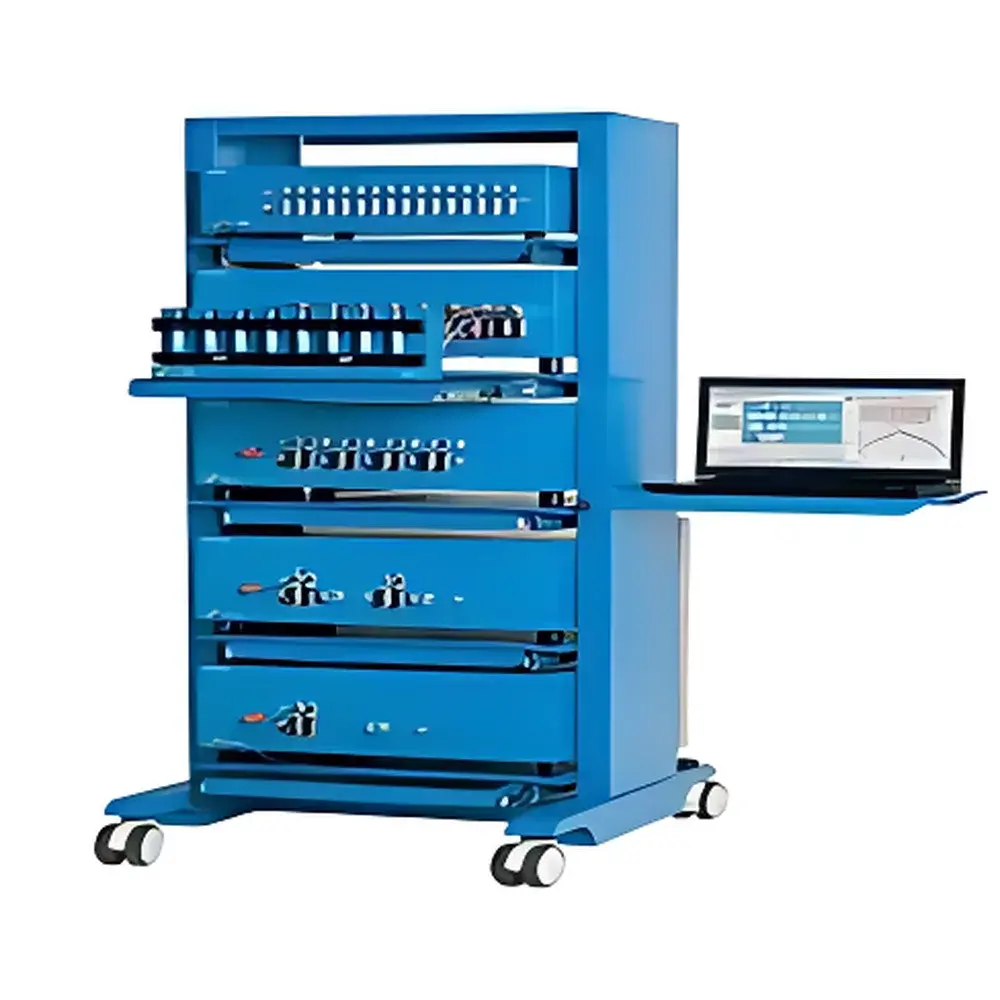
Bio-Logic MPG-2XX High-Precision Multi-Channel Battery Testing System
| Brand | Bio-Logic |
|---|---|
| Origin | France |
| Model | MPG-2XX |
| Instrument Type | Electrochemical Workstation |
| Current Range | ±40 A |
| Current Accuracy | ±20 nA on 10 μA |
| Potential Accuracy | <5 mV on ±2.5 V |
| Potentiostatic Range | ±10 V |
| EIS Frequency Range | 10 μHz – 1 MHz |
Overview
The Bio-Logic MPG-2XX is a high-precision, modular multi-channel electrochemical workstation engineered for advanced battery and energy storage research. Based on Bio-Logic’s proven MacPile architecture and rigorously validated in academic and industrial R&D laboratories across Europe and North America, the MPG-2XX implements true galvanostatic/potentiostatic control per channel using dedicated analog front-ends and synchronized 24-bit ADC/DAC conversion. Each channel operates independently with full four-quadrant capability—enabling precise charge/discharge profiling, impedance spectroscopy under load, and dynamic transient response acquisition. Its design adheres to fundamental electrochemical measurement principles: low-noise current sensing via precision shunt resistors and active feedback compensation, coupled with high-stability reference electrode interfaces and guard-driven cell cabling to minimize stray capacitance and leakage currents. The system is optimized for long-term stability in controlled-environment testing (e.g., climate chambers), supporting continuous operation over thousands of cycles with reproducible baseline drift <10 nA/h.
Key Features
- Modular channel architecture: Five configurations available—MPG-2 (16 channels × 100 mA), MPG-205 (8 × 5 A), MPG-210 (4 × 10 A), MPG-220 (2 × 20 A), MPG-240 (1 × 40 A)—all sharing identical firmware, calibration traceability, and hardware timing synchronization.
- True independent channel operation: Each channel functions as a standalone potentiostat/galvanostat with isolated ground, enabling parallel testing of dissimilar cells (e.g., Li-ion vs. supercapacitor) without cross-talk or shared reference interference.
- High-fidelity signal acquisition: 200 µs minimum sampling interval; voltage resolution down to 5 µV (dynamic range adjustment); current resolution ≤20 nA on 10 µA range, verified per IEC 62660-1 and ASTM D7282 protocols.
- Integrated safety architecture: Hardware-based overvoltage, overcurrent, and thermal cut-off with configurable thresholds; automatic channel shutdown upon open-circuit or short-circuit detection.
- Standardized mechanical interface: Dedicated battery test base with spring-loaded Kelvin contacts, integrated temperature sensor ports (PT100/1000 compatible), and DIN-rail mounting options for rack integration.
Sample Compatibility & Compliance
The MPG-2XX supports standard and custom-format electrochemical cells—from coin cells (CR2032, CR2025) and pouch cells to cylindrical (18650, 21700) and prismatic modules. Its flexible voltage compliance (±10 V or −2 V to +9 V) accommodates aqueous, organic, and solid-state electrolyte systems. All models comply with CE marking requirements under Directive 2014/30/EU (EMC) and 2014/35/EU (LVD). Firmware and data logging meet GLP/GMP-aligned audit trail requirements, including user authentication, electronic signatures, and immutable timestamped event logs. Raw data export conforms to HDF5 v1.12+ and MDF4 standards, ensuring interoperability with MATLAB, Python (SciPy/Pandas), and commercial battery modeling platforms such as COMSOL Multiphysics and AVL BOOST.
Software & Data Management
Control and analysis are performed via Bio-Logic’s EC-Lab® v12.x software suite—a Windows-native application certified for FDA 21 CFR Part 11 compliance (with optional e-signature module). EC-Lab provides scriptable experiment sequencing (via Python API), real-time impedance monitoring during cycling (EIS-on-the-fly), and automated parameter extraction (Rct, CPE, diffusion coefficients) using nonlinear least-squares fitting. All acquired datasets include embedded metadata: instrument serial number, calibration certificate ID, environmental conditions (if connected to external sensors), and operator-defined sample identifiers. Data integrity is ensured through SHA-256 checksums and optional AES-256 encryption for archived files.
Applications
- Lithium-ion and lithium-polymer battery development: cycle life assessment, rate capability mapping, formation protocol optimization.
- Next-generation chemistries: Li–S, Li–air, sodium-ion, and solid-state battery characterization under realistic loading profiles.
- Supercapacitor evaluation: capacitance retention, ESR evolution, self-discharge kinetics, and accelerated aging studies.
- Fundamental electrokinetic analysis: PITT (Potentiostatic Intermittent Titration Technique), GITT (Galvanostatic Intermittent Titration Technique), CLD (Current Load Disruption), and CPW (Constant Power Waveform) experiments.
- Multi-cell pack simulation: emulation of BMS-relevant scenarios including cell imbalance stress testing and thermal runaway propagation modeling.
FAQ
Is the MPG-2XX compatible with third-party battery cyclers or climate chambers?
Yes—via standard digital I/O (TTL/RS-232/RS-485) and analog trigger interfaces; EC-Lab supports LabVIEW and Python-based external device orchestration.
Can I upgrade channel count or current range after purchase?
No—channel count and maximum current per channel are fixed at time of order due to hardware-level power stage configuration; however, firmware updates and new experiment templates are provided free of charge for the product lifetime.
What calibration standards does Bio-Logic provide for the MPG-2XX?
Each unit ships with NIST-traceable calibration certificates for voltage, current, and impedance; annual recalibration services are available through Bio-Logic’s ISO/IEC 17025-accredited service centers in Lyon (FR) and Boston (US).
Does the system support real-time EIS acquisition during galvanostatic cycling?
Yes—using the “EIS-on-the-fly” mode, which superimposes small-amplitude AC perturbations (1–20 mV RMS) onto DC current steps without interrupting the main protocol.
How is data security managed for regulated environments (e.g., pharmaceutical or automotive R&D)?
EC-Lab’s Part 11-compliant mode enforces role-based access control, session locking, electronic audit trails, and encrypted local database storage—all validated per Annex 11 and ISO 13485 requirements.



