
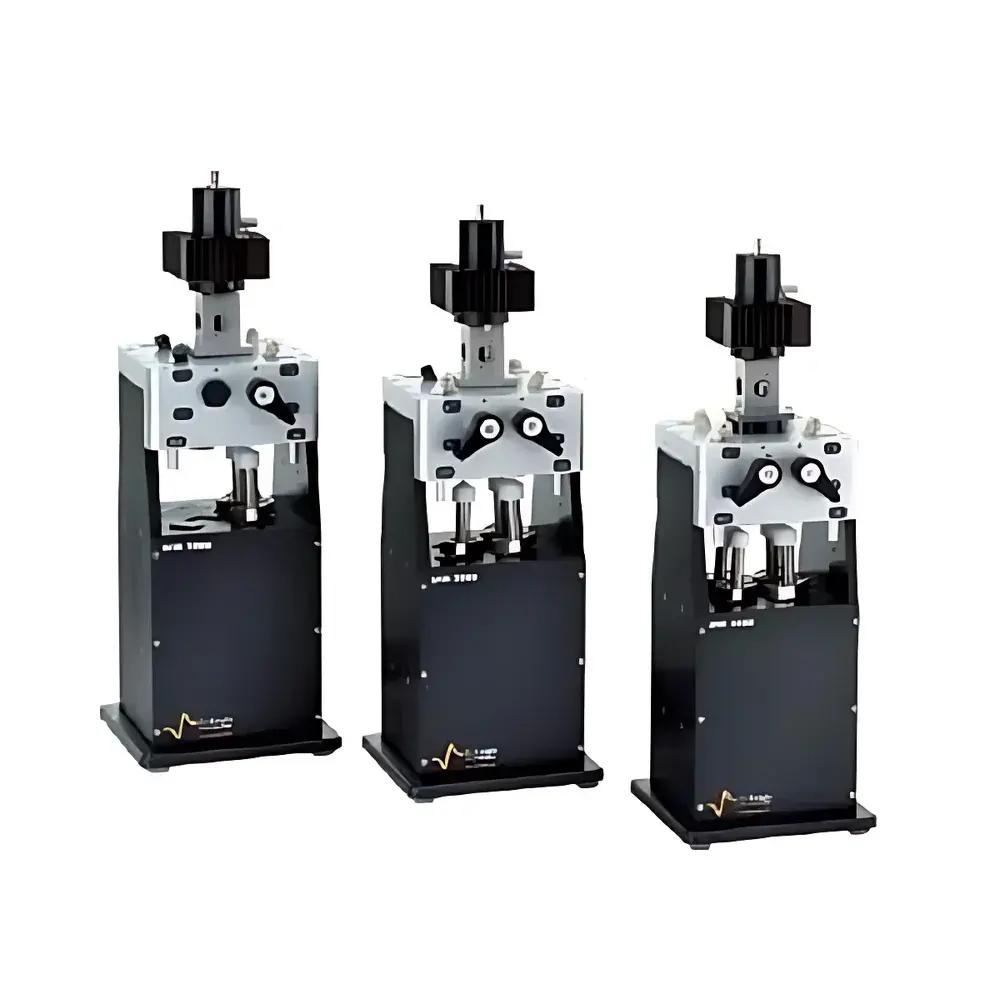
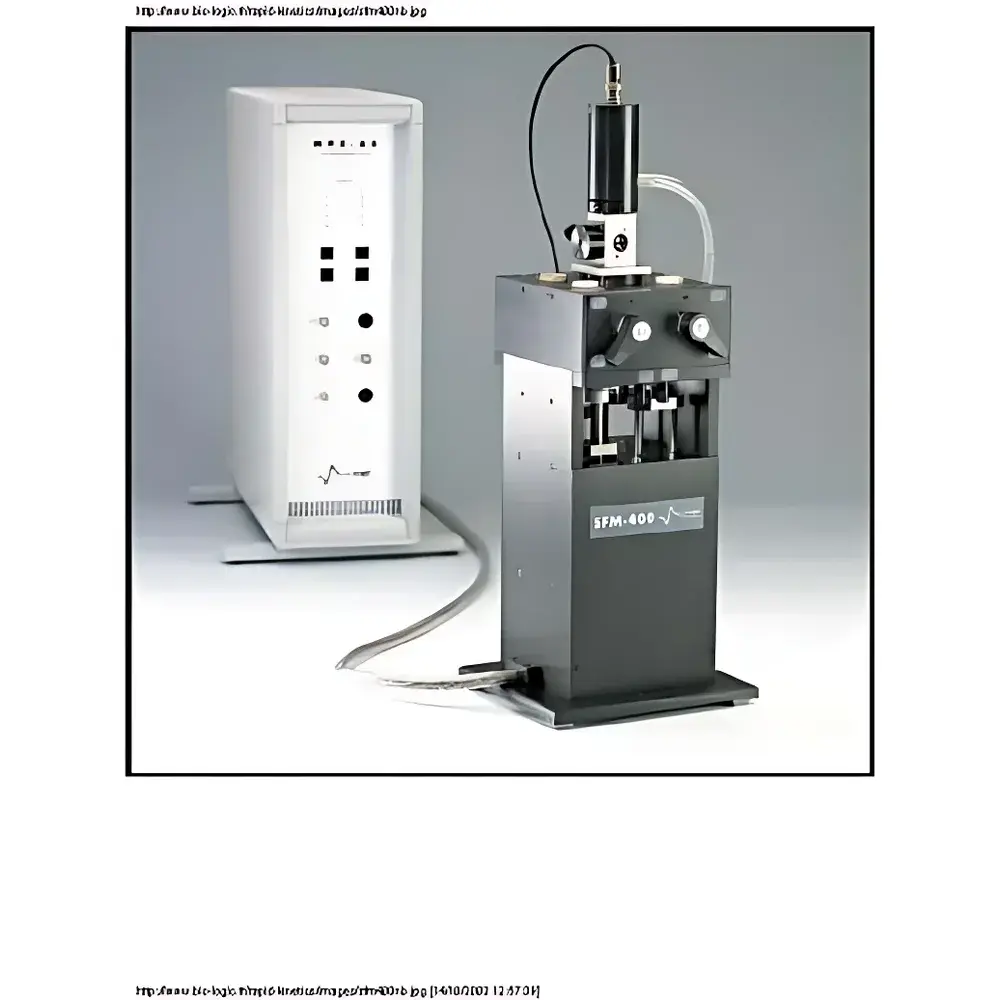
Bio-Logic SFM-3000 Stopped-Flow Instrument
| Brand | Bio-Logic |
|---|---|
| Origin | France |
| Model | SFM-3000 |
| Number of Syringes | 3 |
| Drive Mechanism | Stepper Motor per Syringe |
| Minimum Dead Time | 0.25 ms (microcell) / 0.6 ms (FC-08 cell) |
| Flow Rate Range | 0.01–10 mL/s |
| Mixing Ratio Range | 1:1 to 1:100 (continuously adjustable) |
| Temperature Control | Jacketed Cell with External Circulator |
Overview
The Bio-Logic SFM-3000 Stopped-Flow Instrument is a high-precision, computer-controlled rapid kinetic measurement system engineered for real-time observation of fast biochemical and chemical reactions occurring on the millisecond to second timescale. Operating on the classical stopped-flow principle—where two or more reactant solutions are rapidly mixed under laminar flow conditions and the reaction progress is monitored immediately after mixing—the SFM-3000 delivers exceptional temporal resolution and reproducibility. Its core architecture integrates three independently driven syringes, each actuated by a dedicated stepper motor, enabling precise volumetric delivery and programmable flow profiles. The instrument is designed for seamless coupling with external detection modules including UV-Vis spectrophotometers, fluorescence spectrometers, circular dichroism (CD) systems, and rapid-scan FTIR accessories—making it a modular platform for time-resolved spectroscopic analysis in academic, pharmaceutical, and industrial research laboratories.
Key Features
- Triple-syringe configuration with individual stepper-motor actuation ensures independent control of reagent volumes, flow rates, and injection timing—critical for multi-step mixing protocols and sequential dilution experiments.
- Ultra-low dead time performance: as low as 0.25 ms using the micro-volume observation cell (e.g., 1.2 µL pathlength), and 0.6 ms with the standard FC-08 flow cell—enabling reliable detection of early reaction intermediates in protein folding and enzyme catalysis.
- Continuously adjustable mixing ratios from 1:1 to 1:100 across all channels, achieved via synchronized syringe displacement control—eliminating mechanical valves and minimizing carryover or dispersion artifacts.
- Jacketed observation cell compatible with external temperature-controlled circulators (e.g., Julabo or Huber units), supporting kinetic measurements from 4 °C to 80 °C with ±0.1 °C stability—essential for thermodynamic profiling and Arrhenius analysis.
- Full software-driven operation via Bio-Kine acquisition suite, supporting automated experiment sequencing, trigger synchronization with detector acquisition gates, and real-time data preview during mixing.
Sample Compatibility & Compliance
The SFM-3000 accommodates a broad range of sample types—including purified proteins, nucleic acids, small-molecule ligands, membrane vesicles, and synthetic polymers—without requiring derivatization or immobilization. Its low-volume flow path minimizes sample consumption (typically 20–200 µL per experiment), supporting precious or low-yield biological preparations. The fluidic pathway is constructed from chemically inert materials (e.g., PEEK, fused silica, and stainless steel) compatible with aqueous buffers, organic co-solvents (e.g., glycerol, DMSO ≤10%), and mild detergents. The system complies with ISO/IEC 17025 requirements for method validation in contract research organizations and supports audit-ready data integrity through timestamped metadata embedding and electronic signature-capable workflows—fully aligned with GLP and FDA 21 CFR Part 11 principles when deployed with validated software configurations.
Software & Data Management
Control and data acquisition are managed through Bio-Kine v4.x, a native Windows application offering intuitive experiment design, real-time waveform visualization, and batch processing capabilities. The software provides direct integration with common spectroscopic detectors via TTL, analog, or USB interfaces, allowing precise synchronization between mixing initiation and spectral acquisition triggers. All raw datasets include embedded metadata: syringe positions, flow rates, mixing ratios, temperature setpoints, and detector integration times. Export formats include ASCII (.txt), CSV, and native .bkd binary files—ensuring compatibility with third-party analysis tools such as OriginLab, MATLAB, and KinTek Explorer for global fitting of kinetic models (e.g., sequential, parallel, or conformational selection mechanisms). Audit trails record user actions, parameter changes, and calibration events—supporting traceability in regulated environments.
Applications
- Protein folding/unfolding kinetics, including burst-phase intermediate detection and chevron plot construction.
- Pre-steady-state enzyme kinetics: determination of kcat, KM, and transient acyl-enzyme accumulation.
- Substrate binding and release rates for G-protein-coupled receptors (GPCRs), ion channels, and transporters reconstituted in nanodiscs or liposomes.
- Conformational dynamics of nucleic acid structures (e.g., G-quadruplex formation, riboswitch switching).
- Second messenger activation cascades, including Ca2+-induced calmodulin conformational transitions and cAMP-dependent kinase phosphorylation onset.
- Rapid redox reactions, photo-induced electron transfer, and proton-coupled electron transfer (PCET) processes in metalloprotein mimics.
FAQ
What is the minimum observable time window for kinetic traces acquired with the SFM-3000?
The instrument achieves an effective dead time of 0.25 ms using the microcell configuration, permitting resolution of reaction phases beginning within the first sub-millisecond after mixing.
Can the SFM-3000 be interfaced with a custom-built detector not listed in the standard compatibility matrix?
Yes—provided the detector offers TTL triggering input/output or analog voltage output, hardware-level synchronization can be implemented via the optional digital I/O expansion module (SFM-DIO-16).
Is cleaning and maintenance of the fluidic path operator-accessible without service engineer support?
All syringes, mixing tees, and observation cells are user-replaceable; detailed decontamination protocols for proteinaceous or detergent-laden samples are included in the technical manual.
Does the system support automated titration or serial dilution protocols?
Yes—via Bio-Kine’s “Sequence Mode”, users can define multi-injection experiments with variable volume increments, dwell times, and mixing ratios across up to 99 discrete steps.
Are calibration certificates and IQ/OQ documentation available for GMP-regulated installations?
Bio-Logic provides factory-issued calibration reports traceable to NIST standards; IQ/OQ templates and validation support packages are available upon request for qualified customers.




