
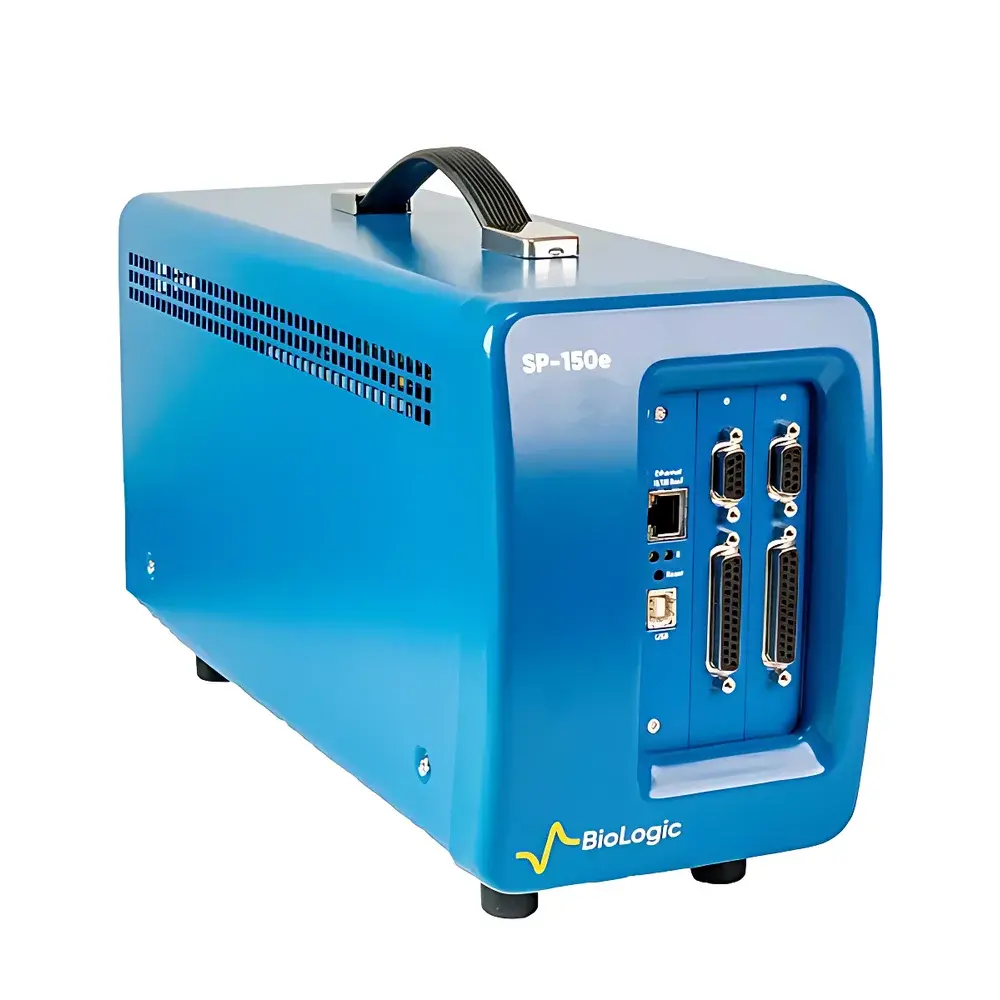
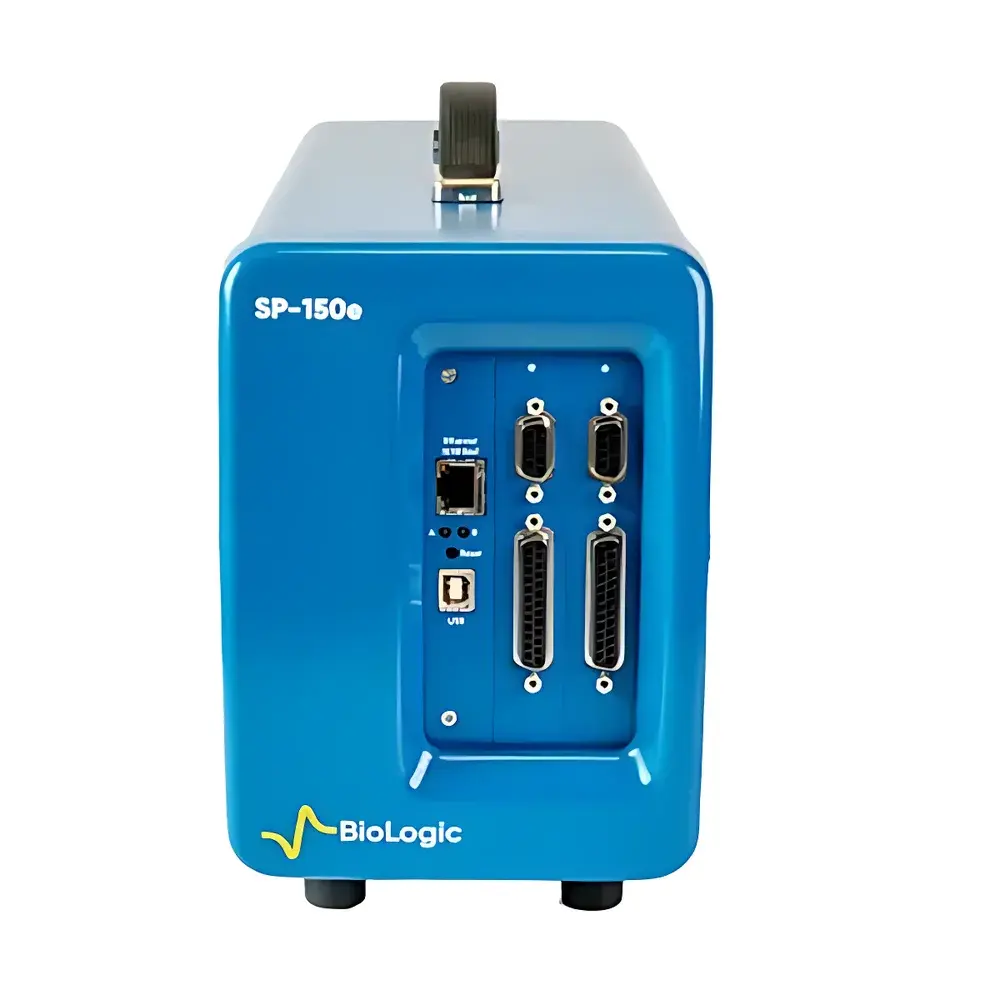
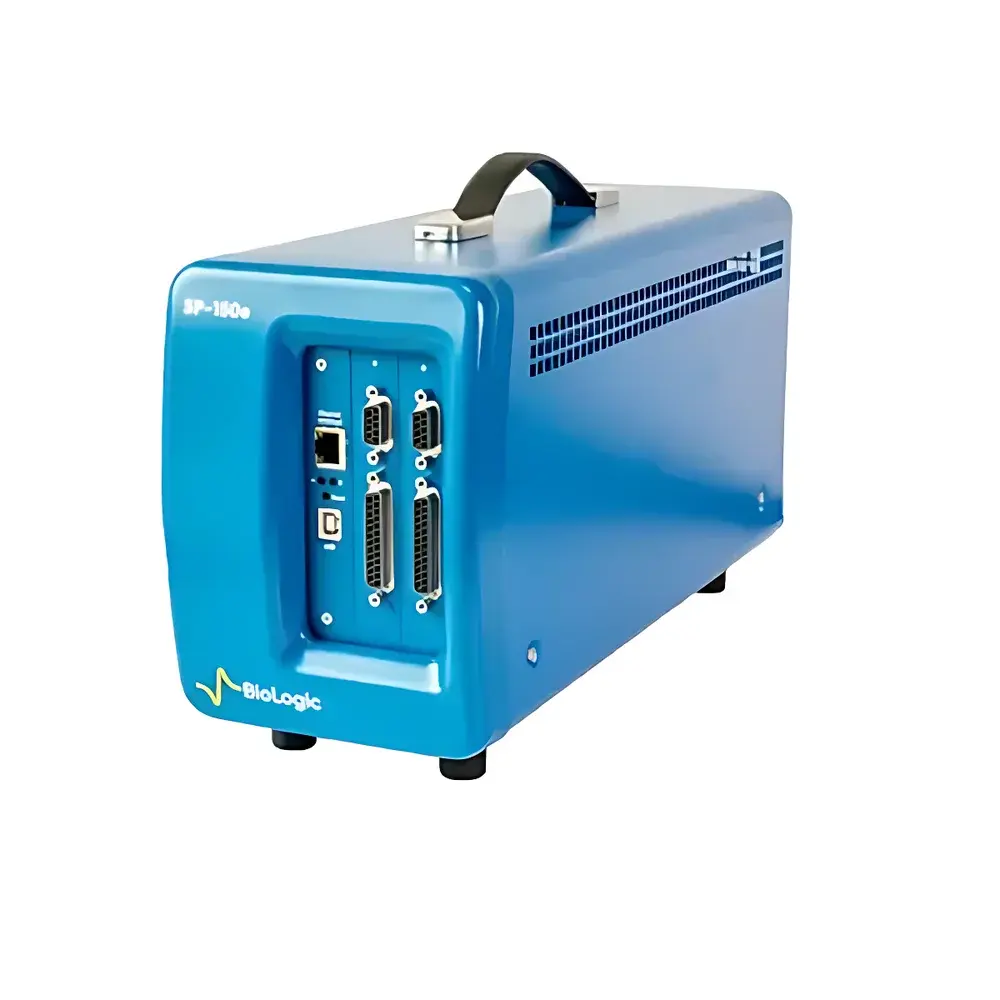
Bio-Logic SP-150e Dual-Channel Research-Grade Electrochemical Workstation
| Brand | Bio-Logic |
|---|---|
| Origin | France |
| Model | SP-150e |
| Instrument Type | Portable Electrochemical Workstation |
| Number of Channels | Dual-Channel |
| Current Range | ±1 A |
| Current Resolution | 760 pA (optional 76 fA) |
| Current Accuracy | ±20 nA on 10 μA range |
| Potential Accuracy | <5 mV on ±2.5 V range |
| Potentiostatic Range | ±10 V |
| EIS Frequency Range | 10 μHz to 1 MHz |
| Voltage Resolution | 300 μV (dynamically adjustable down to 5 μV) |
| Data Acquisition Rate | 200,000 points/s |
| Compliance | CE, RoHS, IEC 61010-1 |
Overview
The Bio-Logic SP-150e Dual-Channel Research-Grade Electrochemical Workstation is a high-precision, modular potentiostat/galvanostat engineered for advanced electrochemical characterization in academic laboratories, industrial R&D centers, and quality control environments. Operating on the principle of controlled potential/current perturbation with real-time current/voltage response acquisition, the SP-150e supports fundamental techniques including cyclic voltammetry (CV), chronoamperometry (CA), chronopotentiometry (CP), linear sweep voltammetry (LSV), and galvanic corrosion testing. Its dual-channel architecture enables simultaneous independent or correlated measurements—such as reference electrode monitoring, multi-electrode array interrogation, or parallel cell evaluation—without hardware reconfiguration. Designed and manufactured in Grenoble, France, the system integrates low-noise analog front-end electronics, high-speed digital signal processing, and adaptive feedback control to ensure stability across wide dynamic ranges—from sub-nanoampere currents to ±1 A full-scale output.
Key Features
- Dual independent potentiostat/galvanostat channels with fully synchronized timing and trigger capability
- Ultra-low current measurement capability: standard 10 μA range with ±20 nA accuracy; optional 1 nA extension mode with 76 fA resolution
- Broad EIS coverage from 10 μHz to 1 MHz, supporting both single-sine and multi-sine (MSP) impedance protocols
- Programmable voltage resolution down to 5 μV (typical 300 μV), enabling high-fidelity detection of subtle interfacial processes
- Real-time data acquisition at up to 200,000 points per second, preserving transient kinetics without aliasing
- Modular expansion support: external current amplifiers (2 A, 5 A, 10 A, 20 A, and 80 A) and auxiliary analog/digital I/O modules for custom experimental integration
- Robust thermal management and electromagnetic shielding compliant with IEC 61010-1 safety standards for laboratory use
Sample Compatibility & Compliance
The SP-150e interfaces seamlessly with standard three-electrode electrochemical cells (working, counter, reference), rotating disk electrodes (RDE), rotating ring-disk electrodes (RRDE), microelectrodes, and thin-film sensors. It supports aqueous and non-aqueous electrolytes, high-impedance coatings, battery electrode slurries, and conductive polymer films. All firmware and hardware designs conform to CE marking requirements, RoHS Directive 2011/65/EU, and IEC 61010-1 for electrical safety in measurement and laboratory equipment. While not inherently FDA-certified, the platform’s audit-trail-capable software architecture (via EC-Lab®) supports configuration for GLP/GMP-aligned workflows—including user access control, electronic signatures, and change history logging—as required for regulated battery development or pharmaceutical electroanalysis.
Software & Data Management
Controlled exclusively by Bio-Logic’s EC-Lab® v12.x software suite (Windows-based), the SP-150e provides intuitive experiment setup, real-time visualization, and post-acquisition analysis tools. EC-Lab includes built-in equivalent circuit modeling (ZView-compatible), Tafel analysis, diffusion-controlled current fitting, and automated EIS stability assessment. Raw data is saved in open-format .mpt files (ASCII-readable), ensuring long-term archival integrity and third-party interoperability. The software supports 21 CFR Part 11-compliant configurations when deployed with validated IT infrastructure, including role-based permissions, electronic signatures, and immutable audit trails for all method modifications and result exports.
Applications
- Battery materials research: SEI formation kinetics, Li-ion cathode/anode degradation profiling, solid-state electrolyte interfacial resistance mapping
- Corrosion science: electrochemical noise analysis (ENA), localized corrosion monitoring, coating delamination quantification
- Electrocatalysis: oxygen reduction reaction (ORR) activity benchmarking, hydrogen evolution reaction (HER) overpotential determination, catalyst stability cycling
- Biosensor development: amperometric glucose detection, DNA hybridization impedance sensing, enzyme electrode characterization
- Fuel cell membrane evaluation: proton conductivity, methanol crossover assessment, catalyst layer impedance spectroscopy
- Photoelectrochemistry: transient photocurrent analysis under modulated illumination, charge separation efficiency quantification
FAQ
Is the SP-150e suitable for ultra-low-current measurements such as single-molecule electron transfer studies?
Yes—the instrument supports optional 1 nA extension mode with 76 fA current resolution and active guarding, making it appropriate for high-impedance systems where leakage currents must be minimized.
Can the two channels operate independently during EIS measurements?
No—EIS is performed on one channel at a time; however, the second channel may concurrently run DC techniques (e.g., CV or CP) or monitor a reference electrode potential.
Does the SP-150e include hardware support for temperature-controlled cell holders?
The workstation itself does not integrate temperature control, but its analog I/O ports allow direct interfacing with commercial temperature controllers and sensor modules via standard 0–10 V or 4–20 mA signals.
What is the maximum sampling rate for time-domain techniques like chronoamperometry?
The system achieves 200,000 data points per second in high-speed acquisition mode, with hardware-triggered start/stop and adjustable dead time to prevent saturation during rapid transients.
Is remote operation supported over LAN or USB?
Yes—EC-Lab supports full remote control via TCP/IP over Ethernet, enabling secure off-site experiment initiation, real-time monitoring, and data streaming to centralized lab information management systems (LIMS).





