
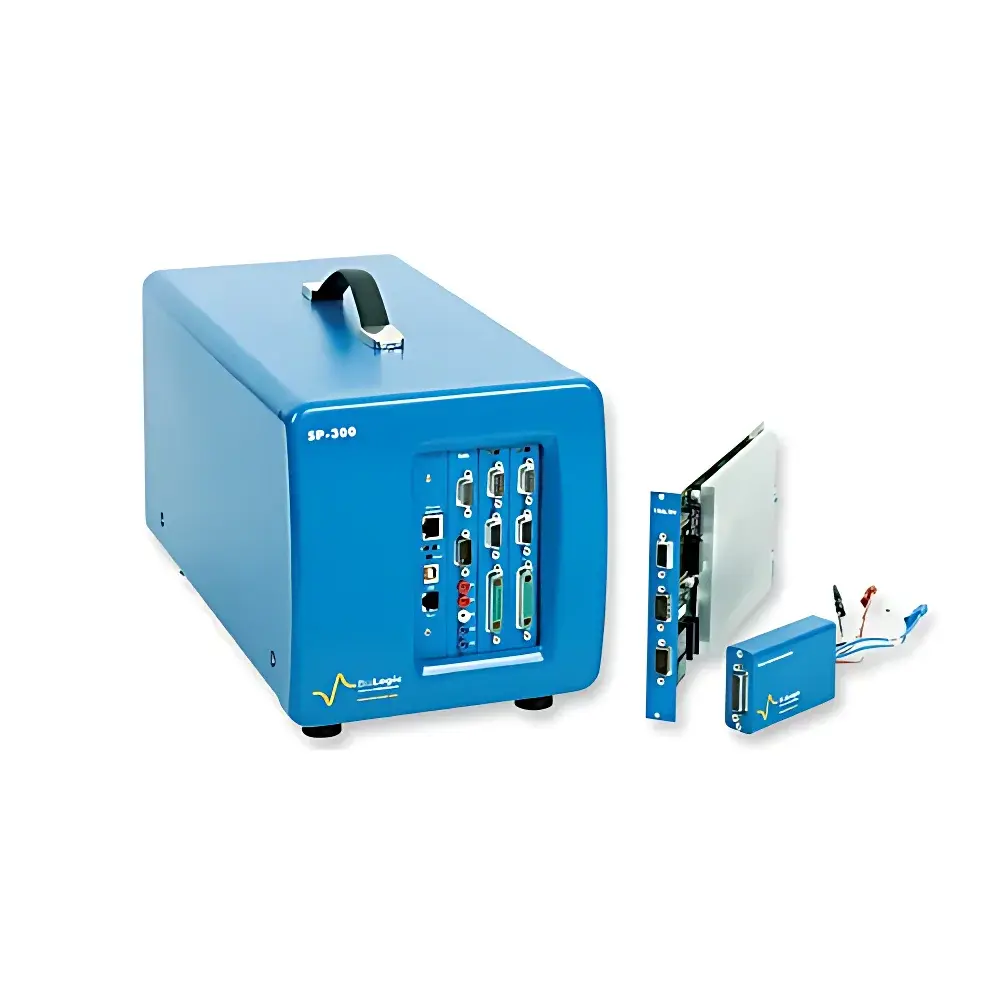
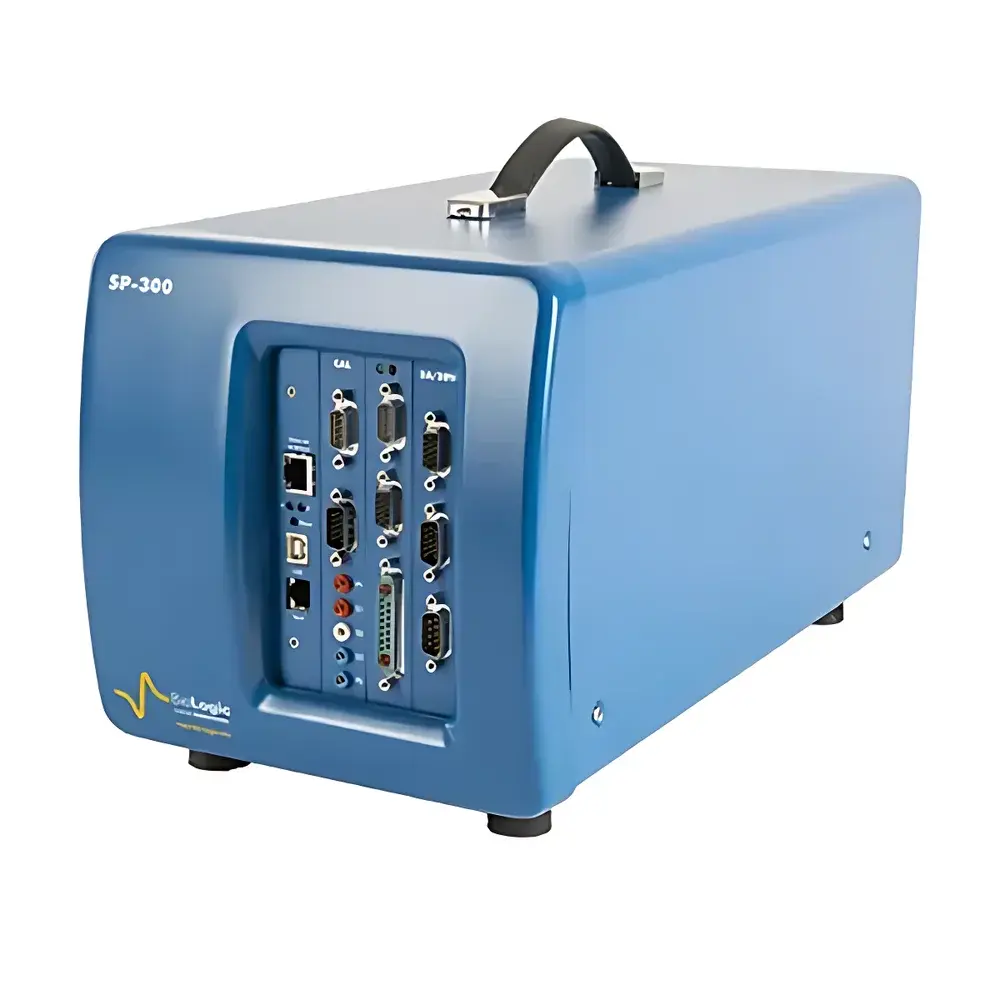
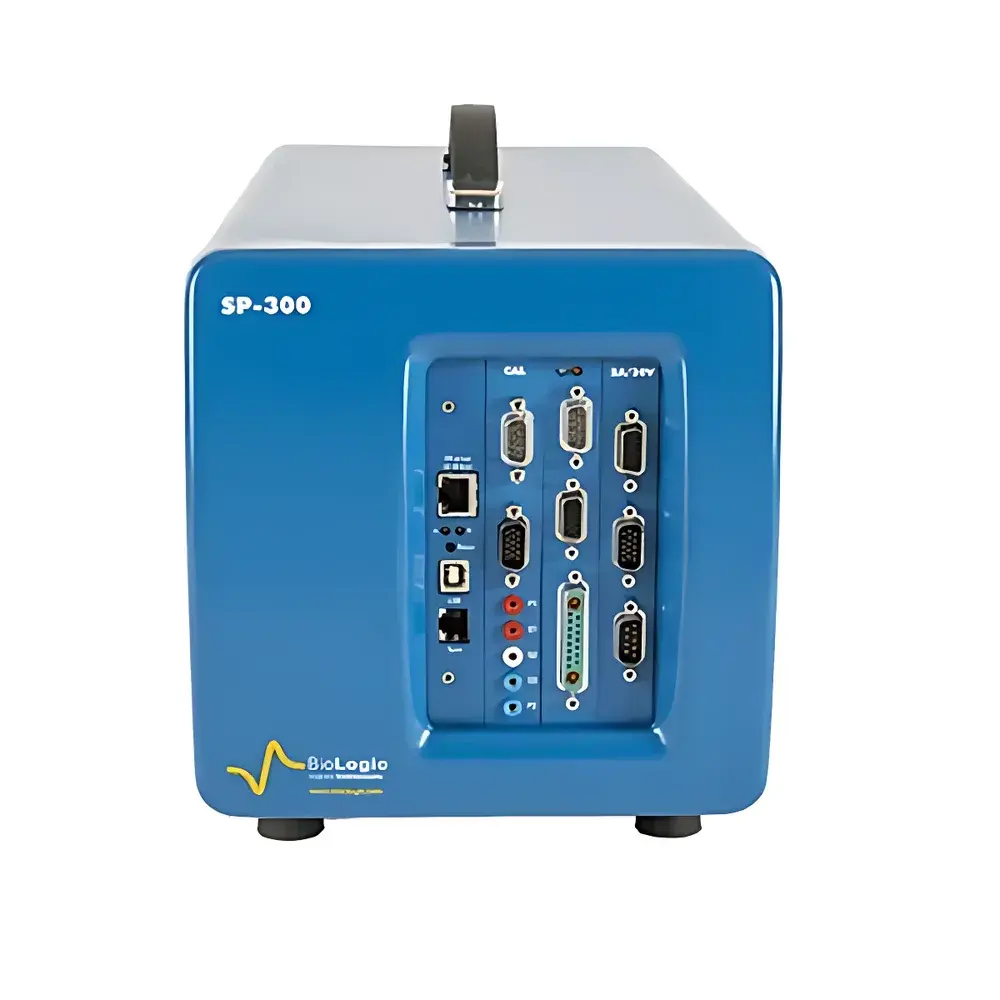
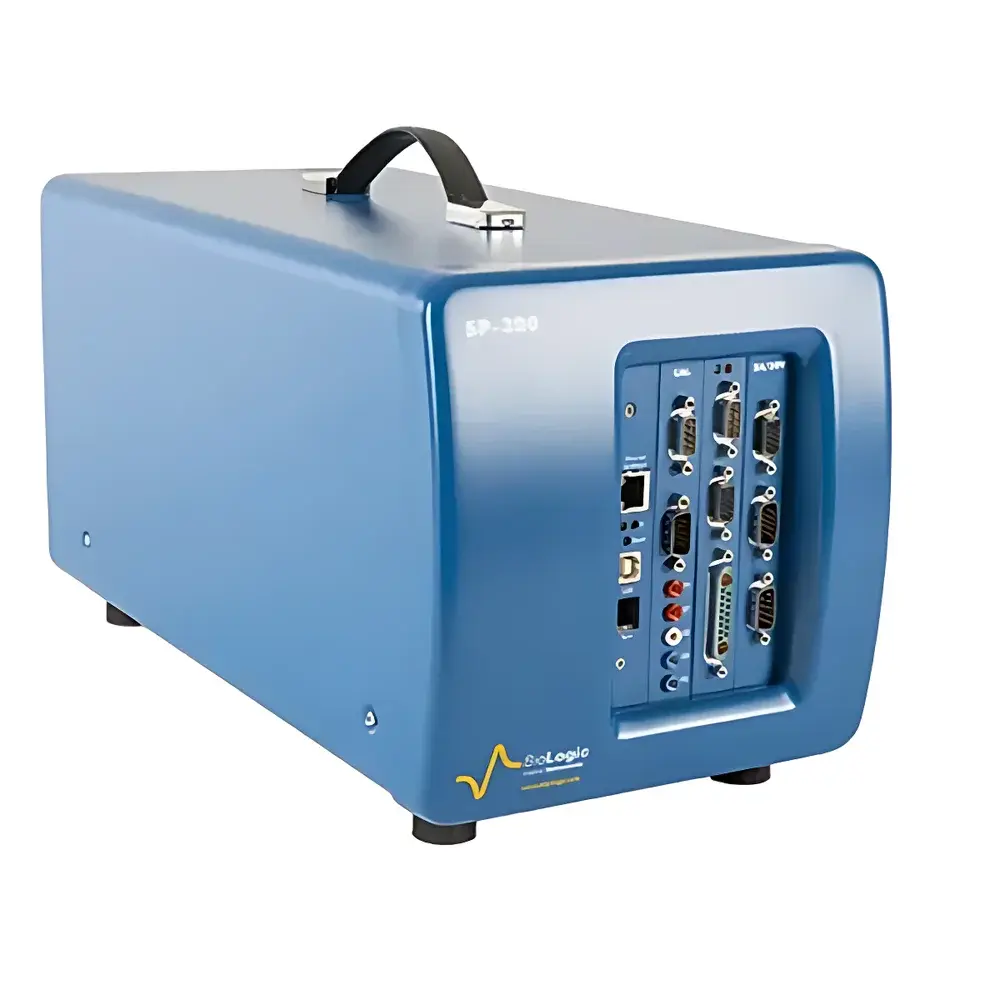
Bio-Logic SP-300 Dual-Channel Electrochemical Workstation
| Brand | Bio-Logic |
|---|---|
| Origin | France |
| Model | SP-300 |
| Channel Count | Dual-channel |
| Current Range | ±500 mA |
| Current Resolution | 76 aA |
| Potential Accuracy | ±1 mV |
| Potentiostatic Range | ±48 V |
| EIS Frequency Range | 10 µHz – 7 MHz |
| Data Acquisition Rate | 1,000,000 pts/s |
| Voltage Resolution | 1 µV (dynamic range adjustable) |
| Optional Modules | ULC (1 pA), High-Current (4 A/14 V), High-Voltage (1 A/48 V) |
Overview
The Bio-Logic SP-300 Dual-Channel Electrochemical Workstation is a research-grade, modular potentiostat/galvanostat engineered for high-fidelity electrochemical characterization across diverse scientific domains. Built upon a dual-core digital signal processing architecture, it implements true galvanostatic and potentiostatic control with real-time feedback compensation, enabling precise current and potential regulation under dynamic load conditions. Its core measurement principle relies on four-quadrant operation with active analog filtering, synchronized 24-bit ADC/DAC conversion, and hardware-accelerated impedance computation — ensuring metrological traceability and minimal phase lag even at the upper limit of its 7 MHz electrochemical impedance spectroscopy (EIS) bandwidth. Designed for laboratories requiring simultaneous multi-parameter interrogation of electrochemical interfaces, the SP-300 supports independent or correlated operation of two fully isolated channels — each capable of full-spectrum EIS, transient techniques, and battery cycling protocols. Its compliance with IEC 61000-4 electromagnetic immunity standards and CE marking confirms suitability for integration into GLP- and GMP-aligned R&D environments.
Key Features
- Dual-channel architecture with electrically isolated working electrode circuits, enabling concurrent but independent experiments (e.g., reference electrode monitoring + sample testing)
- Integrated impedance analyzer covering 10 µHz to 7 MHz with <1° phase error at 1 MHz and <0.1% magnitude accuracy across full frequency sweep
- Programmable bandwidth selection (9 discrete settings) for optimized noise suppression in battery impedance mapping and corrosion studies
- Ultra-low current (ULC) option with 1 pA resolution and sub-femtoampere baseline stability, certified per ASTM E2913 for microelectrode and biosensor applications
- Expandable voltage/current capability: standard ±10 V / ±500 mA; optional modules extend to ±48 V / 1 A or ±14 V / 4 A
- Onboard self-calibration routine traceable to NIST-certified references, executed without external hardware
- Ground-referenced and floating-mode operation support, including dedicated “earthed” configuration for grounded cell assemblies
Sample Compatibility & Compliance
The SP-300 accommodates standard three-electrode cells (working, counter, reference), rotating disk electrodes (RDE), scanning electrochemical microscopy (SECM) probes, and custom multi-electrode arrays. It supports aqueous, non-aqueous, ionic liquid, and solid-state electrolyte systems — validated per ISO 17025 calibration procedures for reproducibility across temperature ranges from −10 °C to +60 °C. All firmware and EC-Lab® software comply with FDA 21 CFR Part 11 requirements for electronic records and signatures, including full audit trail logging, user role-based access control, and immutable data archiving. Hardware design meets EN 61326-1 for laboratory equipment EMC performance and EN 61010-1 for functional safety in Class I installations.
Software & Data Management
EC-Lab® v12.10 provides a unified interface for method sequencing, real-time visualization, and post-experiment modeling. It includes over 50 preconfigured techniques — from classical cyclic voltammetry and chronoamperometry to advanced protocols such as Galvanostatic Intermittent Titration Technique (GITT), Potentiostatic Intermittent Titration Technique (PITT), and Mott-Schottky analysis. EIS data are processed using Levenberg-Marquardt and Simplex nonlinear least-squares fitting algorithms against equivalent circuit models; users may import/export circuit definitions in SPICE-compatible format. Raw data are stored in HDF5 format with embedded metadata (timestamp, instrument ID, calibration history, environmental conditions), ensuring FAIR (Findable, Accessible, Interoperable, Reusable) data principles. The software supports automated report generation compliant with ISO/IEC 17025 documentation requirements.
Applications
The SP-300 serves as a primary characterization tool in academic and industrial electrochemistry laboratories. Its 7 MHz EIS capability enables dielectric relaxation analysis of solid-electrolyte interphases (SEI) in Li-ion batteries and charge-transfer kinetics quantification in dye-sensitized solar cells. In corrosion science, it executes ASTM G5/G102-compliant polarization resistance measurements and electrochemical noise analysis (ENA) under potentiodynamic or galvanostatic perturbation. For electrocatalysis research, the dual-channel mode allows simultaneous evaluation of catalyst activity and stability under identical electrolyte conditions. Additional use cases include redox polymer characterization (via square-wave voltammetry), bioelectrochemical sensor development (with pA-level amperometric detection), and in situ monitoring of electrodeposition processes in additive manufacturing workflows.
FAQ
Is the SP-300 compatible with third-party electrochemical cells and accessories?
Yes — all analog I/O ports conform to IEEE 488.2 and SCPI command sets, enabling seamless integration with commercial RDE controllers, temperature chambers, and gas-dosing modules.
Can both channels operate synchronously during EIS acquisition?
Yes — hardware-triggered synchronization ensures phase-coherent dual-channel EIS, critical for differential measurements such as reference electrode drift correction.
Does the ULC module require recalibration after installation?
No — the ULC module features auto-zeroing circuitry and performs internal offset compensation before each experiment, eliminating manual recalibration steps.
How is data integrity ensured during long-term battery cycling tests?
EC-Lab® implements cyclic redundancy check (CRC) on every acquired data packet and writes checksum-verified binary logs to SSD storage, preventing silent corruption over multi-week experiments.
Is remote operation supported for regulated environments?
Yes — the workstation supports TLS 1.3-encrypted remote desktop sessions and RESTful API access via authenticated tokens, meeting cybersecurity requirements for controlled-access laboratories.





