
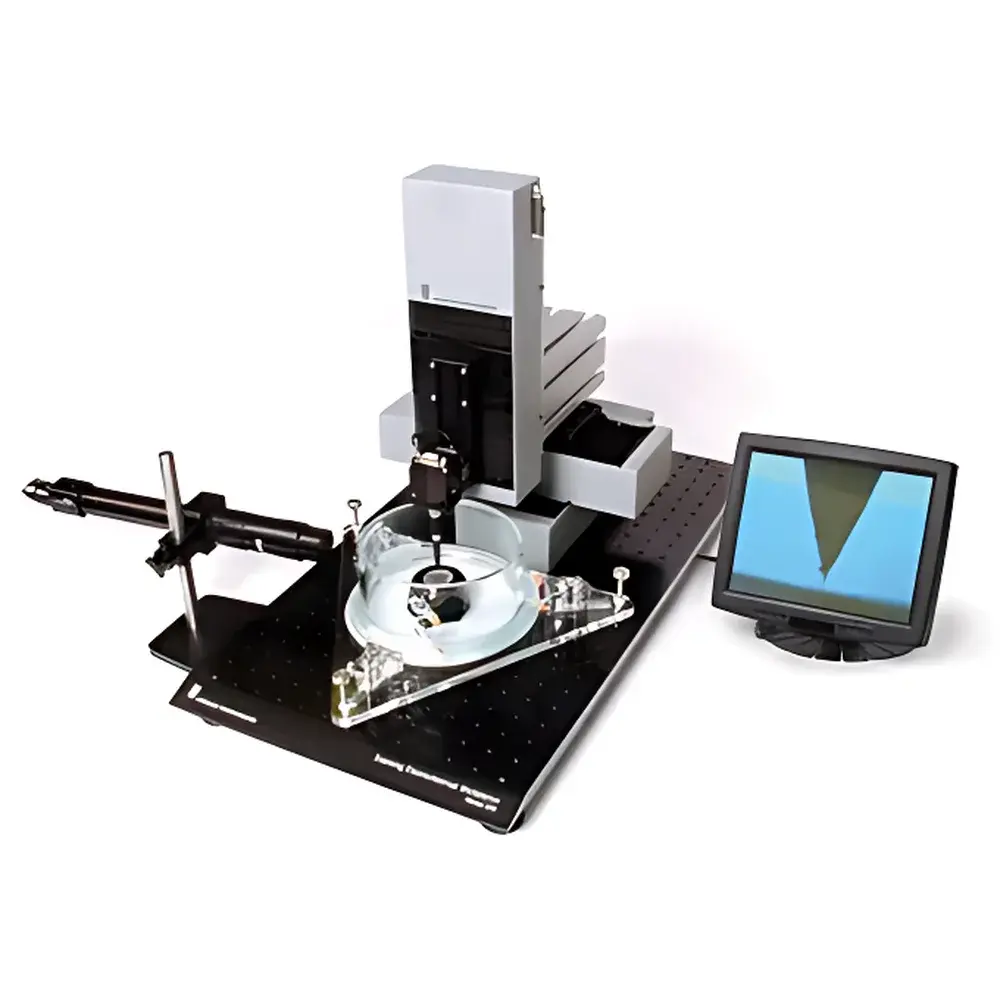
Bio-Logic Uniscan M370 Micro-Region Scanning Electrochemical Workstation (Discontinued; Upgraded to M470)
| Brand | Bio-Logic |
|---|---|
| Origin | France |
| Manufacturer Status | Authorized Distributor |
| Origin Category | Imported |
| Model | Uniscan M370 |
| Instrument Type | Electrochemical Workstation |
| Current Range | ±1 A |
| Current Accuracy | ±0.1% of reading |
| Potential Accuracy | ±10 mV |
| Potentiostatic Range | ±20 V |
| AC Impedance Frequency Range | 10 µHz – 1 MHz |
Overview
The Bio-Logic Uniscan M370 Micro-Region Scanning Electrochemical Workstation is a discontinued, high-precision modular platform engineered for spatially resolved electrochemical characterization at the microscale. Designed around a closed-loop, nanometer-resolution XYZ positioning system and synchronized with real-time data acquisition, the M370 integrates six complementary scanning probe electrochemical techniques into a single, unified architecture. Its core principle relies on localized perturbation and measurement—either through controlled current/potential application at microelectrodes or non-contact capacitive/vibrational sensing—enabling quantitative mapping of electrochemical activity, surface potential, local impedance, interfacial reactivity, and topography without physical contact or sample damage. Though superseded by the M470 platform, the M370 remains a benchmark reference in academic and industrial corrosion science, battery interface research, and functional materials development due to its rigorous mechanical stability, low-noise analog front-end design, and deterministic scan control.
Key Features
- Modular architecture supporting six integrated scanning electrochemical modalities: SECM, SVET, SKP, LEIS, SDS, and OSP
- Closed-loop XYZ nanopositioning stage with sub-100 nm repeatability and <1 µm height resolution in non-contact mode
- Ultra-low-noise potentiostat/galvanostat with ±1 A current range, ±0.1% current accuracy, and ±10 mV potential accuracy
- Wide-frequency electrochemical impedance spectroscopy (EIS) capability spanning 10 µHz to 1 MHz
- Real-time synchronization between probe motion, stimulus waveform generation, and multi-channel data acquisition
- Ergonomic sample chamber access with interchangeable cell configurations (Environmental TriCell™, μTriCell™, Shallow μTriCell™)
- Integrated long-working-distance optical video microscope (VCAM2) for precise probe alignment and in situ visual feedback
Sample Compatibility & Compliance
The M370 accommodates conductive, semiconductive, and insulating substrates—including coated metals, polymer electrolytes, biological tissues, thin-film photovoltaics, and microfabricated sensor arrays—without requiring metallization or vacuum processing. Its non-contact techniques (SKP, OSP, SVET) operate under ambient, humid, or controlled-gas environments, enabling measurements incompatible with conventional wet-cell electrochemistry. The system supports compliance with ISO 16773 (corrosion testing), ASTM G102 (electrochemical impedance analysis), and ASTM G59 (potentiodynamic polarization), and its data acquisition framework meets GLP documentation requirements when paired with timestamped, audit-trail-enabled software logging. While not certified for FDA 21 CFR Part 11 out-of-the-box, raw data export formats (ASCII, HDF5) are fully compatible with validated third-party LIMS and QA/QC workflows.
Software & Data Management
Control and analysis are performed via Bio-Logic’s EC-Lab® software suite, which provides dedicated modules for each scanning technique (e.g., SECM-Lab, SKP-Lab, LEIS-Lab). All modules support scripting (Python API), batch processing, and automated parameter sweeps across user-defined grid maps. Raw datasets include position-stamped current/potential/phase/time traces, with post-processing tools for deconvolution, drift correction, topographic normalization, and 3D surface rendering using 3DlsoPlot™. Data files are structured with embedded metadata (instrument configuration, calibration history, environmental conditions), ensuring traceability per ISO/IEC 17025 guidelines. Export options include CSV, MATLAB (.mat), and standardized electrochemical file formats (MPT, TXT) suitable for cross-platform interoperability.
Applications
- Corrosion Science: Quantitative mapping of anodic/cathodic sites, coating delamination kinetics, galvanic coupling at microstructural interfaces, and inhibitor efficiency at localized defects
- Battery Research: In situ probing of SEI formation heterogeneity, Li-ion flux distribution across composite electrodes, and interfacial degradation in solid-state electrolytes
- Biointerfaces: Real-time monitoring of metabolic activity in adherent cells, redox signaling at enzyme-immobilized surfaces, and ion-selective membrane transport
- Functional Materials: Work function mapping of organic semiconductors, photo-voltage profiling in perovskite films, and electrocatalytic activity screening of nanostructured catalysts
- Sensors & Microelectronics: Characterization of ISFET surface charge, passivation layer integrity on MEMS devices, and electrochemical crosstalk in multi-electrode arrays
FAQ
Is the Uniscan M370 still supported for service and spare parts?
Yes—Bio-Logic and authorized service partners continue to provide technical support, calibration services, and legacy component supply for M370 systems under extended maintenance agreements.
What distinguishes SKP from conventional Kelvin probe measurements?
The M370 SKP module employs a dynamic capacitance bridge with active nulling feedback, enabling stable operation in high-humidity and gaseous environments where static Kelvin probes fail due to leakage currents.
Can LEIS be performed simultaneously with topography mapping?
Yes—the OSP module acquires height data concurrently with LEIS scans, allowing automatic topographic normalization of local impedance values to eliminate geometric artifacts.
Does the M370 meet electromagnetic compatibility (EMC) standards for laboratory use?
The system complies with EN 61326-1:2013 for laboratory equipment, including immunity to radiated RF fields (up to 3 V/m) and conducted disturbances (0.15–80 MHz), verified during CE certification.
How is data traceability ensured during regulatory audits?
EC-Lab generates immutable acquisition logs with digital signatures, hardware timestamps, and full instrument configuration snapshots—fully aligning with ALCOA+ principles for data integrity in GxP environments.





