
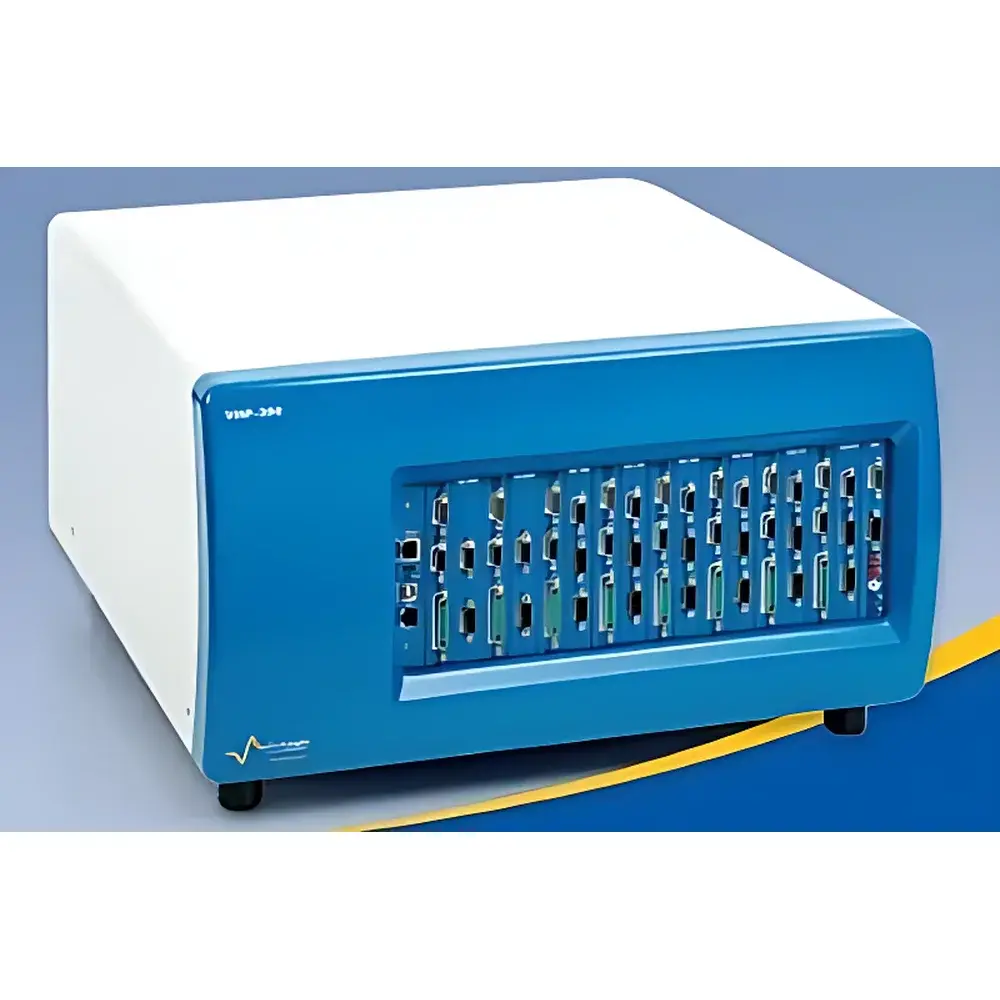
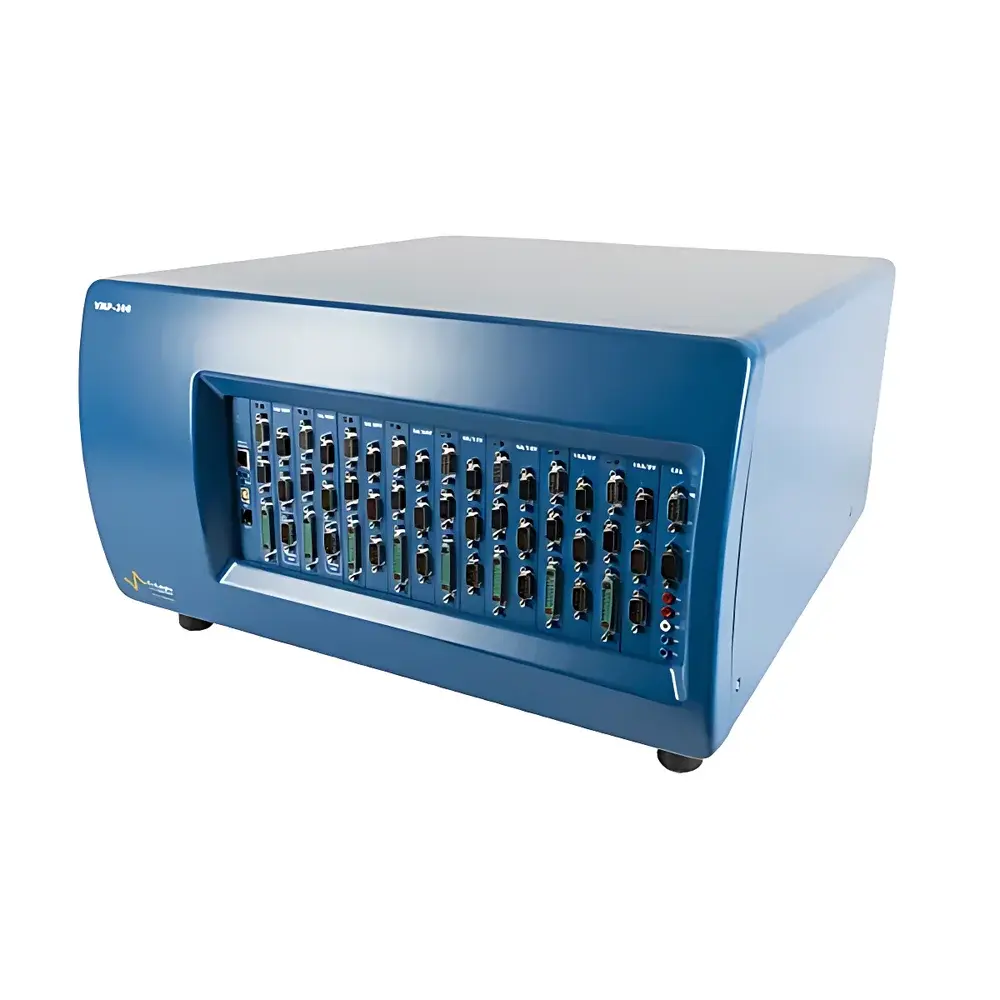
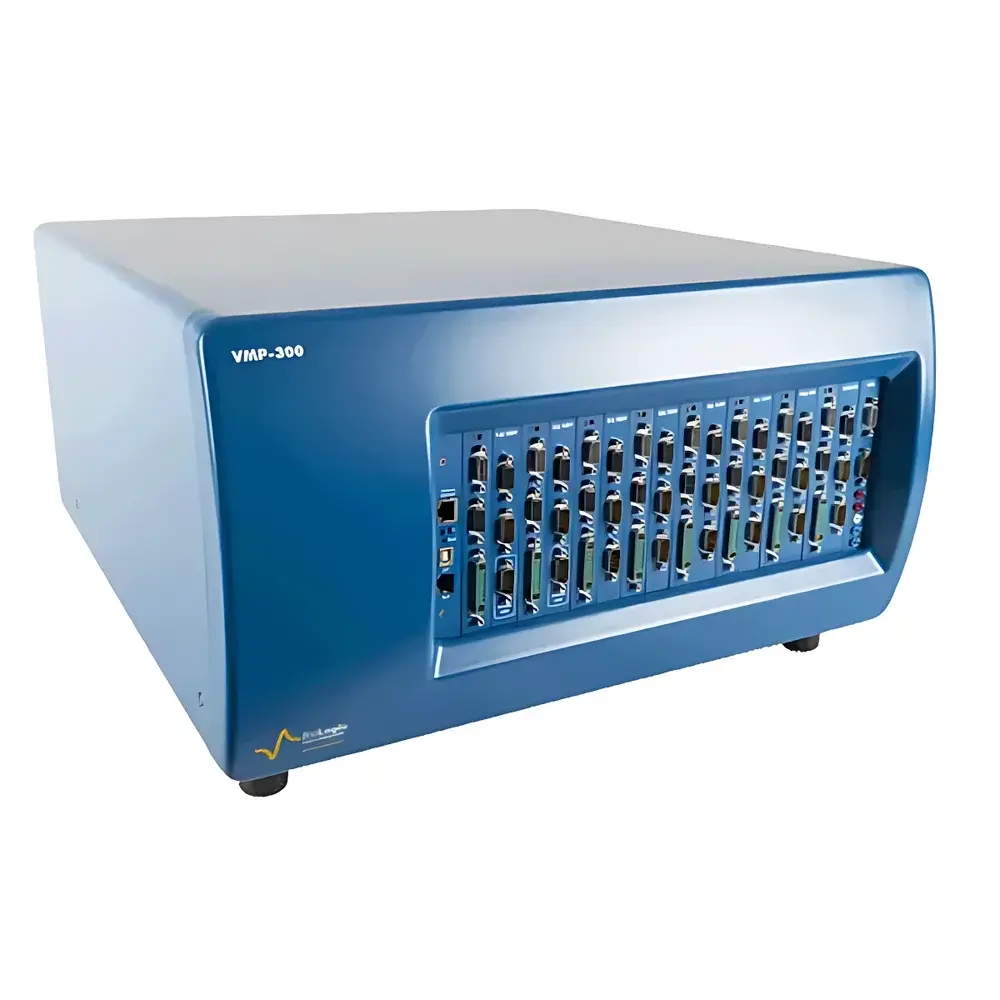
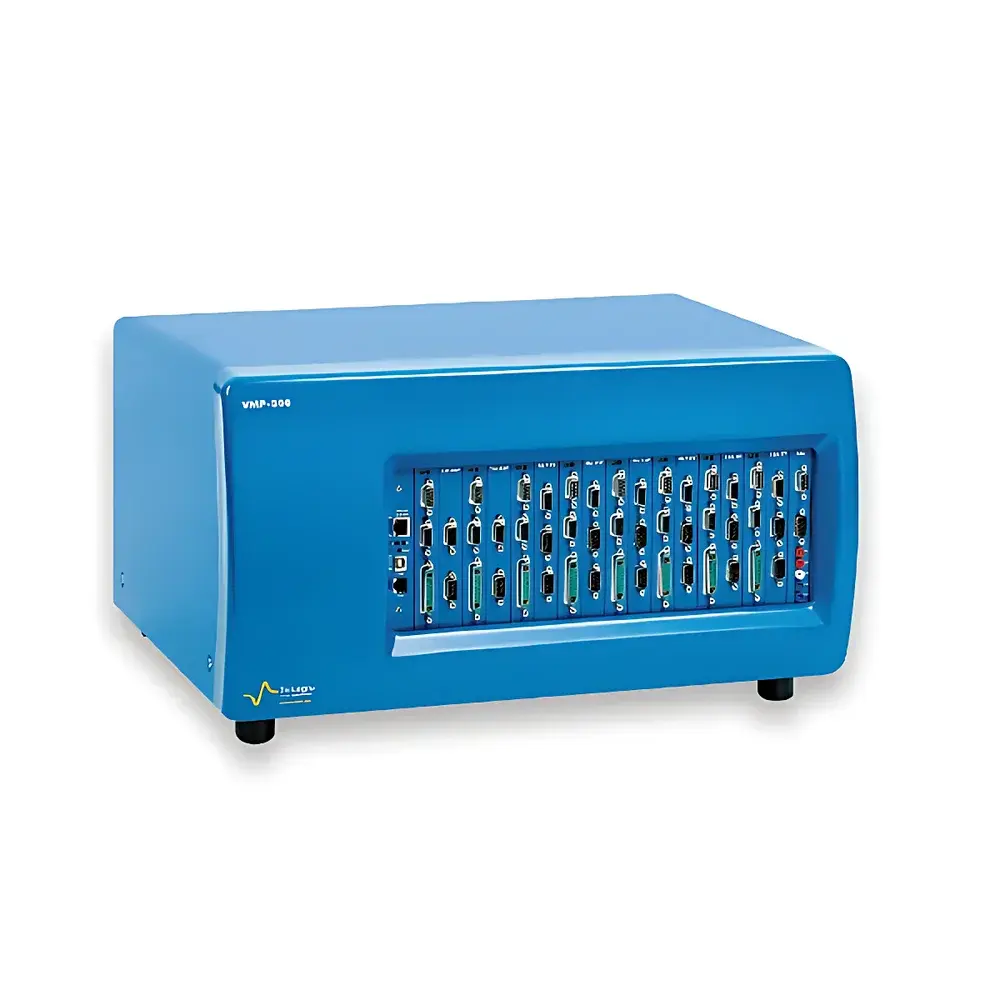
Bio-Logic VMP-300 16-Channel Potentiostat/Galvanostat/FRA Electrochemical Workstation
| Brand | Bio-Logic |
|---|---|
| Origin | France |
| Model | VMP-300 |
| Number of Channels | 16 |
| Current Range | ±500 mA |
| Current Accuracy | ±0.1% |
| Potential Accuracy | ±0.1% |
| Potentiostatic Range | ±10 V |
| EIS Frequency Range | 10 µHz – 7 MHz |
| Voltage Compliance | ±12 V |
| Control Voltage Range | ±10 V |
| Current Resolution (standard board) | 760 fA |
| Floating Mode | Yes |
| Analog Filtering | Built-in |
| Calibration Board | Integrated |
| Control Stability | Digital PID with adaptive tuning |
Overview
The Bio-Logic VMP-300 is a high-performance, modular 16-channel electrochemical workstation engineered for advanced potentiostatic, galvanostatic, and frequency-resolved impedance analysis (FRA) applications. Based on a scalable architecture, the system employs a mainframe chassis with 16 standardized plug-in slots—each supporting independent, fully isolated potentiostat/galvanostat modules or optional booster boards for extended current output. Its design adheres to fundamental electrochemical measurement principles grounded in four-quadrant operation, real-time digital control, and low-noise analog signal conditioning. The VMP-300 is optimized for laboratories requiring parallel experimentation across multiple working electrodes—such as battery electrode screening, corrosion coupon monitoring, sensor array characterization, and high-throughput electrocatalyst evaluation—without cross-talk or shared resource contention. All channels operate autonomously with synchronized timing resolution down to 1 µs, enabling true concurrent acquisition under distinct experimental protocols.
Key Features
- 16 fully independent, electrically isolated channels housed in a single mainframe—no shared ground, no inter-channel interference
- Standard channel specifications: ±10 V compliance voltage, ±500 mA maximum current, ±0.1% accuracy for both potential and current measurements
- Ultra-low current resolution of 760 fA (typical, at 1 nA full scale) enabled by precision low-noise transimpedance amplifiers and adaptive gain switching
- Integrated floating-mode capability for non-grounded cell configurations (e.g., bipolar cells, fuel cell stacks, or reference electrode-free setups)
- Built-in analog anti-aliasing filters with selectable cutoff frequencies (1 Hz–100 kHz), complemented by oversampling and digital post-processing
- On-board calibration board with NIST-traceable references for automated, user-initiated two-point potential and current calibration prior to each experiment
- Digital PID controller with adaptive tuning algorithms for stable potential/current regulation—even during rapid transient responses or high-capacitance interfaces
- Modular expansion support: Booster boards extend individual channel current capacity up to ±2 A; FRA-optimized boards enable seamless EIS acquisition from 10 µHz to 7 MHz
Sample Compatibility & Compliance
The VMP-300 accommodates standard three-electrode electrochemical cells (working, counter, reference), two-electrode configurations, and specialized geometries including microelectrodes, rotating disk electrodes (RDE), and segmented or patterned substrates. Its floating architecture supports measurements in electrolytic systems with elevated common-mode potentials—common in industrial electroplating baths, aqueous zinc-air battery testing, or PEM fuel cell half-cell studies. The instrument complies with IEC 61010-1:2012 for electrical safety and meets electromagnetic compatibility requirements per EN 61326-1:2013. Data integrity features—including audit-trail-enabled experiment logging, timestamped metadata embedding, and user-access-controlled parameter locking—are aligned with GLP and GMP documentation practices. While not FDA-certified as a medical device, its software architecture supports 21 CFR Part 11-compliant electronic signatures when deployed with Bio-Logic’s EC-Lab® Secure Edition and validated IT infrastructure.
Software & Data Management
Control and analysis are performed via Bio-Logic’s EC-Lab® software suite (v12.0+), a Windows-based platform offering intuitive method scripting, real-time visualization, and post-acquisition modeling tools. The software provides native support for all standard electrochemical techniques—including cyclic voltammetry (CV), chronoamperometry (CA), electrochemical impedance spectroscopy (EIS), pulse techniques (DPV, SWV), and galvanostatic intermittent titration (GITT). Multi-channel experiments can be defined globally or per channel, with synchronized start triggers and asynchronous data streaming. Raw data are stored in vendor-neutral .mpt binary format (with ASCII export options) containing full experimental metadata: timestamps, hardware configuration, calibration history, and environmental annotations. EC-Lab® includes built-in equivalent circuit fitting (ZView®-compatible models), diffusion-layer analysis, and customizable reporting templates suitable for peer-reviewed publication or internal QA documentation.
Applications
- Battery R&D: Parallel cycling of Li-ion, Na-ion, or solid-state electrode composites; differential capacity analysis (dQ/dV); SEI growth kinetics via low-frequency EIS
- Corrosion science: Multi-site monitoring of coated steel coupons in simulated marine environments; localized electrochemical impedance mapping (LEIM)
- Electrocatalysis: High-throughput screening of catalyst libraries using identical scan parameters across 16 electrodes
- Sensor development: Real-time amperometric detection limits assessment, interference rejection profiling, and stability validation over >100 h
- Materials electrochemistry: Conductivity mapping of conductive polymers, redox-active MOFs, and 2D material heterostructures
- Fuel cell diagnostics: Individual MEA segment characterization under controlled humidity and temperature gradients
FAQ
Can the VMP-300 perform simultaneous EIS on all 16 channels?
Yes—each channel supports independent EIS acquisition from 10 µHz to 7 MHz. Synchronization is maintained via the master clock; phase alignment across channels is preserved within ±1° up to 100 kHz.
Is external shielding or Faraday cage integration required?
While not mandatory, optimal low-current (<100 pA) or low-frequency (<1 mHz) performance benefits from standard laboratory-grade Faraday enclosures, especially when operating near RF sources or high-power switching equipment.
How is channel-to-channel crosstalk mitigated?
Through galvanic isolation (optocoupled digital lines, transformer-coupled analog paths), separate power domains per slot, and proprietary PCB stack-up design minimizing mutual inductance and capacitive coupling.
Does the system support third-party automation interfaces?
Yes—EC-Lab® exposes COM/ActiveX and TCP/IP APIs for integration with LabVIEW, Python (via pyEClib), MATLAB, and robotic liquid handling platforms compliant with SLIM or ASAM MCD-3 standards.
What maintenance is required for long-term accuracy?
Annual verification using certified reference cells (e.g., KCl/Ag|AgCl) and traceable shunt resistors is recommended; the onboard calibration board enables routine user-level verification without external equipment.





