
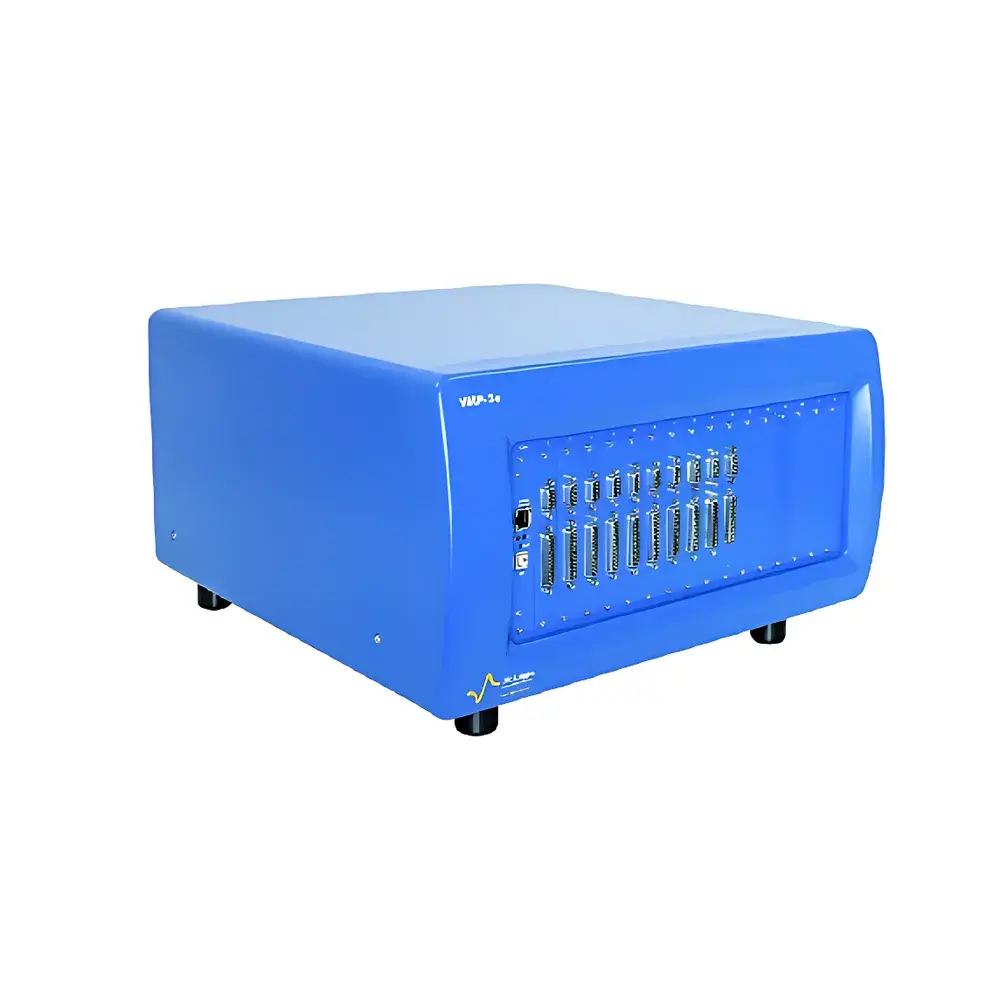
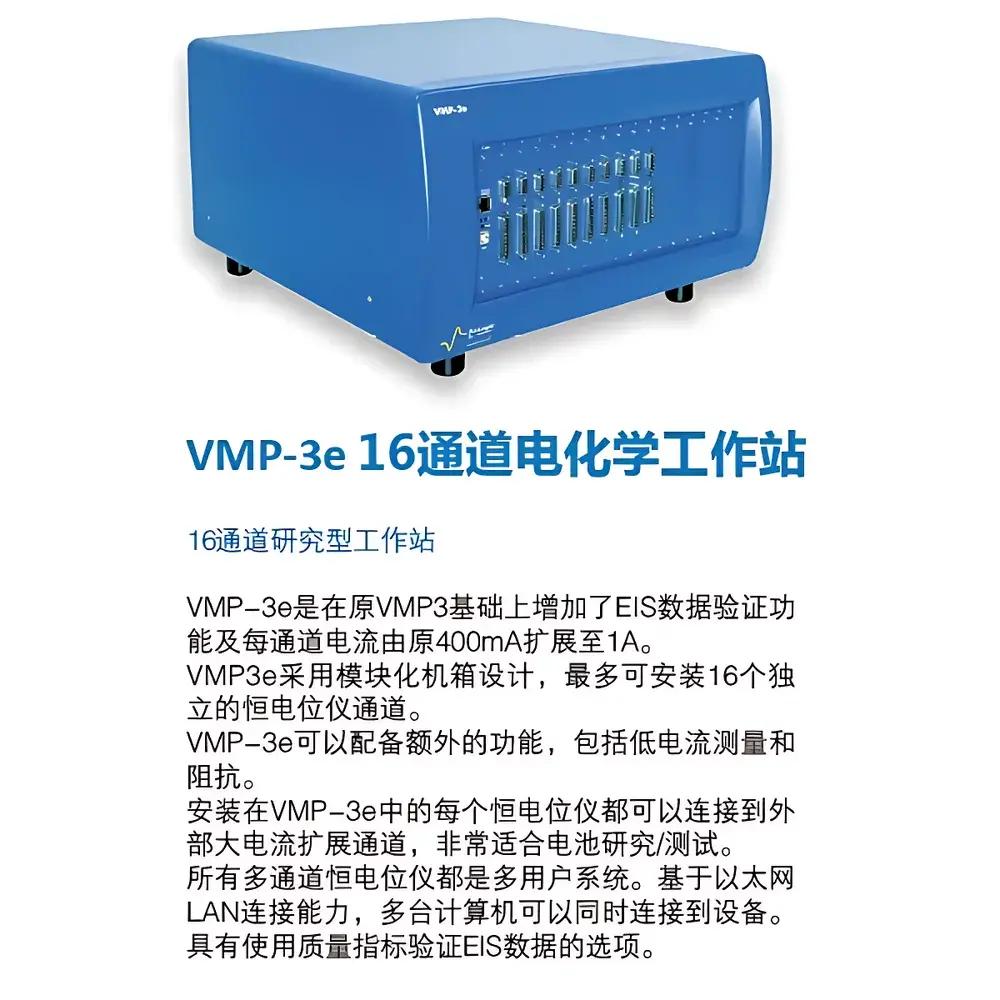
Bio-Logic VMP-3e 16-Channel Potentiostat/Galvanostat/EIS Workstation
| Brand | Bio-Logic |
|---|---|
| Origin | France |
| Model | VMP-3e |
| Channel Count | 16 independent channels |
| Current Range | 76 fA to 100 A (with external amplifiers) |
| Current Accuracy | ±0.1% |
| Potential Range | ±10 V (DC), 0–20 V (galvanostatic mode) |
| Potentiostatic Range | ±20 V |
| EIS Frequency Range | 10 µHz to 1 MHz |
| Data Acquisition Rate | 200,000 points/sec |
| Potential Resolution | 300 µV (dynamic range adjustable down to 5 µV) |
| Switching Time (Potentiostatic ↔ Galvanostatic) | <10 µs |
| Input Impedance | >10^14 Ω |
Overview
The Bio-Logic VMP-3e is a high-performance, modular 16-channel potentiostat/galvanostat/electrochemical impedance spectroscopy (EIS) workstation engineered for precision, scalability, and multi-user laboratory environments. Built on a distributed architecture with Ethernet-based control, the VMP-3e enables simultaneous, fully independent electrochemical experiments across all 16 channels—each operating as a standalone instrument with full potentiostatic, galvanostatic, and EIS capability. Its core design adheres to fundamental electrochemical measurement principles: four-terminal sensing (separate current source, potential monitor, reference, and counter-electrode connections), real-time digital signal processing, and low-noise analog front-end circuitry optimized for both ultra-low-current (sub-picoampere) and high-current (up to 100 A with external amplifiers) applications. The system is widely deployed in academic research labs, industrial R&D centers, and quality assurance facilities where reproducibility, traceability, and compliance with electrochemical testing standards—including ASTM G59, G102, G106, ISO 16773, and IEC 62660—are essential.
Key Features
- 16 fully isolated, software-synchronized channels—each with independent potentiostat/galvanostat/EIS functionality and no shared hardware constraints
- Ultra-wide dynamic current range: 76 fA minimum detectable current (1 nA full-scale with low-current option), scalable to 100 A via optional external current amplifiers (±4 A and ±8 A internal boost modules available)
- High-speed control architecture: <10 µs switching between potentiostatic and galvanostatic modes, enabling true hybrid technique execution (e.g., current-interrupt EIS, pulse-modulated chronoamperometry)
- True dual-EIS capability: simultaneous EIS acquisition on working and auxiliary electrodes within the same cell, supporting advanced three-electrode EIS configurations and zero-resistance ammeter (ZRA) measurements
- Modular expansion support: plug-in modules for low-current measurement (fA–nA), high-current delivery (A–100 A), extended EIS frequency coverage (10 µHz–1 MHz per channel), and Mott-Schottky analysis
- Ethernet-based distributed control: authorized PCs on the same LAN can independently configure, launch, and monitor individual channels without cross-interference or host dependency
Sample Compatibility & Compliance
The VMP-3e accommodates a broad spectrum of electrochemical cells and sample types—from microelectrodes (disk, ring-disk, SECM probes) and solid-state battery coin cells (CR2032, Swagelok-type) to large-format flow cells, corrosion coupons (ASTM G1, G31), fuel cell membrane-electrode assemblies (MEAs), and enzymatic biosensors. Its floating ground architecture supports grounded, isolated, and bipolar cell configurations. All hardware and firmware comply with CE, FCC, and RoHS directives. When operated under EC-Lab® software with audit trail enabled, the system meets GLP and GMP requirements for data integrity (21 CFR Part 11–compliant metadata logging, user access control, electronic signatures, and immutable experiment archives). Calibration protocols are traceable to NIST-certified reference standards.
Software & Data Management
The VMP-3e is operated exclusively via Bio-Logic’s EC-Lab® software suite (Windows-based), which includes two editions: EC-Lab® (full-featured) and EC-Lab® Express (streamlined for routine QA/QC). The platform provides over 50 built-in electrochemical techniques—including linear/cyclic voltammetry, chronoamperometry/chronopotentiometry, pulse voltammetries (DPV, SWV, NPV), corrosion protocols (Tafel, LPR, EIS-Mott-Schottky), and battery-specific methods (GITT, PITT, I-V sweeps, constant-power discharge). Advanced EIS analysis tools include Levenberg-Marquardt and Simplex nonlinear least-squares fitting, Kramers-Kronig validation, and an open-access EIS database (free download) containing >1,200 validated equivalent circuit models. Raw data are stored in standardized .mpt binary format with embedded metadata (timestamp, operator ID, instrument serial, calibration history); export options include CSV, MATLAB (.mat), and Origin-compatible formats. All experiments support sequence programming, conditional branching, and real-time parameter feedback loops.
Applications
The VMP-3e serves as a foundational platform for quantitative electrochemical investigation across disciplines. In energy storage research, it enables parallel screening of electrode materials (Li-ion, Na-ion, solid-state), electrolyte stability windows, SEI formation kinetics, and degradation mapping across multiple cells under identical environmental conditions. For corrosion science, it supports long-term monitoring of polarization resistance, localized pitting initiation, and electrochemical noise analysis in simulated service environments. In electrocatalysis and fuel cell development, its high-bandwidth current control and dual-EIS capability facilitate kinetic deconvolution of oxygen reduction/evolution reactions. Additional use cases include sensor calibration (amperometric, impedimetric), electrosynthesis reaction optimization, environmental redox speciation (e.g., Cr(VI)/Cr(III)), and bioelectrochemical systems (microbial fuel cells, enzymatic electrodes).
FAQ
Can the VMP-3e perform EIS on multiple channels simultaneously?
Yes—each of the 16 channels operates independently and can execute EIS at user-defined frequencies and parameters concurrently.
Is external shielding or Faraday cage integration required for low-current measurements?
For sub-nA measurements (e.g., microelectrode or biological interface studies), operation inside a grounded Faraday cage is strongly recommended to minimize electromagnetic interference.
Does the system support third-party hardware synchronization (e.g., with potentiostats from other vendors or auxiliary equipment like temperature controllers)?
The VMP-3e features TTL trigger I/O ports and LabVIEW-compatible drivers (NI-VISA, .NET API), enabling hardware-level synchronization with external devices such as climate chambers, optical spectrometers, or mass spectrometers.
How is calibration maintained across multiple channels and over time?
Each channel undergoes factory calibration against traceable voltage and current standards; users may perform on-site verification using Bio-Logic’s certified calibration kit (VMP-CAL), with results logged automatically into the experiment metadata archive.
What level of technical support and software updates does Bio-Logic provide?
Bio-Logic offers lifetime software updates for EC-Lab®, remote diagnostics, application engineering support, and annual on-site or virtual training workshops covering method development, data interpretation, and regulatory documentation preparation.





