
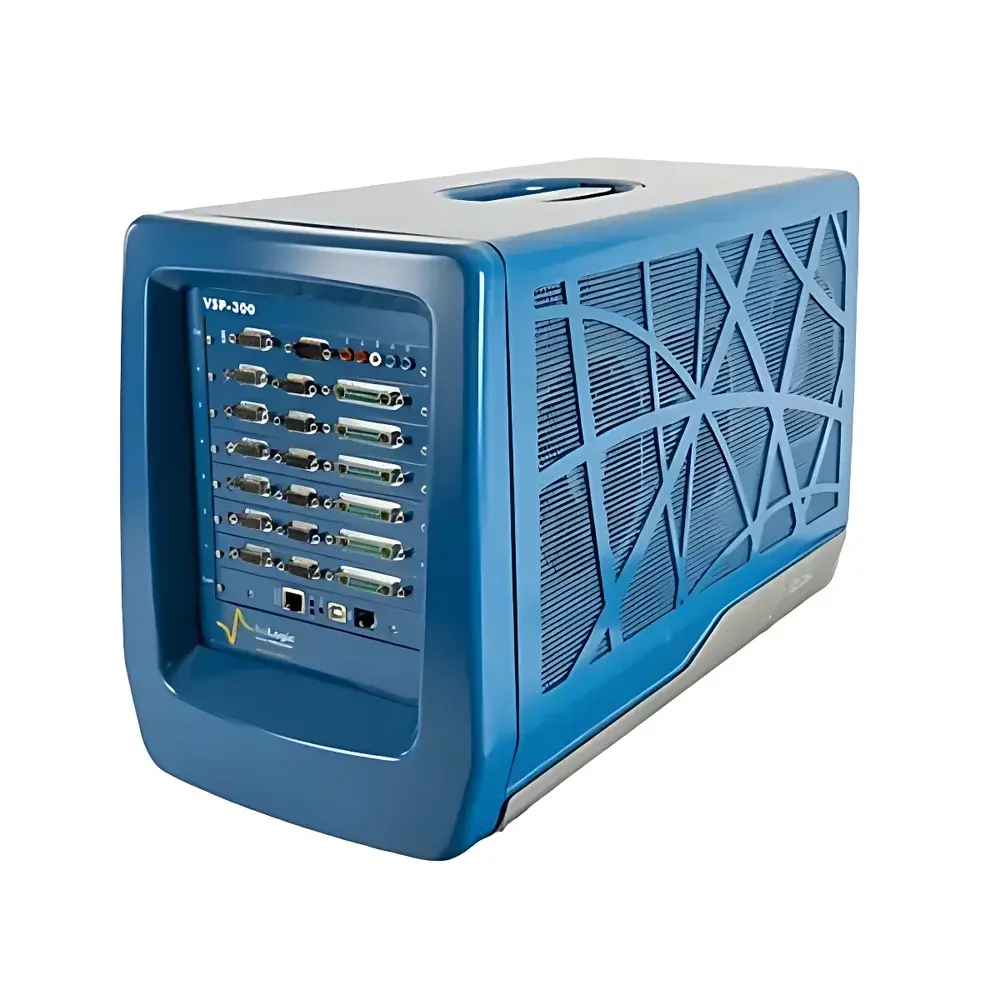
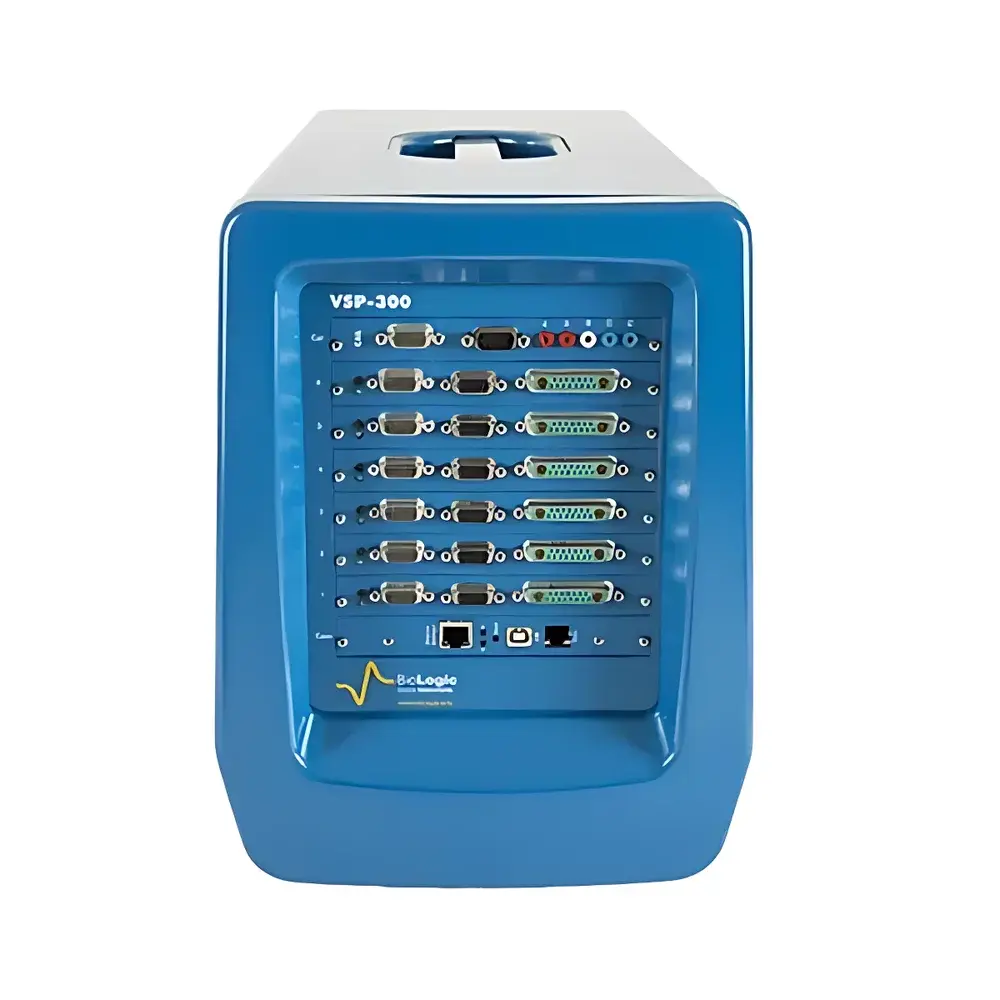
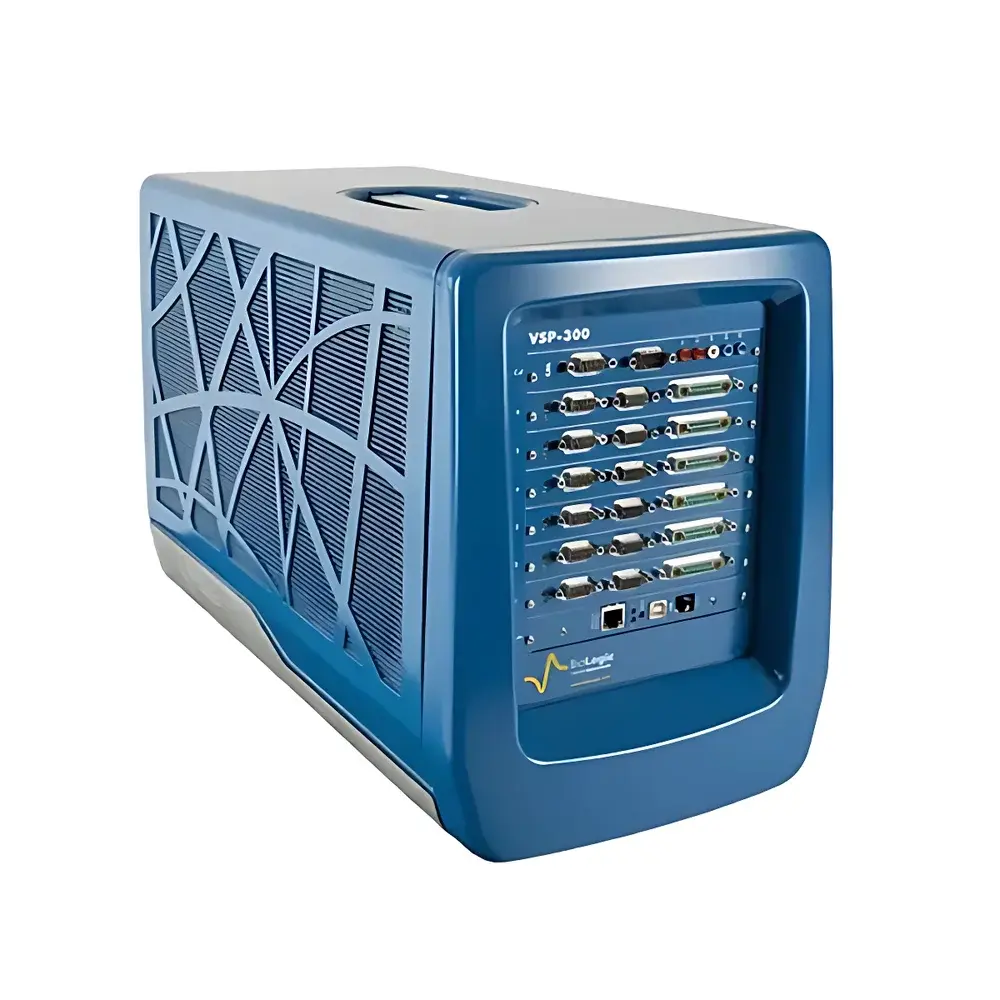
Bio-Logic VSP-300 6-Channel Potentiostat/Galvanostat Electrochemical Workstation
| Brand | Bio-Logic |
|---|---|
| Origin | France |
| Model | VSP-300 |
| Channel Count | 6 |
| Current Range | ±500 mA |
| Current Resolution | down to 76 aA (with ULC option) |
| Current Accuracy | ±20 nA on 10 µA range |
| Potential Accuracy | <5 mV on ±2.5 V range |
| Potentiostatic Range | ±10 V |
| Galvanostatic Range | ±1 A (extendable to ±20 A) |
| EIS Frequency Range | 10 µHz – 7 MHz |
| Sampling Rate | up to 1 µs |
| Compliance | CE, RoHS, ISO 9001-certified manufacturing |
| Software | EC-Lab® v12+ with FDA 21 CFR Part 11-compliant audit trail option |
Overview
The Bio-Logic VSP-300 is a high-performance, modular 6-channel potentiostat/galvanostat electrochemical workstation engineered for precision, scalability, and multi-user laboratory environments. Built upon Bio-Logic’s decades-long heritage in electrochemical instrumentation design, the VSP-300 implements a distributed architecture where each channel operates independently with full hardware autonomy—enabling true parallel acquisition without timing skew or cross-channel interference. Its core measurement principle relies on real-time digital control of potential and current waveforms via high-stability analog front-ends, synchronized 24-bit ADC/DAC conversion, and galvanically isolated channel modules. This architecture ensures metrological integrity across all electrochemical techniques—including potentiodynamic, potentiostatic, galvanostatic, and impedance-based methods—while supporting rigorous traceability requirements in regulated R&D and quality control settings.
Key Features
- Modular 6-channel platform: Install 1–6 fully independent electrochemical channels; each channel supports simultaneous EIS, CV, CP, and pulse techniques.
- Ultra-low current capability: Optional Ultra-Low Current (ULC) module enables resolution down to 76 aA (attoampere) on the 100 pA range—critical for corrosion monitoring, bioelectrochemistry, and nanomaterial characterization.
- Broad dynamic range: Standard current range ±500 mA; extendable to ±20 A via external booster units (4 A/14 V or 1 A/48 V); potential control range ±10 V (±12 V / ±49 V optional).
- High-fidelity EIS: Full-frequency-range impedance spectroscopy from 10 µHz to 7 MHz with phase accuracy <0.1° and magnitude accuracy <0.1%—validated per ASTM E1461 and ISO 17025-compliant calibration protocols.
- Dual-potentiostat functionality: Any two channels can be configured as a bipotentiostat without additional hardware—ideal for rotating ring-disk electrode (RRDE) studies and coupled redox systems.
- Real-time synchronization & LAN remote access: Hardware-level trigger synchronization across channels; secure web-based control via EC-Lab® Remote Server for multi-user collaboration and GLP-compliant experiment delegation.
Sample Compatibility & Compliance
The VSP-300 interfaces seamlessly with standard three-electrode cells (working, reference, counter), microelectrodes, thin-film sensors, battery coin cells (CR2032, CR2025), and custom flow cells. It complies with IEC 61010-1 for electrical safety and meets EMC Directive 2014/30/EU. All firmware and EC-Lab® software support configurable audit trails, electronic signatures, and data integrity features aligned with FDA 21 CFR Part 11 and EU Annex 11 requirements. Calibration certificates are NIST-traceable and include uncertainty budgets per ISO/IEC 17025:2017.
Software & Data Management
EC-Lab® v12+ provides an integrated environment for method development, real-time visualization, automated sequence scripting, and post-experiment analysis—including Kramers-Kronig validation, transmission line modeling, and equivalent circuit fitting (ZView®-compatible export). Raw data is stored in open-format .mpt files (ASCII-based, timestamped, metadata-rich) and supports direct import into MATLAB®, Python (via PyBioLogic), and OriginLab. For regulated labs, optional GxP mode enforces role-based access control, change history logging, and 21 CFR Part 11-compliant electronic signatures.
Applications
The VSP-300 serves advanced research and industrial QA/QC workflows across multiple domains: lithium-ion and solid-state battery cycling (GITT, PITT, dQ/dV analysis), PEM fuel cell catalyst evaluation, corrosion rate quantification (LPR, EFM, EN), conductive polymer characterization, enzymatic biosensor calibration, electrodeposition kinetics, photoelectrochemical water splitting, and fundamental electron-transfer mechanism studies. Its multi-channel capability enables comparative screening of electrode materials under identical environmental conditions—reducing inter-experiment variability and accelerating DOE-driven development cycles.
FAQ
Can the VSP-300 perform simultaneous EIS on all six channels?
Yes—each channel has dedicated impedance hardware and runs EIS independently at frequencies from 10 µHz to 7 MHz without shared resource contention.
Is floating operation supported for grounded electrolyte systems?
Yes—the instrument includes built-in galvanic isolation and standard floating capability, enabling measurements in non-grounded or high-impedance reference configurations.
What is the minimum current resolution achievable?
With the ULC module installed, the system achieves 76 aA (attoampere) resolution on the 100 pA full-scale range.
Does EC-Lab® support automated compliance reporting?
Yes—audit trail generation, user action logging, and electronic signature workflows are available in GxP mode for GLP/GMP-aligned laboratories.
Can third-party accessories (e.g., temperature controllers, gas dosing units) be synchronized?
Yes—via TTL triggers, analog I/O ports, and LabVIEW-compatible drivers, enabling closed-loop environmental control during electrochemical experiments.





