
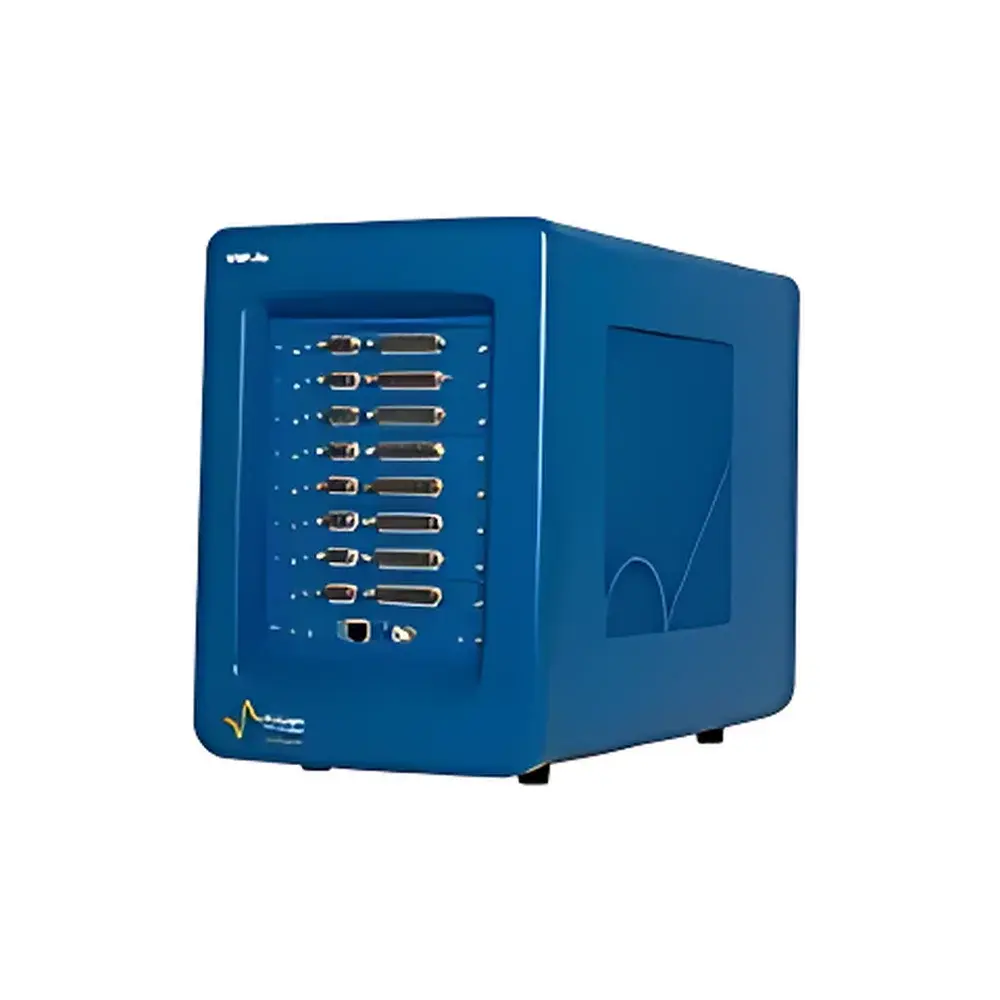
Bio-Logic VSP-3e 8-Channel Research-Grade Electrochemical Workstation
| Brand | Bio-Logic |
|---|---|
| Origin | France |
| Model | VSP-3e |
| Channel Count | 8 |
| Current Range | ±1 pA to ±1 A |
| Current Accuracy | ±0.0033% of reading |
| Potential Accuracy | ±1 µV |
| Potentiostatic Range | ±10 V (adjustable up to ±20 V) |
| EIS Frequency Range | 10 µHz to 1 MHz |
| Voltage Resolution | 5 µV (within ±200 mV range) |
| Current Resolution | 0.76 nA |
| Minimum Sampling Interval | 200 µs |
| Control Bandwidth | 7 adjustable bandwidths |
| Connectivity | Ethernet (LAN), USB, optional EIS module |
Overview
The Bio-Logic VSP-3e is a high-performance, 8-channel research-grade electrochemical workstation engineered for rigorous quantitative electrochemistry in academic, industrial, and regulatory environments. Built upon a modular, galvanically isolated architecture, it employs digital potentiostat/galvanostat control with real-time feedback loops to ensure stable potential or current regulation across all channels simultaneously. Its core design adheres to fundamental electrochemical measurement principles—potentiostatic, galvanostatic, and impedance spectroscopy—enabling precise control of electrode interfaces under dynamic or steady-state conditions. The system supports both single-cell and multi-cell configurations, making it particularly suited for comparative studies of electrode materials, battery stack monitoring, corrosion kinetics, and fuel cell development. All analog signal paths are shielded and filtered to minimize noise, while the internal 24-bit ADC/DAC architecture ensures high dynamic range and low quantization error—critical for resolving sub-picoampere currents and microvolt-level potential shifts during long-duration experiments.
Key Features
- Eight independent, fully isolated electrochemical channels—each capable of simultaneous potentiostatic, galvanostatic, or zero-resistance ammeter (ZRA) operation
- Ultra-low current measurement capability down to ±1 pA with <0.0033% accuracy and 0.76 nA resolution, enabling kinetic analysis of slow redox processes and ultra-low-conductivity electrolytes
- Potential control precision of ±1 µV over ±10 V range (extendable to ±20 V via external modules), essential for detecting subtle interfacial phenomena such as underpotential deposition or surface oxide formation
- Integrated electrochemical impedance spectroscopy (EIS) with frequency sweep capability from 10 µHz to 1 MHz—optimized for both bulk solution characterization and interfacial time-constant analysis
- Ethernet-based communication protocol (TCP/IP) supporting remote instrument control, multi-user access, and seamless integration into automated lab networks compliant with IEEE 802.3 standards
- Stack Mode functionality for synchronized voltage/current tracking across serially connected cells—widely applied in lithium-ion battery pack diagnostics and redox flow battery stack validation
- Seven programmable control bandwidth settings allow dynamic adaptation to varying system time constants, ensuring stability during fast transient measurements without oscillation or overshoot
Sample Compatibility & Compliance
The VSP-3e accommodates standard three-electrode, two-electrode, and four-terminal (Kelvin) configurations, supporting conventional aqueous, non-aqueous, molten salt, and solid-state electrolyte systems. It is compatible with rotating disk electrodes (RDE), rotating ring-disk electrodes (RRDE), microelectrodes, and custom-built electrochemical cells—including glovebox-integrated setups for air-sensitive materials. From a regulatory standpoint, the platform meets essential requirements for GLP-compliant laboratories: full audit trail logging (including user ID, timestamp, parameter set, and raw data), electronic signature support per FDA 21 CFR Part 11, and traceable calibration protocols aligned with ISO/IEC 17025 guidelines. All firmware and hardware designs comply with IEC 61010-1 for electrical safety in laboratory equipment.
Software & Data Management
Control and analysis are performed using Bio-Logic’s EC-Lab® software suite (v12.x or later), a Windows-native application validated for scientific reproducibility and interoperability. EC-Lab provides intuitive experiment sequencing, real-time visualization of multiple channels, and built-in fitting routines for Tafel analysis, Butler–Volmer modeling, EIS equivalent circuit simulation (using ZView-compatible formats), and Coulombic efficiency mapping. Raw data is saved in open binary format (.mpt) with embedded metadata (instrument configuration, environmental conditions, operator notes), ensuring FAIR (Findable, Accessible, Interoperable, Reusable) data principles. Export options include CSV, MATLAB (.mat), and ASCII for third-party analysis tools. Software updates follow a documented change control process, and version history is retained for audit readiness.
Applications
- Battery R&D: Cycle-life testing, differential capacity analysis (dQ/dV), state-of-charge estimation, and post-mortem electrode interface characterization
- Fuel Cell & Electrolyzer Development: Catalyst activity mapping, membrane resistance profiling, and degradation mechanism identification under variable load conditions
- Corrosion Science: Electrochemical noise monitoring, localized corrosion detection via scanning vibrating electrode technique (SVET) integration, and passivation film growth kinetics
- Electrocatalysis: Turnover frequency (TOF) determination, reaction order analysis, and mass-transport-corrected kinetic modeling
- Sensors & Biosensors: Amperometric detection limits, interference rejection assessment, and stability evaluation under continuous operation
- Materials Screening: High-throughput evaluation of novel anode/cathode materials, solid electrolyte interphase (SEI) formation studies, and interfacial charge transfer resistance quantification
FAQ
Can the VSP-3e operate all eight channels simultaneously in EIS mode?
Yes—each channel supports full-frequency EIS acquisition independently, with no shared oscillator or timing constraint.
Is external amplification required for currents above ±1 A?
Yes; for currents up to ±800 A, optional FlexP0012 current booster modules must be installed externally and configured via EC-Lab.
Does the system support ASTM G102 or ISO 16773 standard-compliant corrosion testing protocols?
EC-Lab includes preconfigured methods for ASTM G5, G102, G106, and ISO 16773-2, with automatic calculation of polarization resistance, corrosion rate, and Tafel slopes.
How is data integrity ensured during long-term experiments (e.g., 30-day battery cycling)?
The workstation logs timestamps with microsecond precision, performs cyclic redundancy checks (CRC) on all acquired data packets, and saves incremental backups at user-defined intervals.
Can third-party Python or LabVIEW scripts interface with the VSP-3e?
Yes—Bio-Logic provides a documented COM API and TCP/IP socket interface, enabling direct command-and-control integration within custom automation frameworks.





