
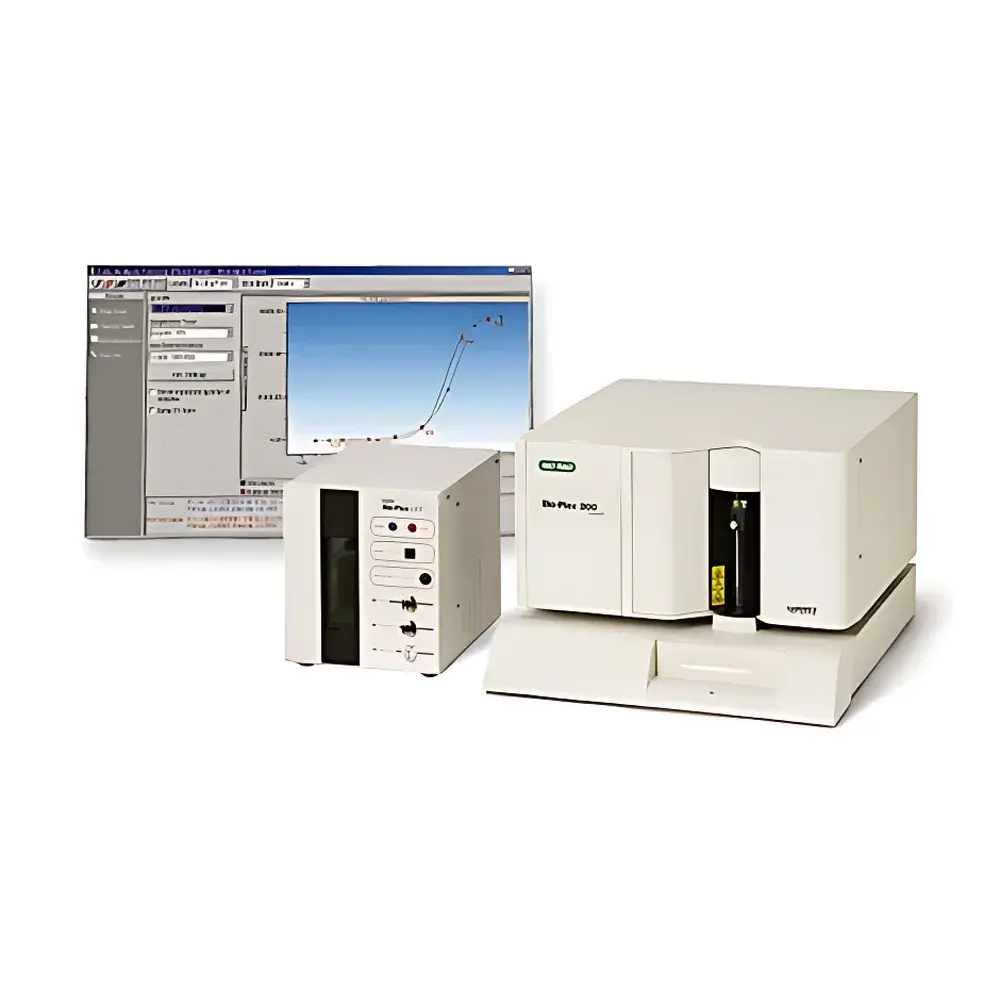
Bio-Rad Bio-Plex Protein Array System
| Brand | Bio-Rad |
|---|---|
| Origin | USA |
| Model | Bio-Plex Protein Array System |
| Excitation Lasers | 532 nm & 635 nm |
| Sensitivity | <10 pg/mL |
| Inter- and Intra-Assay CV | <10% |
| Dynamic Range | 1–32,000 pg/mL |
| Recovery Rate | Serum 80–120%, Cultured Cells 90–110% |
| Throughput | 96 samples in 30 minutes (up to 9,600 data points) |
| Sample Volume | 12 µL per well |
| Plate Format | Standard 96-well microplate |
Overview
The Bio-Rad Bio-Plex Protein Array System is a multiplexed suspension array platform engineered for high-throughput, quantitative detection of multiple soluble analytes—including cytokines, chemokines, growth factors, phosphoproteins, and other biomarkers—in a single small-volume sample. Based on Luminex xMAP® technology, the system utilizes spectrally distinct fluorescently dyed microspheres (beads), each conjugated to a specific capture molecule (e.g., antibody or oligonucleotide). Upon binding target analytes in solution, a biotinylated detection reagent and streptavidin-phycoerythrin reporter are added, enabling quantification via dual-laser flow-based detection—532 nm for bead classification and 635 nm for signal intensity measurement. This principle delivers true parallel analysis with minimal cross-reactivity, high reproducibility, and robust performance across complex biological matrices such as serum, plasma, cell culture supernatants, and tissue lysates.
Key Features
- Simultaneous quantification of up to 100 distinct analytes from a single 12 µL sample volume—ideal for precious, low-yield, or longitudinal clinical specimens.
- Dual-laser optical architecture ensures precise bead identification and accurate fluorescence signal acquisition, supporting sensitivity down to <10 pg/mL and inter- and intra-assay coefficients of variation <10%.
- Dynamic quantification range spanning four orders of magnitude (1–32,000 pg/mL), validated for recovery in human serum (80–120%) and cultured cell supernatants (90–110%).
- High-throughput processing: full 96-well plate analysis completed in ≤30 minutes, yielding up to 9,600 discrete data points per run.
- Integrated calibration and verification protocols—including dedicated calibration kits and automated QC routines—to minimize system drift, batch-to-batch variability, and operator-dependent error.
- Flexible assay development: supports both off-the-shelf Bio-Rad validated kits and custom bead-based assay design using user-supplied antibodies or probes.
Sample Compatibility & Compliance
The Bio-Plex System accommodates a broad spectrum of sample types without requiring pre-fractionation or amplification: native human and rodent serum/plasma, CSF, BAL fluid, urine, and clarified lysates from primary cells or cell lines. All assays are compatible with standard 96-well polystyrene microplates, ensuring seamless integration into existing ELISA-capable laboratory workflows. The platform meets essential regulatory requirements for research-use-only (RUO) applications and supports GLP-aligned documentation practices. While not FDA-cleared for diagnostic use, its analytical performance characteristics align with ISO 13485–informed validation frameworks and ASTM E2500-13 guidance for assay qualification in translational and preclinical studies.
Software & Data Management
Bio-Plex Manager™ software provides end-to-end control—from instrument setup and plate mapping to real-time data acquisition, automatic standard curve fitting (5PL or 4PL), and batch-wise normalization. Raw MFI (median fluorescence intensity) values are converted to concentration units using reference standards traceable to NIST-certified materials where available. Statistical outputs include coefficient of variation, % recovery, linearity-of-dilution, and outlier detection. Export options support CSV, Excel, and XML formats compliant with LIM systems and downstream tools such as GraphPad Prism, R, or Python-based bioinformatics pipelines. Audit trails, user access controls, and electronic signature capability (optional module) facilitate adherence to 21 CFR Part 11 requirements for regulated environments.
Applications
- Immunoprofiling in inflammatory disease models and autoimmune disorders
- Pharmacodynamic monitoring during preclinical drug candidate evaluation
- Biomarker discovery and verification in oncology, neurology, and metabolic disease cohorts
- Host-pathogen interaction studies via simultaneous cytokine/chemokine profiling
- Quality control of recombinant protein therapeutics and vaccine adjuvants
- Longitudinal monitoring of patient-derived xenograft (PDX) or organoid model responses
FAQ
What sample types are validated for use with the Bio-Plex Protein Array System?
Serum, plasma, cell culture supernatants, cerebrospinal fluid (CSF), bronchoalveolar lavage (BAL) fluid, and tissue lysates have been experimentally validated across multiple Bio-Rad assay panels.
Can I develop my own custom assays on this platform?
Yes—Bio-Rad supplies coupling kits and magnetic bead sets for covalent conjugation of user-specified antibodies or nucleic acid probes, enabling fully customized multiplex panels.
Is the system compatible with Good Laboratory Practice (GLP) or GMP environments?
While classified as RUO, the system supports GLP/GMP-aligned operation through optional 21 CFR Part 11-compliant software modules, comprehensive IQ/OQ documentation packages, and traceable calibration standards.
How does the Bio-Plex System compare to traditional ELISA in terms of throughput and cost-per-analyte?
A single Bio-Plex run measures 100 analytes across 96 samples (9,600 data points) in ~30 minutes, reducing hands-on time by >70% and reagent consumption per analyte by up to 90% compared to equivalent ELISA workflows.
Does Bio-Rad offer technical support for assay optimization and troubleshooting?
Yes—Bio-Rad’s global Field Application Scientist network provides protocol optimization, matrix interference assessment, and data interpretation support, including remote instrument diagnostics and method transfer assistance.
Related Products



