
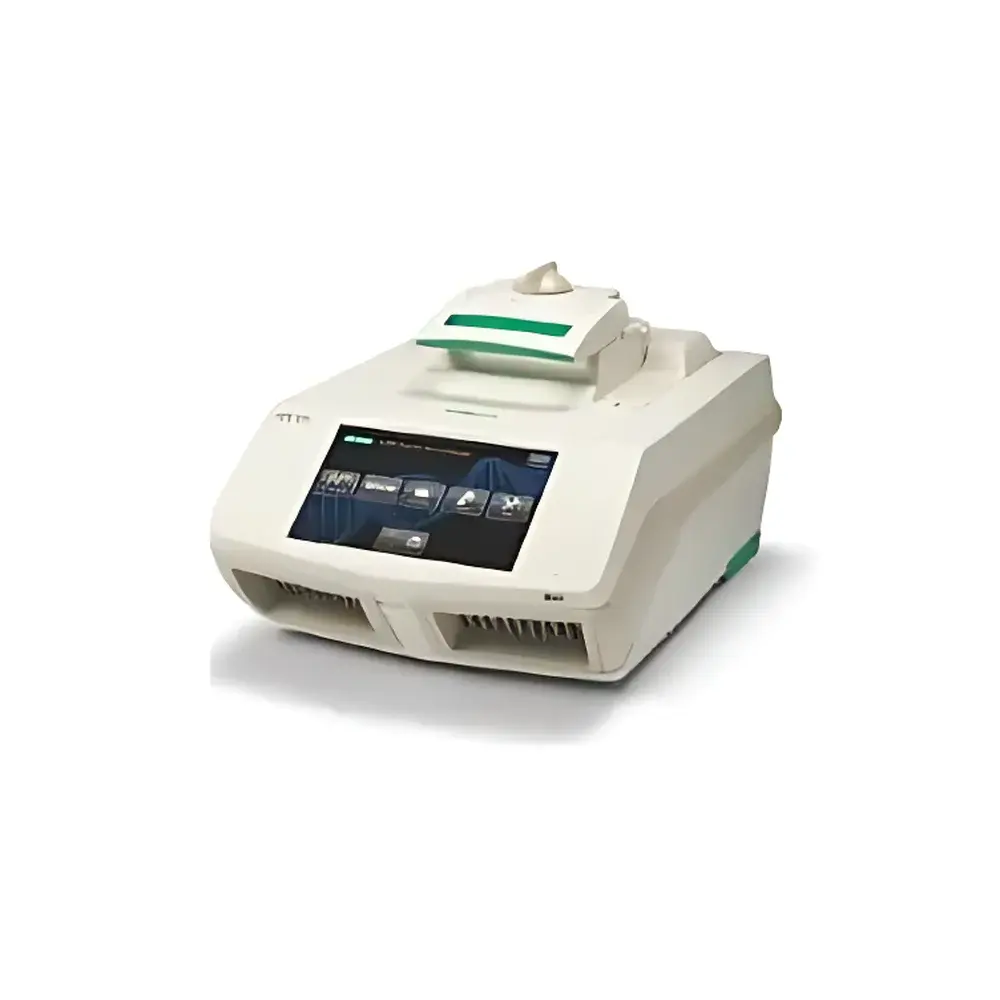
Bio-Rad C1000 Touch™ 96-Well Gradient Thermal Cycler
| Brand | Bio-Rad |
|---|---|
| Origin | USA |
| Instrument Type | Gradient PCR Thermal Cycler |
| Sample Capacity | 96 × 0.2 mL tubes or 1 × 96-well plate |
| Max Heating/Cooling Rate | 5°C/sec |
| Temperature Accuracy | ±0.2°C at 90°C |
| Well-to-Well Temperature Uniformity | ±0.4°C within 10 sec at 90°C |
| Temperature Gradient Range | 30–100°C |
| Gradient Accuracy (last column) | ±0.2°C |
| Column-wise Uniformity | ±0.4°C within 10 sec at 90°C |
| Input Power | 850 W max |
| Display | 8.5" color LCD touchscreen |
| Onboard Memory | >1,000 protocols |
| Dimensions (W×D×H) | 33 × 45.7 × 20.3 cm |
| Weight | 10.4 kg |
Overview
The Bio-Rad C1000 Touch™ 96-Well Gradient Thermal Cycler is a high-performance, modular thermal cycler engineered for precision, reproducibility, and operational flexibility in molecular biology laboratories. It operates on the fundamental principle of controlled thermal cycling—precisely alternating between denaturation, annealing, and extension temperatures—to exponentially amplify specific DNA sequences via polymerase chain reaction (PCR). Designed for rigorous routine and research-grade applications, the system delivers exceptional temperature accuracy (±0.2°C at 90°C) and rapid thermal response (up to 5°C/sec), minimizing cycle time without compromising fidelity. Its patented honeycomb-heated block architecture ensures uniform heat transfer across all 96 wells, achieving ±0.4°C well-to-well uniformity within 10 seconds at 90°C—a critical parameter for reproducible amplification efficiency and assay robustness. The instrument supports full compliance with standard PCR workflow requirements under ISO/IEC 17025-accredited laboratory practices and aligns with Good Laboratory Practice (GLP) documentation expectations for thermal validation records.
Key Features
- Modular block architecture enabling tool-free interchange of six validated reaction modules: 96-well gradient fast block, dual 48-well gradient block, 96-well deep-well gradient block, 384-well gradient block, CFX96™ optical reaction module, and CFX384™ optical reaction module—facilitating seamless transition between endpoint PCR and real-time qPCR configurations.
- 8.5-inch capacitive color touchscreen with intuitive, step-by-step graphical programming interface; supports three programming modes including an intelligent Auto-Programmer that generates optimized cycling profiles based on amplicon length, primer Tm, and template complexity.
- Advanced AOI (Anti-Over-Tightening Indicator) lid mechanism prevents excessive torque during tube sealing—reducing risk of tube deformation or cap fracture during thermal expansion cycles.
- Onboard storage capacity for >1,000 user-defined protocols; expandable indefinitely via USB flash drive; firmware updates supported through USB-B port.
- Network-ready architecture: enables centralized control of up to 32 units via PC-based software (C1000 Touch Manager), supporting batch protocol deployment, remote monitoring, and synchronized run initiation for high-throughput core facility environments.
- Comprehensive security framework: password-protected protocol folders, optional user login, and “Secure Mode” for regulated environments requiring audit-trail–capable operation per FDA 21 CFR Part 11 guidelines.
Sample Compatibility & Compliance
The C1000 Touch accommodates standard 0.2 mL thin-wall PCR tubes, 96-well skirted or semi-skirted plates (including low-profile formats), and deep-well plates up to 50 µL volume per well. All thermal blocks are calibrated and verified per ASTM E2723-19 (Standard Practice for Calibration and Verification of Thermal Cyclers) and meet ISO 13485 design control requirements for in vitro diagnostic (IVD) development workflows. Temperature uniformity and gradient performance are traceable to NIST-certified reference standards. The system supports GLP/GMP-aligned data integrity through timestamped run logs, error event reporting, and exportable CSV-formatted thermal history files—enabling integration into LIMS and electronic lab notebook (ELN) platforms.
Software & Data Management
The instrument runs embedded Windows CE 6.0 firmware with native support for USB peripherals including mice, barcode scanners, and mass-storage devices. Protocol creation, editing, and execution occur directly on the touchscreen or remotely via Bio-Rad’s C1000 Touch Manager software (Windows XP or later). All run data—including cycle-by-cycle temperature profiles, start/end timestamps, user ID, and error codes—are automatically logged and exportable via USB-A ports. Audit trails record protocol modifications, user logins, and system events—critical for regulatory submissions under ICH M10 and FDA guidance on bioanalytical method validation. Firmware upgrades preserve existing protocol libraries and maintain backward compatibility with legacy C1000 series methods.
Applications
The C1000 Touch serves as a foundational platform for diverse nucleic acid amplification workflows, including but not limited to: routine genotyping, colony PCR screening, cDNA synthesis, mutagenesis, library preparation for next-generation sequencing (NGS), pathogen detection assays, and pre-qPCR target enrichment. Its precise gradient capability (30–100°C, ±0.2°C column accuracy) supports empirical optimization of annealing temperatures for novel primer sets or multiplex reactions. When equipped with CFX optical modules, it transitions seamlessly into quantitative real-time PCR applications compliant with MIQE guidelines. The system is widely deployed in academic core facilities, clinical diagnostics labs (CLIA-certified), pharmaceutical QC/QA departments, and contract research organizations performing method development and validation studies.
FAQ
Is the C1000 Touch compatible with third-party PCR consumables?
Yes—it accepts industry-standard 0.2 mL PCR tubes and 96-well plates from major suppliers (e.g., Axygen, Thermo Fisher, Eppendorf), provided dimensional tolerances conform to ANSI/SBS standards.
Can temperature calibration be performed in-house?
Yes—Bio-Rad provides certified calibration kits and SOPs aligned with ASTM E2723; verification intervals are recommended every 6 months or after 500 cycles, whichever occurs first.
Does the system support LIMS integration?
Direct LIMS connectivity is achieved via exported CSV run logs and metadata files; API-level integration requires middleware configuration using Bio-Rad’s SDK documentation.
What safety certifications does the instrument hold?
It complies with IEC 61010-1 (Safety Requirements for Electrical Equipment for Measurement, Control, and Laboratory Use) and carries CE, UL, and CSA marks for global deployment.
Is remote firmware update possible over network?
Firmware updates require local USB media installation; however, version status and update notifications are accessible via the touchscreen dashboard and C1000 Touch Manager software.
Related Products



