
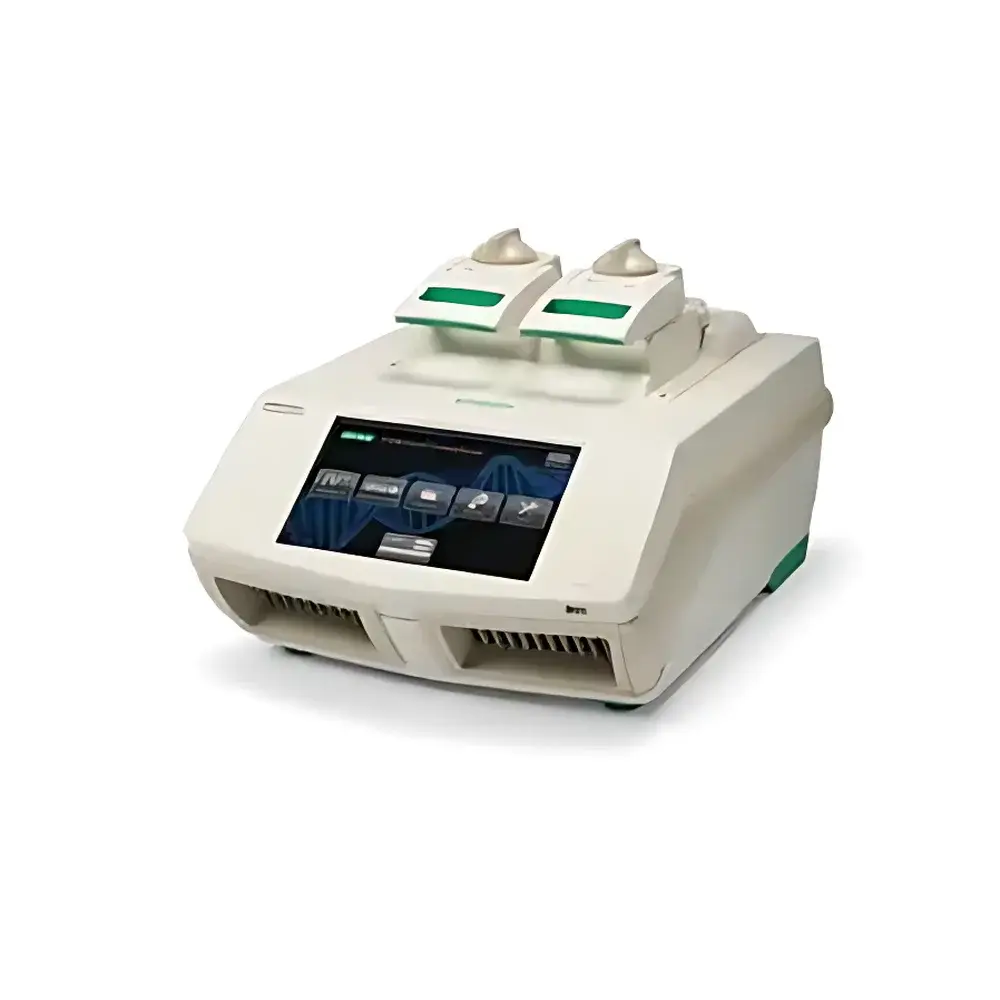
Bio-Rad C1000 Touch™ Dual 48-Well Thermal Cycler
| Brand | Bio-Rad |
|---|---|
| Origin | USA |
| Model | C1000 Touch™ Dual 48 |
| Instrument Type | Gradient PCR Thermal Cycler |
| Sample Capacity | 2 × 48 × 0.2 mL tubes or 2 × 48-well plates |
| Max Heating Rate | 4°C/s |
| Temperature Accuracy | ±0.2°C at 90°C |
| Well-to-Well Temperature Uniformity | ±0.4°C within 10 s at 90°C |
| Temperature Gradient Range | 1–24°C (30–100°C) |
| Gradient Accuracy | ±0.2°C (last column) |
| Gradient Uniformity per Column | ±0.4°C within 10 s |
| Input Power | 850 W max |
| Dimensions (W×D×H) | 33 × 45.7 × 20.3 cm |
| Weight | 10.4 kg |
Overview
The Bio-Rad C1000 Touch™ Dual 48-Well Thermal Cycler is a high-performance, modular gradient PCR instrument engineered for precision thermal cycling in molecular biology laboratories. It operates on the fundamental principle of controlled, rapid, and uniform thermal transitions—critical for efficient DNA denaturation, primer annealing, and polymerase extension across two independent 48-well reaction blocks. Its patented honeycomb heating block architecture ensures rapid thermal equilibration and exceptional spatial temperature homogeneity, minimizing cycle time variability and enhancing reproducibility across replicates. Designed to meet stringent laboratory workflow demands, the system supports both standard endpoint PCR and preparatory amplification for downstream applications including Sanger sequencing, cloning, NGS library preparation, and qPCR assay development. The instrument complies with ISO/IEC 17025-relevant calibration traceability requirements and incorporates hardware-level safeguards aligned with GLP-compliant documentation practices.
Key Features
- Modular thermal block design enables tool-free interchange of six validated reaction modules—including Dual 48-well, 96-well fast, 96-well deep-well, 384-well, CFX96™ optical, and CFX384™ optical modules—without recalibration.
- 8.5-inch full-color capacitive touchscreen interface with intuitive, step-by-step graphical programming and real-time thermal profile visualization.
- Advanced Auto-Programmer function calculates optimal cycling parameters—including denaturation, annealing, and extension times—based on amplicon length, primer Tm, and polymerase kinetics.
- AOI (Anti-Over-Tightening Interface) lid mechanism prevents excessive cap torque, eliminating tube deformation or seal failure during thermal cycling.
- Instant heating capability reduces pre-run equilibration time; achieves target temperature in under 10 seconds at 90°C with ±0.4°C well-to-well uniformity.
- Onboard storage for >1,000 protocols; expandable via USB flash drive; supports password-protected folders and configurable “Secure Mode” for regulated environments (e.g., clinical or QC labs).
- Network-ready architecture allows centralized control of up to 32 units via Ethernet-connected PC using Bio-Rad’s CFX Maestro™ software suite.
Sample Compatibility & Compliance
The Dual 48-well configuration accommodates standard 0.2 mL thin-wall PCR tubes or 48-well skirted/unskirted plates, compatible with all major thermostable DNA polymerases (e.g., Taq, Q5®, Phusion®). Block geometry and thermal mass distribution are optimized to minimize edge effects and ensure consistent performance across both modules simultaneously. The system meets electromagnetic compatibility (EMC) standards per IEC 61326-1 and electrical safety requirements per IEC 61010-1. Firmware and data logging functions support audit-trail generation for FDA 21 CFR Part 11 compliance when used with validated CFX Maestro™ software configurations. Temperature calibration is performed per ASTM E2876-22 guidelines for thermal cyclers, with documented uncertainty budgets available upon request.
Software & Data Management
Instrument operation and protocol management are supported by Bio-Rad’s CFX Maestro™ Software (Windows 10/11 compatible), enabling remote scheduling, batch protocol deployment, and export of raw thermal logs in CSV or XML formats. On-device Windows CE 6.0 firmware maintains local execution independence while supporting USB peripherals—including barcode scanners for sample tracking and HID-compliant mice for enhanced navigation. All run logs—including start/stop timestamps, temperature deviations, error codes, and user login events—are stored internally with SHA-256 hashing for integrity verification. Data export paths comply with LIMS integration standards (e.g., HL7, ASTM E1384) and support automated backup to network drives or cloud repositories via scheduled tasks.
Applications
This thermal cycler is routinely deployed in academic research for multiplex PCR optimization, mutagenesis screening, and genotyping assays requiring parallel condition testing. In diagnostic development labs, it facilitates validation of primer-probe sets under gradient conditions prior to transfer to qPCR platforms. Its dual-block architecture accelerates comparative studies—such as enzyme performance benchmarking or buffer formulation screening—by running matched reactions under identical thermal profiles with independent ramp rate control. The system also serves as a robust platform for RNA integrity assessment via RT-PCR and for preparing amplicons intended for long-read sequencing library construction.
FAQ
Can the Dual 48 module be used simultaneously with different programs on each block?
Yes—the C1000 Touch™ supports independent program execution on each 48-well block, including distinct ramp rates, hold times, and gradient profiles.
Is firmware upgrade supported in-house without service engineer intervention?
Yes—updates are delivered via USB flash drive and installed through the touchscreen interface; no external tools or network connection required.
Does the system provide NIST-traceable temperature validation reports?
Calibration certificates with NIST-traceable reference sensors are available through Bio-Rad’s Field Service Network upon request and annual maintenance contract.
What peripheral devices are certified for use with the USB ports?
Certified peripherals include USB 2.0 flash drives (FAT32 formatted), optical mice, and USB barcode scanners compliant with HID class specifications.
How is data integrity ensured during power interruption?
The system features non-volatile memory that preserves active protocol state and thermal history; upon recovery, it resumes from the last completed cycle or enters safe-cool mode based on user-configurable settings.



