
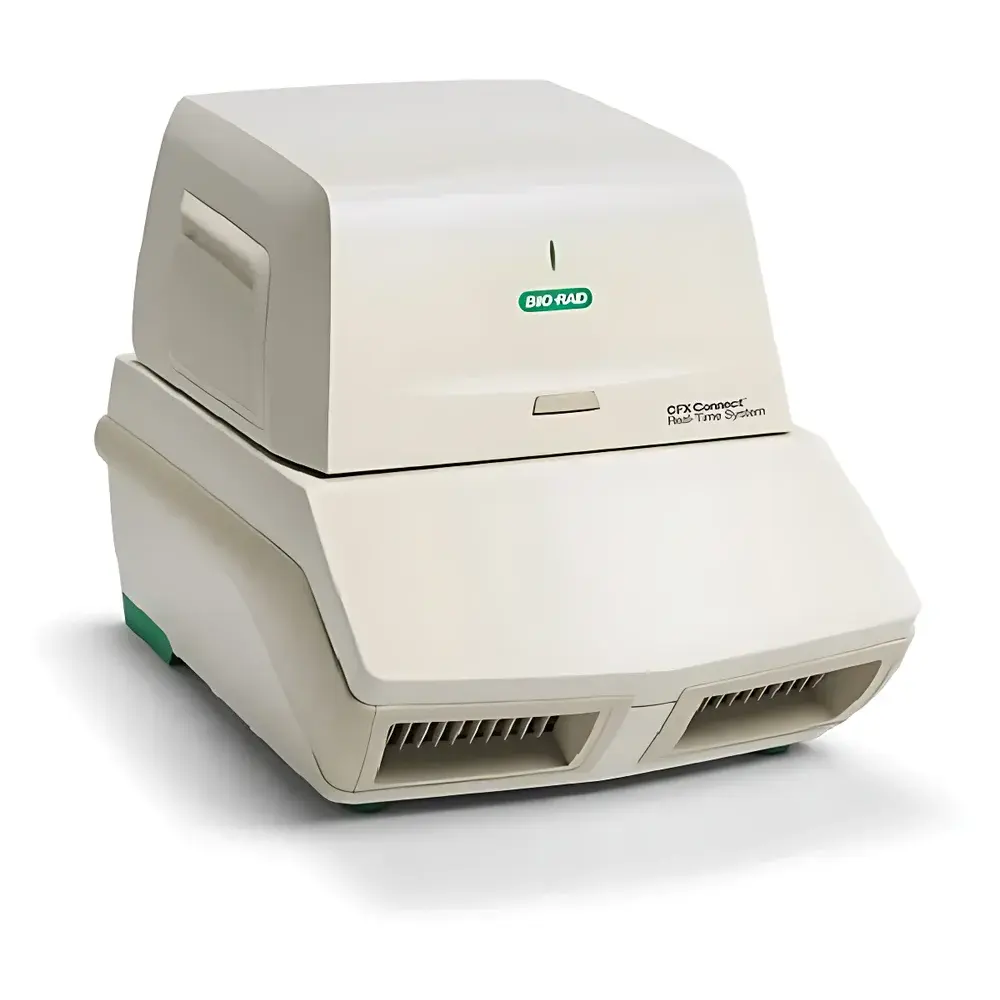
Bio-Rad CFX Connect Real-Time PCR Detection System
| Brand | Bio-Rad |
|---|---|
| Origin | USA |
| Model | CFX Connect |
| Instrument Type | Real-Time Fluorescence Quantitative PCR System |
| Sample Throughput | 96-well (0.2 mL tubes) |
| Maximum Heating Rate | 5 °C/s (adjustable from 0.1 to 5 °C/s) |
| Temperature Accuracy | ±0.2 °C at 90 °C setpoint |
| Well-to-Well Temperature Uniformity | ±0.4 °C within 10 seconds after reaching 90 °C |
| Excitation Sources | 3 LEDs (450–535 nm) |
| Emission Detection Range | 3 Photodiodes (515–580 nm) |
| Gradient PCR | Yes, range 30–100 °C, max ΔT = 24 °C |
| High-Resolution Melting (HRM) Support | Yes |
| Connectivity | USB |
| Dimensions (W×D×H) | 33 × 45.7 × 35.6 cm |
| Weight | 21 kg |
Overview
The Bio-Rad CFX Connect Real-Time PCR Detection System is a compact, high-performance thermal cycler engineered for precise nucleic acid quantification using real-time fluorescence detection. Built upon the proven C1000 Thermal Cycler chassis and optical architecture of the CFX96 Touch platform, the CFX Connect delivers consistent thermal control and robust optical sensitivity in a streamlined configuration optimized for routine gene expression, genotyping, and pathogen detection workflows. Its measurement principle relies on synchronous thermal cycling and multi-channel fluorescence acquisition—capturing SYBR Green, FAM, HEX, VIC, and other common dyes across three independent excitation/emission pathways. The system employs a Peltier-based heating/cooling module with closed-loop feedback control, ensuring rapid ramp rates up to 5 °C/s and tight temperature uniformity across all 96 wells—critical for reproducible amplification kinetics and reliable Ct value determination. Designed for laboratories requiring validated performance without the complexity of higher-channel systems, the CFX Connect meets core requirements for ISO/IEC 17025-compliant molecular testing environments when operated under documented SOPs.
Key Features
- Factory-Calibrated Optical Pathway: Pre-aligned LED excitation sources and photodiode detectors eliminate user calibration steps—ensuring immediate operational readiness and inter-instrument comparability.
- Full-Plate Fluorescence Acquisition: Simultaneous data collection from all 96 wells per cycle removes dependency on pre-defined plate setup files; users may define analysis parameters post-run without sacrificing data integrity.
- Configurable Data Collection Modes: Supports standard full-spectrum acquisition, single-color rapid scanning, and endpoint melt curve collection—enabling optimization of run time versus resolution based on assay requirements.
- Integrated Thermal Gradient Function: Enables empirical optimization of annealing temperature across a 24 °C span (30–100 °C) in a single run—accelerating primer validation and multiplex assay development.
- High-Resolution Melting (HRM) Capability: Delivers sufficient thermal precision and signal-to-noise ratio for post-PCR discrimination of SNP variants, methylation status, and amplicon heterogeneity without requiring specialized hardware upgrades.
- Modular Expandability: A single Windows-based workstation running CFX Maestro Software can control up to four CFX Connect instruments concurrently—supporting scalable throughput in core facilities or multi-user labs.
Sample Compatibility & Compliance
The CFX Connect accommodates standard 96-well PCR plates and 0.2 mL tube strips, with a maximum reaction volume of 50 µL per well. It supports all major qPCR chemistries including double-stranded DNA-binding dyes (e.g., SYBR Green I), hydrolysis probes (TaqMan), hybridization probes (FRET), and molecular beacons. The system’s thermal performance complies with ASTM E2581-21 guidelines for thermal cyclers used in quantitative nucleic acid assays. While not pre-certified for clinical diagnostics under FDA 510(k) or CE-IVD, its design aligns with key elements of ISO 13485 quality management systems and supports implementation of GLP/GMP-aligned documentation practices—including audit trails, electronic signatures, and version-controlled protocol storage when paired with validated CFX Maestro configurations.
Software & Data Management
CFX Maestro Software (v5.x or later) provides an integrated environment for instrument control, data visualization, and statistical interpretation. It includes built-in gene expression analysis modules that perform multi-reference gene normalization using geNorm or NormFinder algorithms, incorporate user-defined amplification efficiency corrections, and generate publication-ready plots with confidence intervals. Statistical tools include unpaired t-tests, one-way ANOVA with Tukey’s post-hoc analysis, and correlation matrices. All raw fluorescence and temperature data are stored in vendor-neutral .rdml format, enabling third-party interoperability. Audit trail functionality records user actions, parameter changes, and file modifications—meeting foundational expectations for 21 CFR Part 11 compliance when deployed with appropriate IT controls (e.g., domain authentication, encrypted storage, and periodic backup).
Applications
- Relative and absolute quantification of mRNA transcripts in drug response studies
- Validation of CRISPR/Cas9 editing efficiency via T7E1 or RFLP-coupled qPCR
- Microbial load assessment in environmental or food safety testing
- Viral load monitoring in research-grade virology assays (e.g., SARS-CoV-2 N gene targeting)
- Allelic discrimination using ARMS or KASP chemistry in plant breeding programs
- Quality control of synthetic oligonucleotides and plasmid preparations
FAQ
Does the CFX Connect support four-color detection?
No—the CFX Connect is a three-channel system optimized for dual-target detection plus FRET or HRM applications. For four- or five-color multiplexing, consider the CFX96 Touch or CFX Opus series.
Can I upgrade the CFX Connect to add more fluorescence channels?
No—optical channel count is fixed at time of manufacture. Channel expansion requires replacement with a higher-tier model.
Is the CFX Connect compatible with third-party qPCR master mixes?
Yes—it accepts all commercially available hot-start DNA polymerases and buffer formulations designed for standard 96-well thermal cyclers.
What operating system versions does CFX Maestro support?
CFX Maestro v5.2+ supports Windows 10 (64-bit) and Windows 11 (64-bit); legacy versions are not supported on macOS or Linux platforms.
How often does the system require optical recalibration?
None—factory calibration is permanent under normal operating conditions. Bio-Rad recommends annual preventive maintenance by certified service personnel, including thermal verification and lamp intensity checks.



