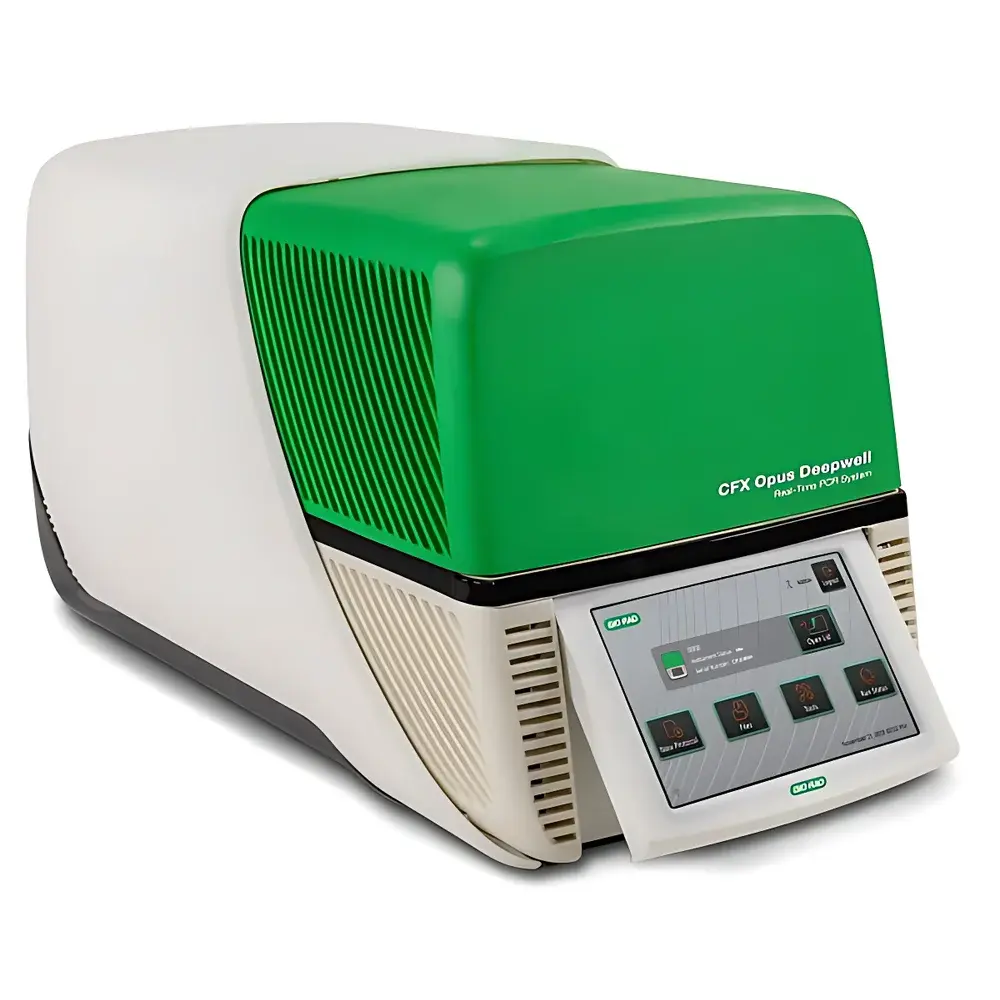
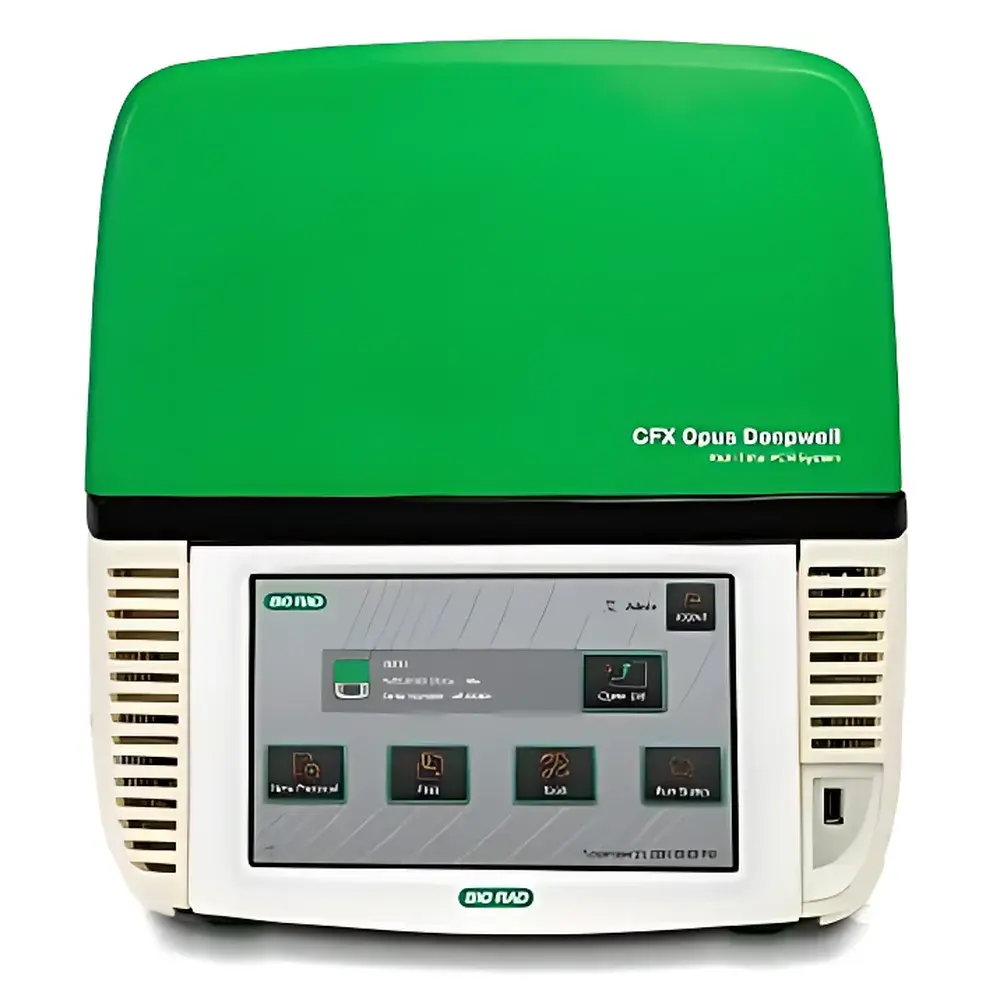
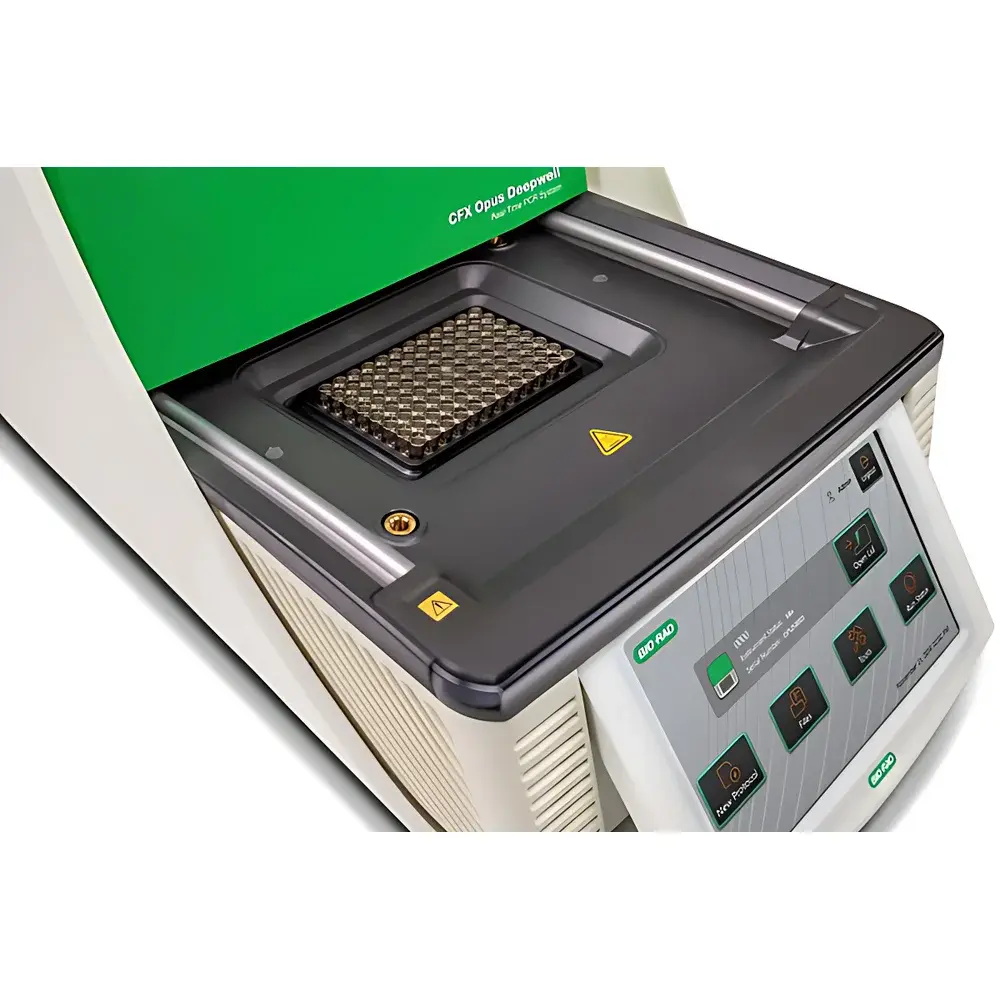
Bio-Rad CFX Opus Deepwell Real-Time PCR Detection System
| Brand | Bio-Rad |
|---|---|
| Origin | Singapore |
| Model | CFX Opus Deepwell |
| Instrument Type | Real-Time Fluorescent Quantitative PCR System |
| Sample Capacity | 96-well format |
| Heating Rate | 2.5°C/sec |
| Temperature Accuracy | ±0.2°C |
| Well-to-Well Temperature Uniformity | ±0.4°C |
Overview
The Bio-Rad CFX Opus Deepwell Real-Time PCR Detection System is an engineered platform for high-fidelity nucleic acid quantification, built upon the foundational principles of fluorescence-based real-time polymerase chain reaction (qPCR). It employs a precisely controlled thermal cycling architecture combined with a proprietary optical scanning mechanism—termed the “Optical Shuttle”—to deliver per-well excitation and emission detection without cross-well signal bleed-through or path-length variability. Unlike conventional fixed-optic systems, the CFX Opus Deepwell utilizes a moving optical head that sequentially interrogates each well in a 96-well plate, eliminating the need for inter-well fluorescence normalization or background correction algorithms. Its deep-well configuration supports reaction volumes up to 125 µL—enabling enhanced template capture, improved assay robustness for low-abundance targets, and greater tolerance to sample matrix effects in complex biological extracts. Designed for research-grade reproducibility, the system operates within stringent thermal specifications: ±0.2°C absolute temperature accuracy and ±0.4°C well-to-well uniformity across the full block—critical parameters for minimizing amplification bias and ensuring inter-run comparability.
Key Features
- Patented lightweight aluminum thermal block with optimized heat transfer kinetics, reducing edge-effect artifacts and improving cycle-to-cycle thermal stability.
- Dynamic temperature gradient functionality (spanning up to 24°C across adjacent columns) for rapid empirical optimization of annealing conditions without hardware reconfiguration.
- Per-well optical interrogation via precision-stepped optical shuttle—ensuring consistent excitation intensity and collection efficiency across all 96 positions.
- Dedicated FRET channel support (e.g., FAM/TAMRA, Cy3/Cy5 pairs), enabling multiplexed probe-based assays and allelic discrimination workflows.
- Integrated touchscreen interface with adjustable tilt (12°–55°), glove-compatible capacitive sensing, and real-time visual feedback on navigation inputs.
- Multi-modal connectivity: native Ethernet/Wi-Fi interfaces support local network integration, BR.io cloud synchronization, and direct USB mass storage export—all without requiring dedicated host PC tethering.
Sample Compatibility & Compliance
The CFX Opus Deepwell accommodates standard 96-well PCR plates—including skirted, semi-skirted, and unskirted formats—as well as deep-well plates certified for volumes up to 125 µL. It supports all common qPCR chemistries: double-stranded DNA-binding dyes (e.g., SYBR Green I), hydrolysis probes (TaqMan), molecular beacons, scorpions, and FRET hybridization probes. The system complies with ISO/IEC 17025:2017 general requirements for competence of testing and calibration laboratories, and its firmware architecture supports audit-trail-enabled operation under GLP and GMP-aligned environments. While intended solely for research use—not clinical diagnostics—the instrument’s data integrity features (including timestamped run logs, user-authenticated session tracking, and immutable result file generation) align with expectations for regulatory-compliant method development and validation studies.
Software & Data Management
CFX Maestro™ Software v5.x serves as the primary analytical environment, offering native statistical modules including unpaired/paired t-tests, one-way and two-way ANOVA with post-hoc corrections (Tukey, Bonferroni), and reference gene stability ranking (geNorm, NormFinder). All graphical outputs are exportable in publication-ready vector (SVG, PDF) and bitmap (TIFF, PNG) formats—with customizable annotations (p-values, significance arrows, font scaling, legend positioning). The software natively imports PrimePCR Assay metadata, auto-populating target information, assay validation status, and recommended cycling conditions. Data files adhere to MIQE-compliant metadata tagging standards, and raw fluorescence traces (.rdml) are generated in accordance with RDML v1.2 specification. For enterprise deployment, CFX Maestro supports LDAP/Active Directory integration and optional 21 CFR Part 11 compliance packages—including electronic signatures, role-based access control, and tamper-evident audit logs.
Applications
The CFX Opus Deepwell is routinely deployed in academic and industrial research settings for applications demanding high sensitivity and quantitative rigor: absolute and relative gene expression profiling in heterogeneous tissues; low-input viral load quantification (e.g., SARS-CoV-2, HIV, HBV); miRNA expression analysis using stem-loop RT-qPCR; copy number variation (CNV) assessment via digital-droplet calibrated assays; and verification of CRISPR editing efficiency through T7E1 or SURVEYOR nuclease-based qPCR. Its large-volume capability proves especially valuable in environmental microbiology (soil/water DNA extraction workflows), single-cell lysate analysis, and extracellular vesicle RNA quantification—where dilution-induced stochastic sampling error is minimized by maximizing input material per reaction.
FAQ
Is the CFX Opus Deepwell FDA-cleared for diagnostic use?
No. This instrument is designated for research use only (RUO) and is not approved or cleared by the U.S. FDA or other regulatory bodies for clinical diagnostic applications.
Can the system perform melt curve analysis?
Yes. It supports high-resolution melting (HRM) with ramp rates configurable from 0.01°C/sec to 0.5°C/sec and data acquisition intervals down to 0.1°C increments.
Does CFX Maestro support third-party assay import (e.g., from IDT or Thermo Fisher)?
Yes—via CSV-based assay definition templates that map target names, probe sequences, fluorophore/quencher assignments, and expected amplicon lengths.
What network security protocols does BR.io cloud integration support?
TLS 1.2+ encrypted communication, OAuth 2.0 authentication, and session timeout enforcement—fully compliant with institutional IT security policies.
Is offline operation possible without internet or local network access?
Yes. All core thermal cycling, optical acquisition, and onboard analysis functions operate independently; data may be saved directly to USB drives or internal storage without external connectivity.