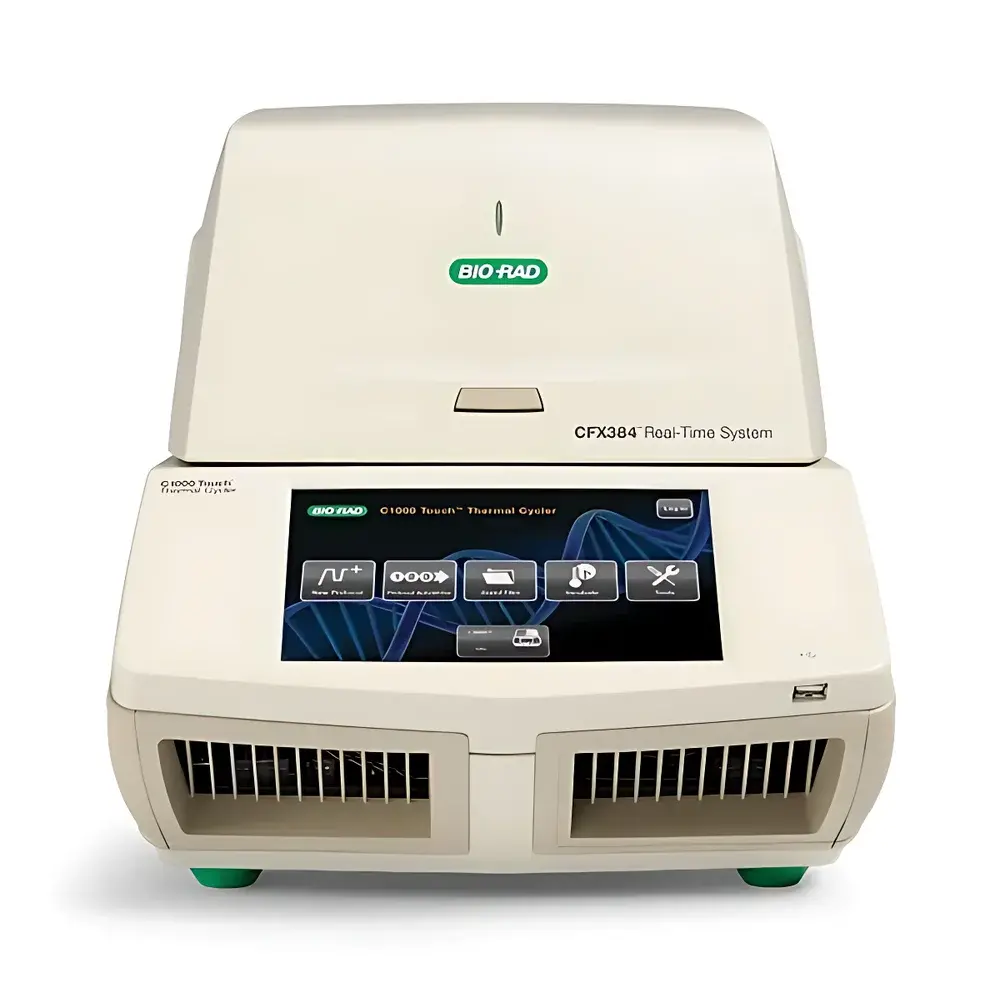
Bio-Rad CFX384 Touch Real-Time PCR Detection System
| Brand | Bio-Rad |
|---|---|
| Origin | USA |
| Model | CFX384 Touch |
| Instrument Type | Real-Time Fluorescence Quantitative PCR System |
| Sample Throughput | 384-well format |
| Maximum Heating Rate | 2.5 °C/s (adjustable from 0.1 to 2.5 °C/s) |
| Temperature Accuracy | ±0.2 °C at 90 °C setpoint |
| Well-to-Well Temperature Uniformity | ±0.4 °C within 10 seconds after reaching 90 °C |
| Excitation Range | 5 LEDs (400–650 nm) |
| Emission Detection Range | 5 Photodiodes (515–690 nm) |
| Supported Applications | Absolute Quantification, Gene Expression Analysis, SNP Genotyping, HRM (High-Resolution Melting), Multiplex Detection (up to 4 targets per well) |
| Software | CFX Maestro Secure Edition (21 CFR Part 11 compliant, audit trail, user access control) |
| Thermal Block | Integrated C1000 Touch thermal cycler engine |
| Gradient PCR | Yes, 30–100 °C range, max ΔT = 24 °C |
| Dimensions (W × D × H) | 33 × 45.7 × 35.6 cm |
| Weight | 21 kg (47 lb) |
Overview
The Bio-Rad CFX384 Touch Real-Time PCR Detection System is a high-throughput, thermally precise, and optically optimized platform engineered for quantitative nucleic acid analysis in demanding research and quality-controlled laboratory environments. Built upon the proven thermal architecture of the C1000 Touch thermal cycler, the system delivers exceptional temperature accuracy (±0.2 °C at 90 °C) and uniformity (±0.4 °C across all 384 wells within 10 seconds of target attainment), ensuring reproducible amplification kinetics critical for absolute quantification, differential gene expression profiling, and allelic discrimination. Its optical design employs a fixed-path, five-channel excitation/detection system—comprising five narrow-band LEDs (400–650 nm) and five matched photodiodes (515–690 nm)—enabling simultaneous, cross-talk-free detection of up to four fluorescent dyes per well. This “light shuttle” architecture eliminates mechanical movement during acquisition, enhancing signal stability and long-term calibration integrity.
Key Features
- 384-well high-throughput capacity with 30 µL maximum reaction volume per well, supporting scalable assay development and large-cohort studies.
- Adjustable heating/cooling rates (0.1–2.5 °C/s), enabling optimization of ramp times for sensitive templates or fast-cycling protocols.
- Integrated gradient PCR capability (30–100 °C, up to 24 °C span) for empirical annealing temperature optimization without instrument reconfiguration.
- 8.5-inch full-color capacitive touchscreen interface—enabling standalone operation, real-time curve monitoring, protocol editing, and run initiation without external PC dependency.
- Factory-calibrated optical system with no user-performed alignment; validated performance traceable to NIST-traceable standards prior to shipment.
- Support for High-Resolution Melting (HRM) analysis with sub-degree thermal resolution and high-sampling-rate fluorescence acquisition.
Sample Compatibility & Compliance
The CFX384 Touch accommodates standard ANSI/SBS-compliant 384-well plates—including low-profile, skirted, and semi-skirted formats—as well as compatible optical seals. It supports common qPCR chemistries (SYBR Green I, hydrolysis probes, molecular beacons, scorpions) and multiplex assays using spectrally distinct dyes (FAM, HEX, ROX, Cy5, Texas Red). The system meets ISO/IEC 17025 requirements for test method validation and is routinely deployed in GLP- and GMP-aligned workflows. Its hardware and CFX Maestro Secure Edition software comply with FDA 21 CFR Part 11 for electronic records and signatures, including role-based access control, full audit trail logging, electronic signature enforcement, and data immutability safeguards.
Software & Data Management
CFX Maestro Secure Edition provides a unified interface for instrument control, experiment design, real-time monitoring, and advanced post-run analysis. It supports comparative ΔΔCq, standard curve quantification, efficiency-corrected models, statistical testing (ANOVA, t-test), and cluster-based expression heatmaps. All raw fluorescence data (Rn values), normalized reporter signals, and baseline-subtracted curves are stored in vendor-neutral .rdml format (RDML v1.2 compliant), facilitating third-party integration and long-term archival. Data export options include CSV, PDF reports, and XML metadata packages suitable for LIMS ingestion or regulatory submission.
Applications
The CFX384 Touch serves as a primary platform for applications requiring statistical power through sample replication and multi-target interrogation: transcriptional profiling across tissue panels, pathogen load quantification in clinical specimens, CRISPR editing efficiency assessment via T7E1 or ddPCR-confirmed indel detection, pharmacodynamic biomarker monitoring in preclinical models, and SNP genotyping in population genetics studies. Its HRM functionality enables closed-tube mutation scanning for oncology panels (e.g., BRAF V600E, KRAS codons 12/13), while its multiplex capability streamlines QC assays for bioprocess monitoring (e.g., host cell DNA clearance, vector copy number).
FAQ
Does the CFX384 Touch support remote instrument monitoring?
Yes—when connected to a local network and configured with CFX Maestro Secure Edition, users can monitor active runs, receive email alerts upon completion, and access real-time amplification plots via web browser on authorized devices.
Is routine optical recalibration required?
No—the fixed optical path and factory calibration are designed for long-term stability; Bio-Rad recommends annual performance verification using the included CFX Calibration Standard Kit, traceable to internal reference materials.
Can the system be integrated into automated liquid handling workflows?
Yes—CFX Maestro supports API-driven control via Bio-Rad’s RESTful instrument control interface, enabling synchronization with robotic deck management systems and centralized scheduling platforms.
What validation documentation is provided?
Each unit ships with a Certificate of Conformance, Factory Calibration Report, and IQ/OQ documentation templates aligned with ASTM E2500 and ISO 13485 Annex A for medical device-related use cases.
Is HRM analysis performed in real time or post-run?
HRM data acquisition occurs during the melting phase immediately following amplification; full-resolution melt curve analysis—including derivative peak calling and genotype clustering—is executed post-run within CFX Maestro using proprietary smoothing and normalization algorithms.
Related Products