
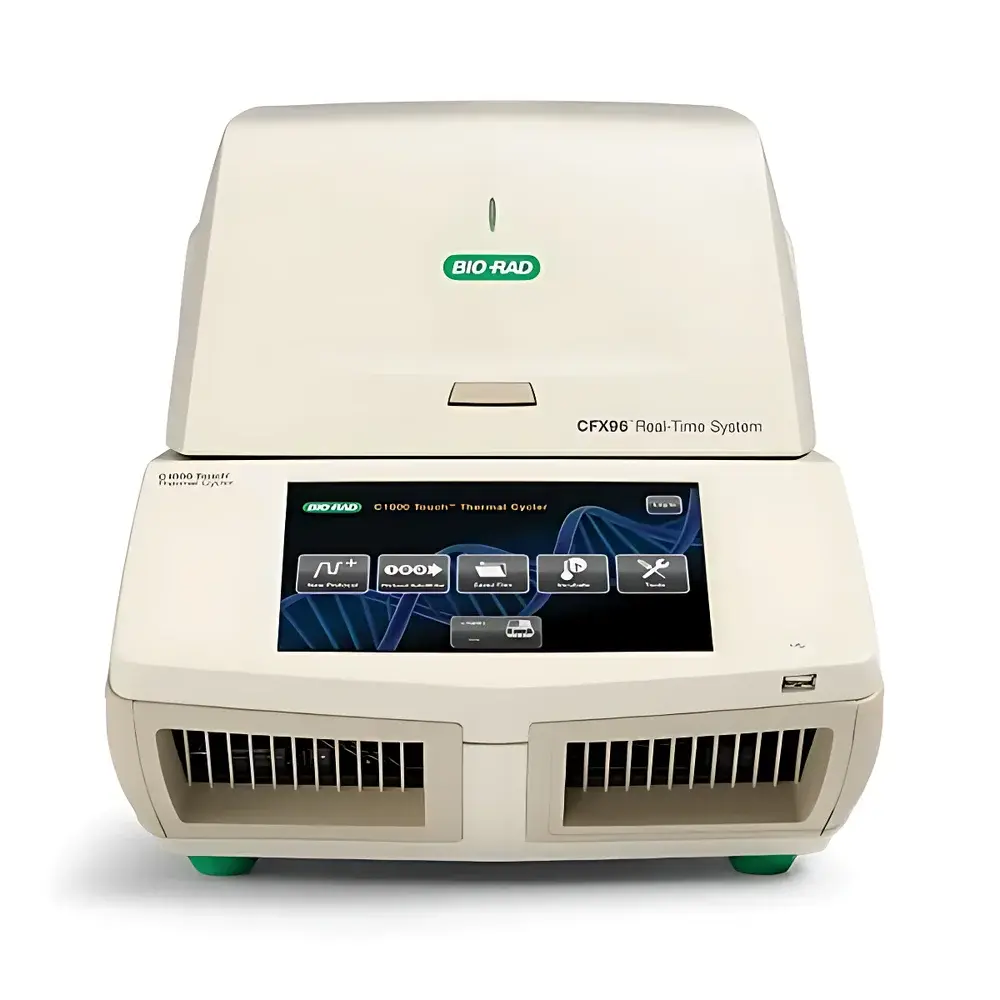
Bio-Rad CFX96 Touch Real-Time PCR Detection System
| Brand | Bio-Rad |
|---|---|
| Origin | USA |
| Model | CFX96 Touch |
| Instrument Type | Real-Time Fluorescence Quantitative PCR System |
| Sample Throughput | 96-well (0.2 mL tubes) |
| Max Heating Rate | 5 °C/s (adjustable from 0.1 to 5 °C/s) |
| Temperature Accuracy | ±0.2 °C at 90 °C setpoint |
| Well-to-Well Temperature Uniformity | ±0.4 °C within 10 seconds after reaching 90 °C |
| Excitation Range | 6 LEDs (450–684 nm) |
| Emission Detection Range | 6 Photodiodes (515–730 nm) |
| Gradient PCR | Yes, 30–100 °C, max ΔT = 24 °C |
| High-Resolution Melting (HRM) Support | Yes |
| Interface | USB |
| Dimensions (W×D×H) | 33 × 45.7 × 35.6 cm |
| Weight | 21 kg |
Overview
The Bio-Rad CFX96 Touch Real-Time PCR Detection System is a fully integrated, high-performance real-time quantitative polymerase chain reaction platform engineered for precision nucleic acid quantification, genotyping, and high-resolution melting (HRM) analysis. It combines the thermally robust C1000 Touch thermal cycler with a dedicated six-channel optical detection module featuring fixed-position LED excitation and photodiode-based fluorescence collection. Unlike systems relying on moving optical components or reference dyes for normalization, the CFX96 Touch employs a factory-aligned, stationary optical architecture—each of the six excitation LEDs and six matched photodiodes is permanently focused on the geometric center of its corresponding well. This design eliminates mechanical drift, ensures consistent focal geometry across all cycles and runs, and removes the need for a dedicated reference channel, thereby maximizing usable detection channels for multiplex assay development. The system operates on the principle of sequence-specific fluorescent probe hybridization (e.g., TaqMan®) or intercalating dye accumulation (e.g., SYBR® Green), with real-time fluorescence intensity captured during each annealing/extension step to generate amplification curves for absolute or relative quantification.
Key Features
- 8.5-inch high-resolution color touchscreen interface enabling standalone operation—program editing, run initiation, and real-time amplification curve monitoring without external computer dependency
- Six independent optical channels with broad spectral coverage (excitation: 450–684 nm; emission: 515–730 nm), supporting common dyes including FAM™, HEX™, ROX™, Cy®3, Cy®5, and Texas Red®
- Factory-calibrated optical path—no user alignment required; guaranteed signal reproducibility across instruments and over time
- Full-plate fluorescence acquisition per cycle—data collected from all 96 wells simultaneously, eliminating plate-file predefinition and enabling flexible post-run analysis
- Programmable thermal gradient functionality (30–100 °C, up to 24 °C differential across the block) for rapid empirical optimization of annealing temperature and primer efficiency
- Integrated HRM capability with precise temperature ramp control (0.01–0.2 °C/s) and high-sampling-rate fluorescence acquisition for robust SNP discrimination and methylation profiling
- Thermal performance validated to ±0.2 °C accuracy at 90 °C and ±0.4 °C well-to-well uniformity within 10 seconds of target attainment—critical for reproducible Cq determination
Sample Compatibility & Compliance
The CFX96 Touch accommodates standard 96-well PCR plates and 0.2 mL tube strips, with maximum reaction volumes of 50 µL. Its thermal block is compatible with both low-profile and full-height vessels meeting ANSI/SBS dimensional standards. The system supports assays compliant with CLIA, ISO 15189, and FDA 21 CFR Part 11 when deployed with appropriate procedural controls and audit-trail-enabled software configurations. While the instrument itself does not carry CE-IVD or FDA 510(k) clearance as a diagnostic device, it is widely used in clinical research laboratories operating under GLP and GMP frameworks for assay development, validation, and routine QC testing of nucleic acid-based methods—including viral load quantification, gene expression profiling, and residual host cell DNA assessment.
Software & Data Management
Data acquisition and analysis are managed through Bio-Rad’s CFX Maestro™ Software—a Windows-based application designed for regulatory-compliant workflows. The software provides built-in tools for baseline correction, threshold setting, efficiency-aware relative quantification (using multiple reference genes), and statistical validation via Student’s t-test and one-way ANOVA. It supports automated export of MIQE-compliant experiment metadata and raw fluorescence data in CSV and RDML formats. Audit trail functionality logs all user actions—including parameter edits, analysis re-runs, and report generation—with timestamps and operator IDs. Data integrity is reinforced through role-based access control, electronic signatures, and encrypted local storage. A single workstation can concurrently manage up to four CFX96 Touch instruments via USB, facilitating centralized instrument monitoring in core facilities.
Applications
The CFX96 Touch is routinely deployed in academic, pharmaceutical, and diagnostic research settings for applications requiring high sensitivity and inter-run reproducibility. These include quantitative detection of RNA viruses (e.g., SARS-CoV-2, influenza), mRNA expression profiling in oncology and immunology studies, allelic discrimination using hydrolysis probes or HRM, copy number variation (CNV) analysis, and validation of CRISPR editing efficiency. Its thermal precision and multi-channel flexibility make it particularly suitable for multiplexed assays targeting co-regulated gene families or pathogen panels. In bioprocess development, the system supports rapid qPCR-based monitoring of adventitious agents and process-related impurities in upstream and downstream unit operations.
FAQ
Does the CFX96 Touch require regular optical recalibration?
No—its fixed-optics architecture is factory calibrated and does not require user-performed optical recalibration. Performance verification is recommended annually using Bio-Rad’s CFX Calibration Dye Kit.
Can I perform melt curve analysis immediately after amplification without pausing the run?
Yes—the system automatically initiates high-resolution melting acquisition following the final extension step, with user-defined ramp rates and data sampling intervals.
Is cloud-based data storage or remote instrument control supported?
Native cloud integration is not provided; however, exported RDML and CSV files are compatible with third-party LIMS and ELN platforms. Remote monitoring requires local network configuration and is limited to status polling via USB-connected host PC.
What validation documentation is supplied with the instrument?
Each unit ships with a Factory Performance Verification Report detailing thermal accuracy, uniformity, optical sensitivity, and channel crosstalk measurements conducted per Bio-Rad’s internal SOPs aligned with ISO/IEC 17025 principles.
Are consumables such as calibration dyes and service contracts available globally?
Yes—Bio-Rad maintains an international distribution network for certified calibration reagents, maintenance kits, and extended service agreements with response-time SLAs defined by regional support centers.




