
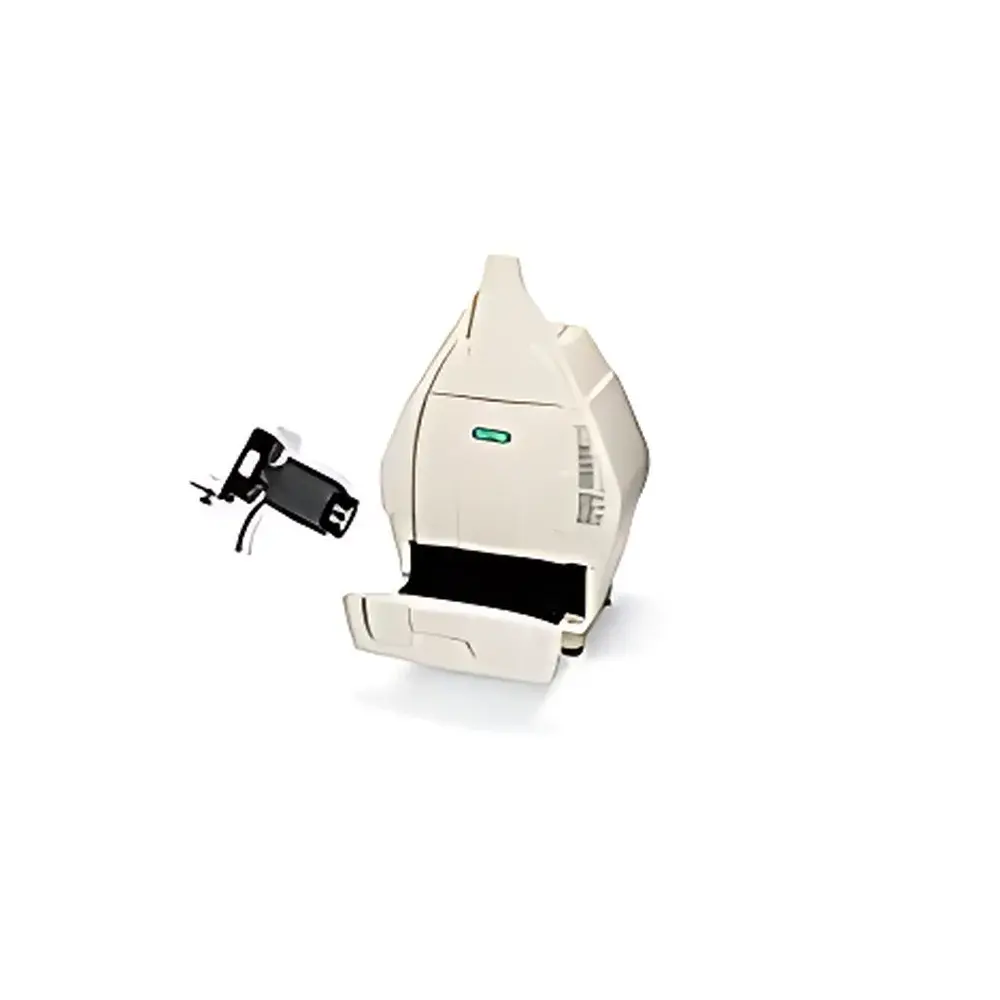
Bio-Rad GelDoc XR+ Gel Imaging System
| Brand | Bio-Rad |
|---|---|
| Origin | USA |
| Model | GelDoc XR+ |
| Instrument Type | Standard Gel Documentation System |
| CCD Resolution | 4.0 Megapixels |
| Bit Depth | 12-bit |
| Dynamic Range | 0–3.6 OD |
| CCD Sensor Size | 2/3-inch |
| Detection Sensitivity | 0.1 ng DNA stained with ethidium bromide (EB) |
| Signal-to-Noise Ratio | >56 dB |
| Lens | Motorized Optical Zoom Lens (8.5–51 mm focal length) |
Overview
The Bio-Rad GelDoc XR+ Gel Imaging System is a dedicated, benchtop-grade documentation platform engineered for reproducible acquisition and quantitative analysis of nucleic acid and protein electrophoresis gels, blot membranes, and other planar biosamples. It operates on the principle of controlled ultraviolet (UV) and visible-light transillumination or epi-illumination, coupled with high-fidelity digital image capture via a cooled monochrome CCD sensor. The system integrates hardware-level exposure control, automated lens focusing, and motorized zoom optics to ensure consistent illumination geometry and pixel-level spatial fidelity across repeated acquisitions. Designed for routine laboratory environments—including core facilities, teaching labs, and QC/QA workflows—the GelDoc XR+ delivers calibrated optical density (OD) measurements traceable to standard reference materials, supporting semi-quantitative densitometry and comparative band intensity analysis without requiring external calibration steps.
Key Features
- Cooled 4.0-megapixel monochrome CCD sensor with 12-bit digitization, enabling high-resolution spatial sampling and linear response across a dynamic range of 0–3.6 optical density units.
- Motorized optical zoom lens (8.5–51 mm focal length) with programmable focus and magnification presets—ensuring repeatable framing and minimal parallax error between samples.
- Dual excitation light sources: long-wave UV (302 nm) for ethidium bromide and SYBR Safe-stained nucleic acids; white LED transilluminator for Coomassie- and silver-stained protein gels; optional blue-light epi-illumination module for SYPRO Ruby and Oriole fluorescence detection.
- Integrated darkroom enclosure with UV-blocking safety interlock and automatic shutter control—complying with IEC 61000-6-3 electromagnetic compatibility standards and minimizing operator UV exposure per ANSI Z136.1 guidelines.
- Onboard image acquisition engine with real-time histogram preview, auto-exposure optimization, and background subtraction algorithms—reducing manual intervention and improving inter-operator consistency.
Sample Compatibility & Compliance
The GelDoc XR+ accommodates a broad spectrum of planar biosamples: transparent/translucent gels (agarose, polyacrylamide), nitrocellulose and PVDF membranes (Western, Southern, Northern blots), autoradiography films, and reflective media (photographic prints, filter papers). It supports common nucleic acid stains including ethidium bromide (detection limit: 0.1 ng DNA), SYBR Safe, GelRed, and Radiant Red; protein stains such as Coomassie Brilliant Blue R-250, silver nitrate, SYPRO Ruby, and Oriole. All image acquisition protocols are compatible with GLP-compliant documentation workflows. ImageLab software optionally supports 21 CFR Part 11 audit trails, electronic signatures, and secure user access controls when deployed in regulated environments (e.g., clinical research labs under CLIA or ISO 15189 accreditation).
Software & Data Management
Controlled exclusively via Bio-Rad’s ImageLab software (v6.1 or later), the GelDoc XR+ enables fully automated acquisition, annotation, and analysis. ImageLab provides lane and band detection using adaptive thresholding, molecular weight estimation via internal or user-defined standards, relative quantification with background-subtracted integrated density values (IDV), and export of MIAME-compliant metadata. Raw images are saved in TIFF format with embedded EXIF tags (exposure time, lens position, light source ID, gain setting), ensuring full experimental traceability. Batch processing, report generation (PDF/Excel), and LIMS integration via CSV or XML export are supported. Software validation packages—including IQ/OQ documentation and installation qualification checklists—are available upon request for GxP-regulated installations.
Applications
- Verification and documentation of PCR, RT-PCR, and qPCR amplification products on agarose or polyacrylamide gels.
- Quantitative assessment of protein expression levels from SDS-PAGE gels stained with Coomassie or fluorescent dyes.
- Validation of Western blot transfer efficiency and antibody specificity through chemiluminescent or fluorescent signal capture (with optional CCD cooling upgrade).
- Educational use in undergraduate and graduate molecular biology laboratories for standardized gel documentation and peer-reviewed data presentation.
- QC release testing of recombinant proteins, plasmid preps, and CRISPR editing outcomes where visual confirmation and band intensity ratios are required.
FAQ
Does the GelDoc XR+ support chemiluminescence detection?
Yes, when equipped with the optional deep-cooled CCD upgrade and high-sensitivity lens, the system achieves sufficient sensitivity for routine chemiluminescent Western blot imaging—though it is not optimized for ultra-low-light applications such as single-cell bioluminescence.
Can ImageLab software be installed on Windows 11 or macOS?
ImageLab is validated for Windows 10 and Windows 11 (64-bit); macOS is not supported. Virtual machine deployment is not recommended due to USB device enumeration and real-time camera latency constraints.
Is UV exposure automatically disabled during sample loading?
Yes—the internal UV lamp deactivates immediately upon opening the imaging chamber door, and the safety interlock prevents reactivation until the door is fully latched and the shutter is closed.
What file formats does the system export for downstream analysis?
TIFF (primary raw image), PNG (annotated preview), PDF (formatted reports), and Excel-compatible CSV files containing band intensities, molecular weights, and normalization metrics.
How often does the UV lamp require replacement?
The 302 nm UV transilluminator lamp has a rated service life of ≥2,000 hours; Bio-Rad recommends annual verification of irradiance output using a NIST-traceable UV radiometer as part of preventive maintenance.




