
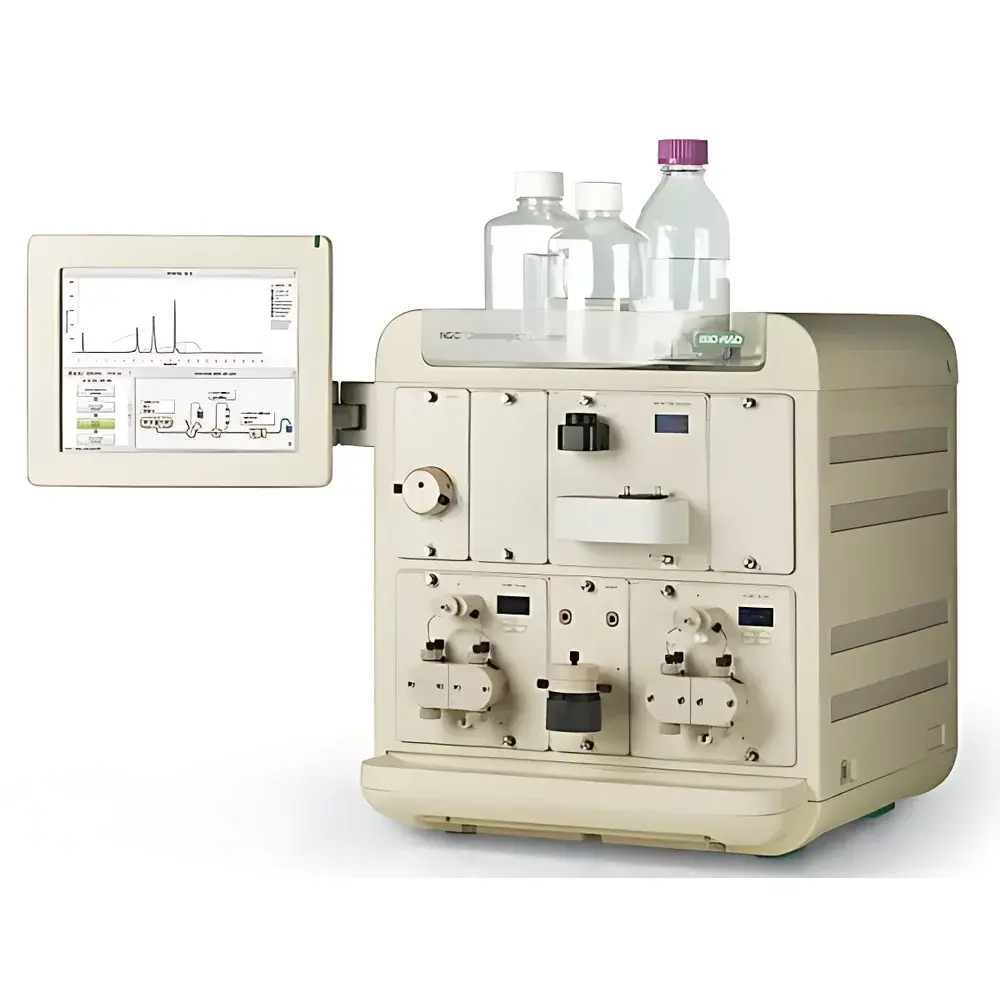
Bio-Rad NGC Quest 10 Medium- to High-Pressure Chromatography System
| Brand | Bio-Rad |
|---|---|
| Origin | USA |
| Model | Quest 10 |
| Flow Rate | 0–10 mL/min |
| Maximum Pressure | 3650 psi |
| Buffer Blending | Integrated Auto-Buffering Valve System (up to 20 mL/min effective flow) |
| UV Detection Options | Single-wavelength (255 nm / 280 nm) or Full-spectrum (190–800 nm, 4-channel simultaneous detection) |
| Software | ChromLab™ with touchscreen interface |
| Automation Modules | Optional sample/injection valves, column switching valves, fraction collection (BioFrac™), and outlet valves |
Overview
The Bio-Rad NGC Quest 10 is a medium- to high-pressure liquid chromatography system engineered for precise, reproducible purification of biomolecules—including monoclonal antibodies, recombinant proteins, enzymes, and viral vectors—across research, process development, and pilot-scale manufacturing environments. Built upon a true modular architecture, the Quest 10 operates on principles of low-dispersion gradient elution and real-time UV absorbance monitoring, enabling robust separation performance under controlled pressure and flow conditions up to 3650 psi. Its design adheres to fundamental chromatographic requirements for backpressure stability, gradient fidelity, and dwell volume minimization—critical for method transfer between analytical and preparative scales. Unlike fixed-configuration systems, the Quest 10 supports scalable hardware expansion without software reconfiguration, allowing seamless integration of additional fluidic modules, detection channels, or collection units as workflow complexity increases.
Key Features
- Modular fluidic architecture with standardized interconnects—enables plug-and-play addition of valves, mixers, detectors, and fraction collectors without recalibration.
- High-fidelity dual-piston pump delivering stable flow from 0.01 to 10 mL/min with pulse dampening optimized for low-volume analytical and semi-preparative runs.
- Integrated auto-buffering valve system supporting on-the-fly binary or ternary gradient formation; extends effective flow capacity to 20 mL/min via dynamic dilution while maintaining stoichiometric accuracy.
- UV/Vis detection options: choice between single-wavelength detector (255 nm and 280 nm fixed-bandwidth) or full-spectrum diode-array detector (190–800 nm, 1 nm resolution, 4 wavelengths monitored simultaneously for peak deconvolution and purity assessment).
- ChromLab™ software with embedded 7-inch capacitive touchscreen—provides intuitive method building, real-time chromatogram visualization, baseline correction, peak integration, and export of AIA-compliant .cdf files.
- Compliance-ready features including user access levels, electronic signatures, audit trail logging, and method locking—aligned with FDA 21 CFR Part 11 and GLP/GMP documentation expectations.
Sample Compatibility & Compliance
The Quest 10 accommodates standard analytical and semi-preparative columns (e.g., 4.6 × 150 mm to 21.2 × 250 mm) packed with reversed-phase, ion-exchange, size-exclusion, or affinity media. It supports aqueous and organic solvent compatibility (including acetonitrile, methanol, and isopropanol), pH-stable mobile phases (pH 1–14), and biocompatible buffer systems (e.g., sodium acetate, Tris-HCl, phosphate). All wetted parts are constructed from chemically inert materials—including PEEK, sapphire, and stainless steel 316L—to ensure minimal metal leaching and long-term system integrity. The platform conforms to ISO 9001-certified manufacturing practices and supports validation protocols per ICH Q5A, USP , and ASTM E2500-22 for analytical instrument qualification.
Software & Data Management
ChromLab™ serves as the unified control and analysis environment for the Quest 10. It supports method templates compliant with common purification workflows (e.g., protein A capture, ion-exchange polishing, desalting), includes built-in QC checks (e.g., pressure ramp verification, UV lamp intensity calibration), and enables direct export to LIMS or ELN platforms via CSV, PDF, or XML. Audit trails record all parameter changes, run executions, and user actions with timestamps and operator IDs. Data integrity safeguards include write-protection for completed runs, encrypted database storage, and configurable retention policies—all essential for regulated environments requiring traceability under 21 CFR Part 11.
Applications
- Purification of therapeutic proteins and antibody fragments during upstream/downstream process development.
- Method scouting and optimization for HIC, SEC, and multimodal chromatography under varying salt gradients and pH conditions.
- Quality control testing of purified biologics—including aggregate quantification, fragment analysis, and host cell protein clearance assessment.
- Small-molecule ligand screening using immobilized target proteins in affinity mode.
- Scale-down modeling for tech transfer from lab-scale to clinical manufacturing processes.
FAQ
What is the maximum operating pressure for the Quest 10 system?
The Quest 10 is rated for continuous operation up to 3650 psi (25.2 MPa), with pressure sensors calibrated and certified per ANSI/ISA-5.1 standards.
Can ChromLab software be installed on external PCs for remote monitoring?
Yes—ChromLab supports client-server deployment over local networks; remote desktop access requires IT-approved secure tunneling protocols.
Is the system compatible with third-party columns and consumables?
The Quest 10 accepts industry-standard fittings (10-32 UNF, 1/16″ tubing) and is fully compatible with columns from manufacturers including Cytiva, Tosoh, Agilent, and Thermo Fisher—provided they meet dimensional and pressure specifications.
Does the system support automated method validation per ICH guidelines?
While the hardware and software provide foundational tools for validation (e.g., system suitability tests, precision checks), formal IQ/OQ/PQ execution requires site-specific protocols developed in accordance with ICH Q2(R2) and internal SOPs.
How is data backup and recovery handled?
ChromLab includes scheduled automatic database backups to network drives or external USB storage; recovery is performed via point-in-time restore using native SQLite transaction logs.






