
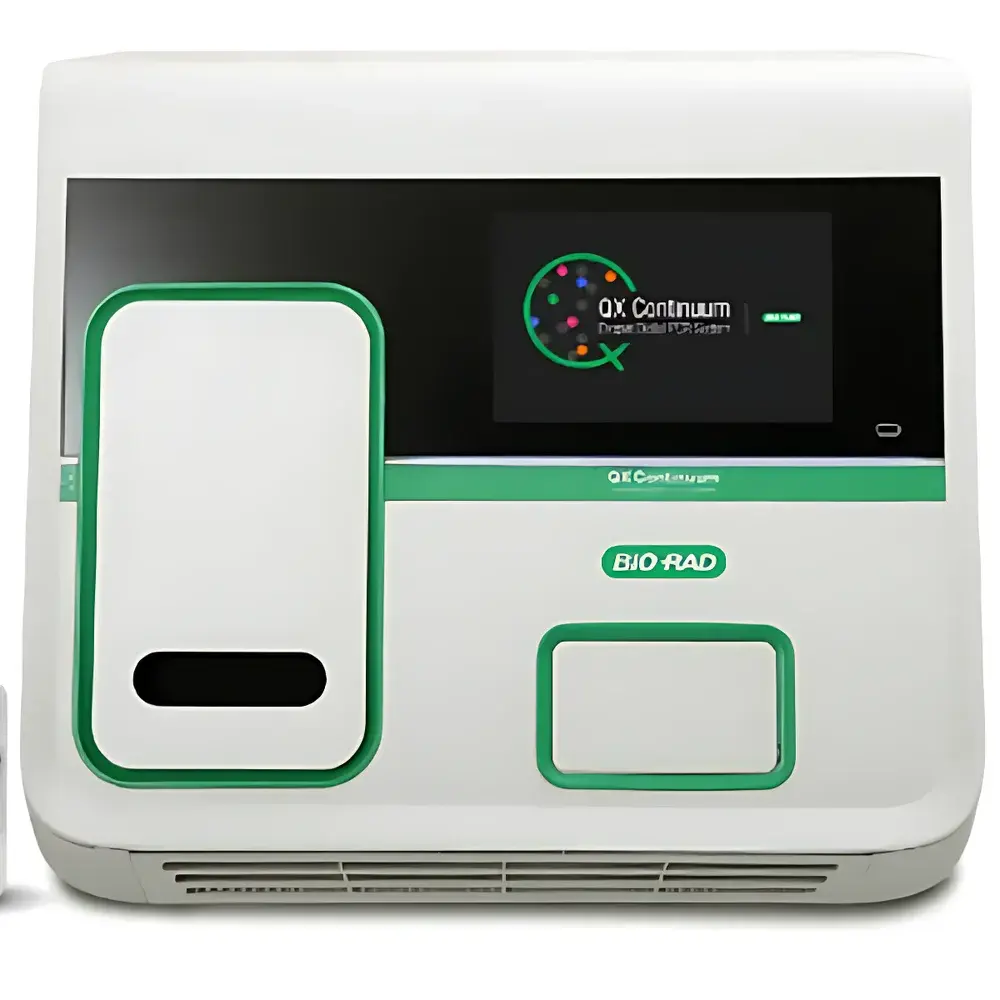
Bio-Rad QX Continuum™ Droplet Digital PCR™ System
| Brand | Bio-Rad |
|---|---|
| Origin | USA |
| Model | QX Continuum™ |
| Instrument Type | Digital PCR System |
| Sample Throughput | 96-well format |
| Certified Performance | NMI-traceable reference material validation |
| Droplet Generation | >20,000 droplets per 16 µL sample |
| Multiplexing Capacity | Up to 4 targets per well |
| Thermal Zones | Up to 8 independent temperature zones per plate |
| Software | QX Insight Analysis Software |
| Regulatory Status | For Research Use Only (RUO), not for clinical diagnostic use |
| Compliance | Designed to support GLP/GMP-aligned data integrity practices |
Overview
The Bio-Rad QX Continuum™ Droplet Digital PCR™ (ddPCR™) System is an integrated, walk-away digital PCR platform engineered for precision absolute nucleic acid quantification without reliance on standard curves. It employs water-oil emulsion-based microdroplet partitioning—generating over 20,000 nanoliter-scale reaction compartments per 16 µL input sample—to enable binary (positive/negative) endpoint detection of target DNA or cDNA molecules. This partitioning strategy eliminates amplification efficiency bias inherent in quantitative PCR (qPCR), delivering statistically robust copy number measurements with exceptional reproducibility across technical replicates and inter-laboratory studies. The system bridges the performance advantages of ddPCR—namely, high sensitivity for rare allele detection (<0.001% mutant fraction), resilience to PCR inhibitors, and precise absolute quantification—with operational familiarity drawn from conventional qPCR workflows, including compatibility with standard 96-well PCR plates and intuitive thermal cycling paradigms.
Key Features
- Integrated hardware architecture enabling fully automated droplet generation, thermal cycling, and fluorescence readout in a single instrument footprint—no external droplet generator or reader required.
- Four-channel optical detection system supporting simultaneous quantification of up to four targets per well using FAM, HEX, Cy5, and Cy5.5-compatible dyes.
- Programmable thermal block with up to eight independently controlled temperature zones per 96-well plate, facilitating multiplexed assays requiring distinct annealing or extension conditions within a single run.
- NMI-traceable performance validation: system accuracy verified against certified reference materials issued by Australia’s National Measurement Institute, ensuring metrological confidence in reported copy numbers.
- Robust partitioning efficiency: consistent generation of ≥20,000 monodisperse droplets per 16 µL sample volume, minimizing Poisson noise and maximizing dynamic range (typically 1–10⁵ copies/µL).
Sample Compatibility & Compliance
The QX Continuum™ accepts standard 96-well PCR plates (full-skirted, semi-skirted, or non-skirted), eliminating the need for proprietary consumables and reducing per-run cost. It supports both DNA and reverse-transcribed cDNA templates, with demonstrated compatibility across diverse sample types—including FFPE-derived nucleic acids, plasma cfDNA, microbial lysates, and food matrix extracts—without requiring pre-amplification or cleanup in most cases. All assay chemistries validated for Bio-Rad’s ddPCR portfolio—including PrimePCR™ ddPCR Assays and custom probe-based designs—are directly deployable. As a Research Use Only (RUO) instrument, it complies with ISO/IEC 17025 principles for testing laboratories and incorporates design elements aligned with FDA 21 CFR Part 11 expectations, including electronic signatures, role-based user permissions, and time-stamped audit trails within QX Insight software.
Software & Data Management
QX Insight Analysis Software (v3.0+) provides a unified interface for experiment setup, real-time monitoring, droplet classification, and statistical reporting. Its algorithm suite applies adaptive thresholding and cluster recognition to distinguish true positive partitions from background fluorescence, with optional manual review mode for borderline events. Data export supports CSV, FCS, and MIAME-compliant formats; raw fluorescence intensity files are stored with embedded metadata (instrument ID, operator, timestamp, thermal profile). Version-controlled analysis pipelines ensure method reproducibility, while encrypted local storage and optional LDAP integration support institutional IT security policies. All analysis sessions generate immutable audit logs compliant with GLP documentation requirements.
Applications
- Gene expression quantification at low-abundance levels—e.g., transcriptional profiling of rare cell populations or single-cell lysates.
- CNV (copy number variation) analysis in cancer genomics, particularly for focal amplifications/deletions below qPCR resolution limits.
- Rare mutation detection in liquid biopsy applications, including EGFR T790M, BRAF V600E, and KRAS G12D in circulating tumor DNA.
- Pathogen load monitoring in virology and antimicrobial resistance studies, where absolute titer determination informs therapeutic decisions.
- NGS library quality control—validating target enrichment efficiency and detecting off-target amplification prior to sequencing.
- Food authenticity testing and GMO quantification, meeting EU Regulation (EC) No 1829/2003 requirements for trace-level detection and reporting.
FAQ
Is the QX Continuum™ approved for clinical diagnostics?
No. This system is designated for Research Use Only (RUO) and is not cleared or approved by the FDA, CE-IVD, or other regulatory bodies for clinical diagnostic procedures.
Can I use my existing qPCR assays on the QX Continuum™?
Yes—most hydrolysis probe-based qPCR assays can be adapted for ddPCR with minor optimization of primer/probe concentrations and annealing temperatures; Bio-Rad provides detailed conversion protocols in Application Note 10022237.
What is the minimum input DNA quantity required for reliable quantification?
For most applications, 1–10 ng of high-quality genomic DNA yields optimal droplet occupancy; however, the system has demonstrated reliable detection down to 100 pg in inhibitor-rich matrices when combined with ddPCR Supermix for Probes.
Does the system support automation integration?
Yes—the QX Continuum™ features standard RS-232 and Ethernet interfaces, and its API supports LIMS connectivity and scheduled run initiation via third-party laboratory automation platforms.
How is data integrity maintained during long-term archival?
QX Insight stores all raw fluorescence data, analysis parameters, and audit logs in a relational database structure with SHA-256 hash verification; backup exports include cryptographic checksums to ensure bit-for-bit fidelity upon restoration.




