
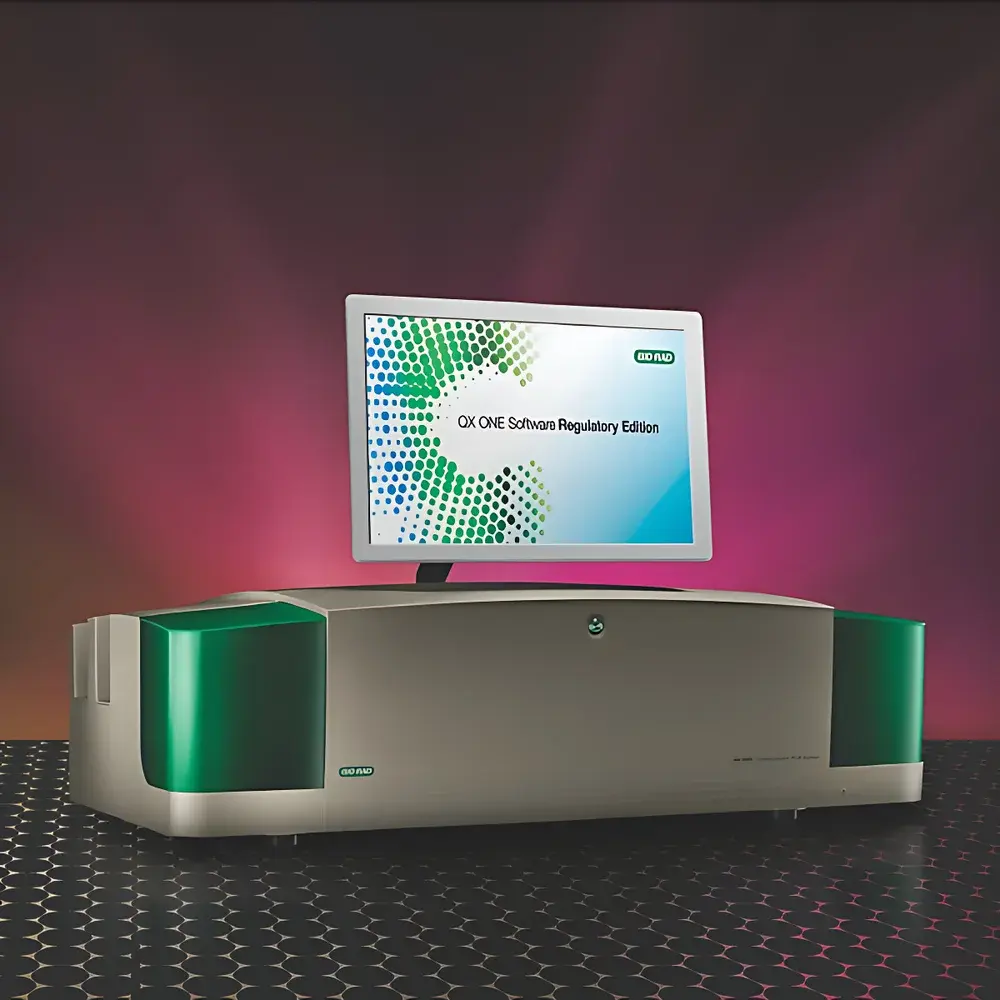
Bio-Rad QX ONE Digital Droplet PCR System
| Brand | Bio-Rad |
|---|---|
| Origin | USA |
| Manufacturer Type | Authorized Distributor |
| Product Origin | Imported |
| Model | QX ONE |
| Instrument Type | Digital PCR System |
| Sample Throughput | 32–480 wells per run |
| Heating Rate | 2.5 °C/s |
| Temperature Accuracy | ±0.2 °C (at 90 °C) |
| Well-to-Well Temperature Uniformity | ±0.4 °C (at 90 °C) |
Overview
The Bio-Rad QX ONE Digital Droplet PCR System is an integrated, walk-away digital PCR platform engineered for precision quantification of nucleic acid targets at the single-molecule level. Leveraging water-oil emulsion-based droplet partitioning and endpoint fluorescence detection, the system implements absolute quantification without reliance on standard curves—enabling high sensitivity, low coefficient of variation (60% compared to legacy ddPCR workflows.
Key Features
- End-to-end automation: Fully integrated droplet generation, thermocycling (with ramp rate up to 2.5 °C/s), and optical readout in one instrument—no external droplet generator or reader required.
- High-throughput capacity: Supports 32–480 reactions per run across standard 96-well or 384-well PCR plates; up to five plates (480 reactions) can be processed unattended in a single day.
- Four-channel fluorescence detection: Simultaneous excitation and emission capture across four spectrally distinct channels (FAM, HEX/VIC, Cy5, and Cy5.5/Quasar 670), enabling multiplexed target discrimination via both wavelength and intensity resolution.
- Enhanced multiplex capability: Optimized for up to 8-plex copy number variation (CNV) analysis, 5-plex mutation detection (e.g., SNVs, indels), or 4-plex gene expression profiling per well using validated ddPCR Multiplex Supermix formulations.
- Intuitive touchscreen interface: Graphical user interface with guided workflow setup, real-time status monitoring, and embedded QC metrics—including droplet count validation, cluster separation assessment, and threshold auto-calibration.
- Thermal precision engineering: Peltier-based thermal control with ±0.2 °C accuracy at 90 °C and ±0.4 °C well-to-well uniformity ensures reproducible amplification kinetics critical for digital endpoint quantification.
Sample Compatibility & Compliance
The QX ONE maintains full backward compatibility with all QX200 consumables, including ddPCR Supermixes (Probe and EvaGreen), assay-specific primers/probes, and microfluidic cartridges. It accepts standard 96-well and 384-well PCR plates with barcoded or RFID-enabled lids—supporting automated lot traceability and inventory management per ISO 13485 and GMP-aligned laboratory practices. The regulatory-compliant software edition meets U.S. FDA 21 CFR Part 11 requirements, providing role-based access control, electronic signatures, and immutable audit trails for all protocol modifications, run executions, and data exports. All data files are stored in vendor-neutral .ddpcr format compliant with MIAME and MIAPE metadata standards, facilitating integration into LIMS and ELN environments under GLP/GCP frameworks.
Software & Data Management
QX ONE Control Software v3.x delivers a unified environment for experimental design, real-time acquisition, and post-run analysis—including automatic droplet classification, Poisson correction, confidence interval estimation, and statistical comparison across samples. Raw fluorescence intensity data is retained at full resolution for reanalysis. Export options include CSV, Excel, and PDF reports conforming to CLIA and CAP reporting guidelines. Audit logs record timestamps, operator IDs, parameter changes, and file integrity hashes—fully traceable for internal audits or regulatory inspections. Cloud-based data backup and multi-user collaboration features support distributed research teams operating under shared SOPs.
Applications
The system is routinely deployed in clinical assay development (e.g., MRD monitoring in hematologic malignancies), liquid biopsy validation (ctDNA variant allele frequency quantification), reference material characterization (NIST-traceable DNA standards), and bioprocess analytics (viral vector titer determination). Its low limit of detection (~0.1% VAF) and high inter-run reproducibility (CV < 5% across 10 replicates) make it suitable for ISO/IEC 17025-accredited testing laboratories. Applications extend to food safety (pathogen load quantification), environmental microbiology (antibiotic resistance gene copy number), and agricultural biotechnology (GMO copy number verification).
FAQ
Is the QX ONE compatible with existing QX200 assays and reagents?
Yes—the system uses identical ddPCR Supermixes, probe-based assays, and cartridge formats as the QX200 platform, ensuring seamless method transfer and data comparability.
What level of multiplexing does the four-channel detection support?
Depending on assay design and spectral overlap, users routinely achieve 4-plex gene expression, 5-plex mutation detection, or 8-plex CNV analysis per well using optimized probe sets and the 4x ddPCR Multiplex Supermix.
Does the system support remote monitoring or integration with laboratory information systems?
Yes—via secure HTTPS API endpoints and HL7/FHIR-compatible metadata export, enabling bidirectional communication with major LIMS platforms and centralized instrument monitoring dashboards.
How is temperature calibration maintained across the plate?
Each instrument undergoes factory calibration with NIST-traceable sensors; users may perform optional field verification using certified thermal validation plates per ASTM E2251 guidelines.
Are consumables tracked automatically during runs?
RFID-tagged plate lids and cartridge labels are scanned at loading; lot numbers, expiration dates, and usage history are logged automatically in the audit trail and exported with analytical reports.




