
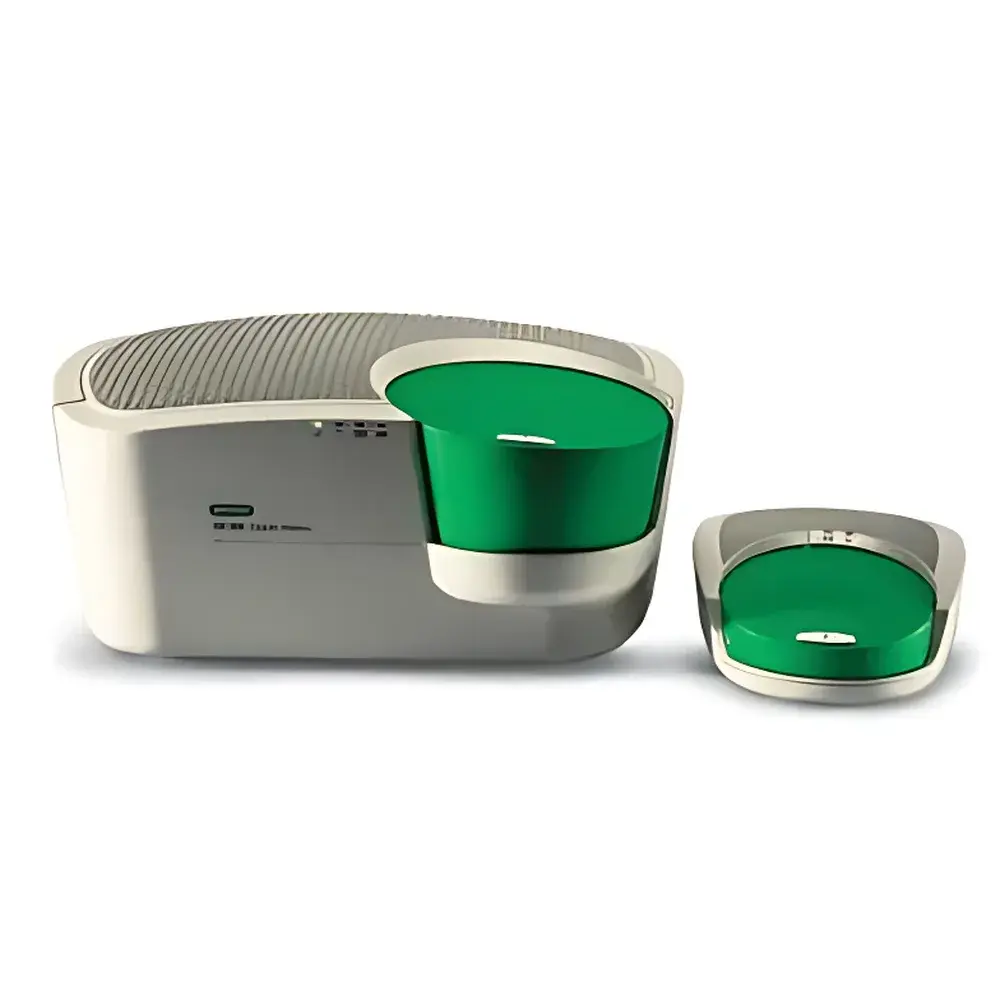
Bio-Rad QX200 Droplet Digital PCR System
| Brand | Bio-Rad |
|---|---|
| Origin | Singapore |
| Model | QX200 |
| Instrument Type | Digital PCR System |
| Sample Throughput | 96-well format |
| Heating Rate | 0.1–5.0°C/s (typical setting: 2.0°C/s) |
| Temperature Accuracy | ±0.2°C (at 90°C) |
| Well-to-Well Temperature Uniformity | ±0.4°C (at 90°C) |
Overview
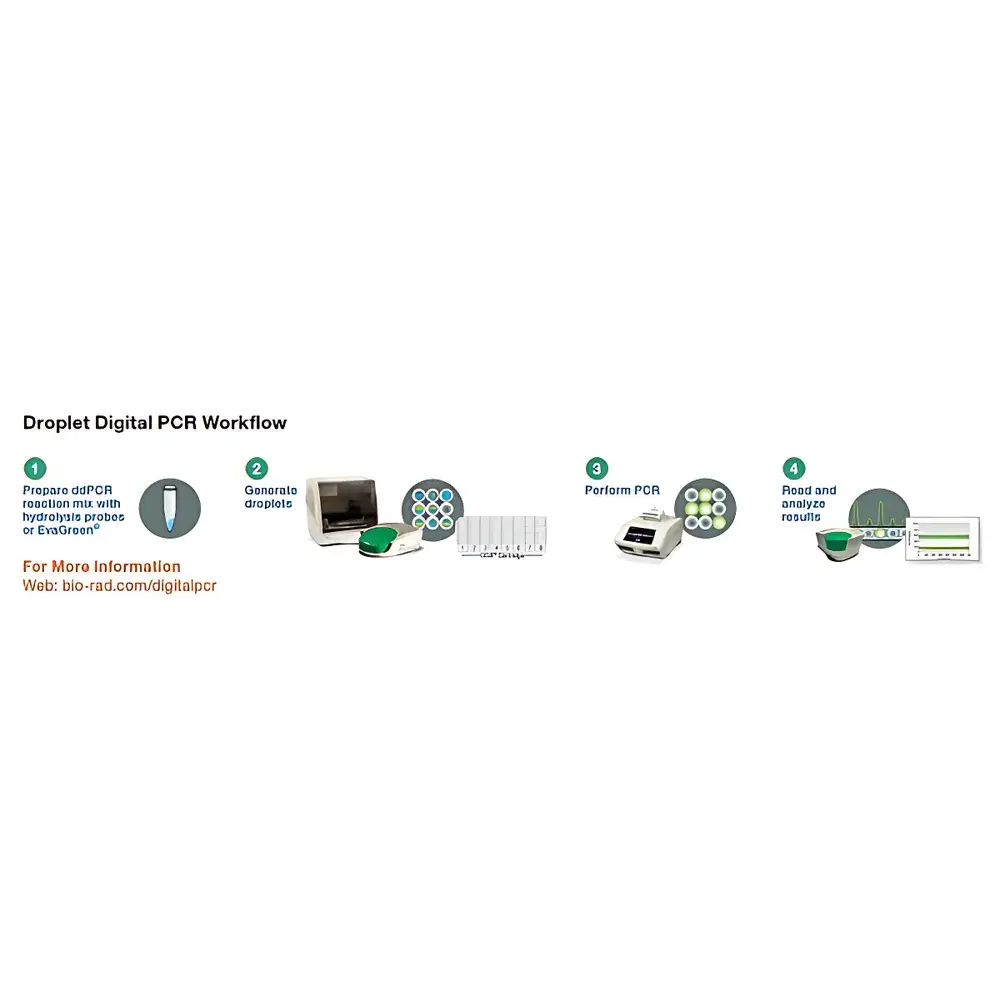
The Bio-Rad QX200 Droplet Digital PCR (ddPCR) System is a two-instrument platform engineered for absolute nucleic acid quantification without reliance on standard curves. It implements partition-based digital PCR technology—specifically droplet-based microfluidic compartmentalization—to convert analog amplification signals into binary (positive/negative) digital readouts. Each sample is partitioned into approximately 20,000 nanoliter-sized water-in-oil droplets using the QX200 Droplet Generator, followed by endpoint thermal cycling. Post-amplification, the QX200 Droplet Reader optically interrogates each droplet via dual-channel fluorescence detection (FAM/HEX or similar dye pairs), enabling precise enumeration of target-positive and target-negative partitions. This binary counting principle delivers inherent resistance to PCR inhibition, reduced sensitivity to amplification efficiency variance, and superior precision in low-abundance target detection—particularly critical in applications requiring single-molecule resolution and high reproducibility across heterogeneous biological matrices.
Key Features
- Dual-instrument architecture: Integrated QX200 Droplet Generator and QX200 Droplet Reader for end-to-end ddPCR workflow execution
- High-fidelity partitioning: Generates ~20,000 monodisperse nanoliter droplets per reaction, ensuring statistically robust digital quantification
- 96-well sample throughput: Fully compatible with standard PCR plates, supporting parallel processing under controlled thermal profiles
- Thermal performance: Programmable heating rate (0.1–5.0°C/s), temperature accuracy of ±0.2°C at 90°C, and well-to-well uniformity of ±0.4°C at 90°C—meeting ISO/IEC 17025-relevant thermal validation criteria for quantitative molecular assays
- Flexible assay compatibility: Optimized for both probe-based (TaqMan hydrolysis probes) and intercalating dye (EvaGreen) chemistries
- No-standard-curve quantification: Enables direct absolute copy number determination per microliter of input sample
- Post-PCR droplet recovery option: Amplified products can be extracted from emulsified droplets for downstream applications including Sanger sequencing, NGS library validation, and cloning
Sample Compatibility & Compliance
The QX200 system accommodates diverse nucleic acid inputs—including genomic DNA, cDNA, miRNA, viral RNA, and FFPE-derived extracts—across clinical, environmental, food safety, and research settings. Its partitioning strategy mitigates matrix effects commonly observed in complex samples (e.g., soil lysates, plasma, stool supernatants). The platform supports assay development and validation aligned with CLIA, CAP, and ISO 13485 frameworks. While not inherently 21 CFR Part 11-compliant out-of-the-box, the QuantaSoft analysis software (v1.7+) offers optional audit trail, electronic signature, and user access control modules suitable for GLP/GMP-regulated environments when deployed on validated IT infrastructure.
Software & Data Management
Data acquisition and analysis are performed using QuantaSoft™ software, which provides real-time droplet classification, Poisson correction, copy number calculation, and statistical confidence interval estimation. Raw FCS (Flow Cytometry Standard)-formatted droplet data files support third-party integration and reanalysis. Version-controlled software updates, automated QC flagging (e.g., droplet count outliers, fluorescence threshold drift), and batch reporting templates facilitate traceability. Export options include CSV, PDF, and XML formats compliant with LIMS interoperability standards. All analysis parameters—including fluorescence thresholds, gating logic, and background subtraction algorithms—are fully documented and exportable for regulatory submissions.
Applications
- Cancer biomarker research: Detection of rare somatic mutations (e.g., EGFR T790M, BRAF V600E) and precise copy number variation (CNV) profiling in liquid biopsies and tumor tissue
- Infectious disease monitoring: Absolute quantification of viral load (e.g., HIV, HBV, SARS-CoV-2) and antimicrobial resistance gene copies in clinical specimens
- NGS library quantification: Accurate, bias-free measurement of adapter-ligated DNA fragments prior to sequencing—eliminating qPCR overestimation artifacts
- Gene expression analysis: Reliable detection of low-abundance transcripts and isoform-specific variants, especially in single-cell or exosomal RNA workflows
- Environmental microbiology: Enumeration of functional genes (e.g., nitrogen cycle markers) and pathogen DNA in wastewater, soil, and marine samples
- Food authenticity testing: Certified GMO quantification per EU Regulation (EC) No 1829/2003 and ISO 21570:2019 requirements
FAQ
How does ddPCR differ from conventional qPCR in terms of quantification accuracy?
ddPCR eliminates dependence on amplification efficiency and standard curves by digitally counting endpoint fluorescence events across thousands of partitions—yielding absolute copy number with lower coefficient of variation, especially below 10 copies/μL.
Can the QX200 system process non-standard plate formats?
No—the system is designed exclusively for ANSI/SLAS-compliant 96-well plates; custom or low-profile plates are not supported.
Is droplet generation compatible with master mix formulations containing additives like BSA or betaine?
Yes, provided surfactant-compatible master mixes are used; however, high concentrations of glycerol (>5%) or viscous polymers may impair droplet formation uniformity and require empirical optimization.
What regulatory documentation is available for method validation?
Bio-Rad provides instrument qualification protocols (IQ/OQ), application notes aligned with USP , and technical bulletins supporting assay transfer per ICH Q2(R2); full validation packages require site-specific execution.
Does the system support multiplexed detection beyond two channels?
The optical configuration is dual-channel (FAM/HEX); true triplex or higher-plex detection requires post-run sample splitting or sequential hybridization strategies—not native hardware capability.
Related Products




