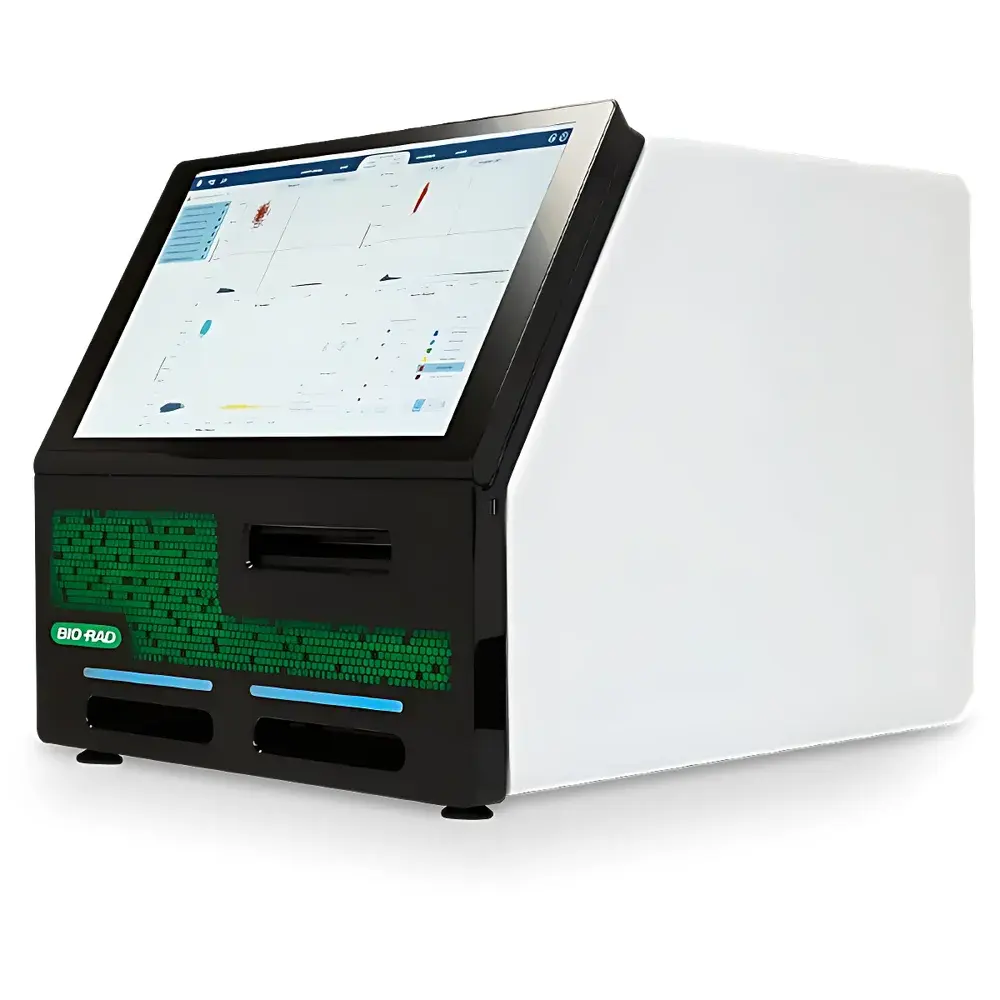
Bio-Rad QX700™ S Droplet Digital PCR System
| Brand | Bio-Rad |
|---|---|
| Origin | USA |
| Manufacturer Type | Authorized Distributor |
| Product Category | Imported Instrument |
| Model | QX700™ S |
| Instrument Type | Digital PCR System |
| Sample Throughput | 192-well format |
| Detection Channels | 7-color simultaneous detection |
| Sample Input Volume | 5 µL |
| Effective Droplet Partitions per Sample | ≥17,000 |
| Automation Level | Fully automated end-to-end workflow |
| Chip Format | 16-well disposable cartridge (scalable to 192 samples per run) |
| Run Time for 192 Samples | 8 hours |
| Run Time for 96 Samples | 5 hours |
| Thermal Cycling | Independent programmable thermal cycling per well |
Overview
The Bio-Rad QX700™ S Droplet Digital PCR (ddPCR™) System is a fully integrated, high-throughput digital PCR platform engineered for absolute nucleic acid quantification without reliance on standard curves. Based on water-oil emulsion droplet partitioning and endpoint fluorescence detection, the system partitions each 5 µL sample into ≥17,000 nanoliter-scale reaction compartments—enabling binary (positive/negative) detection of target DNA or RNA molecules with single-molecule sensitivity and exceptional precision. Unlike conventional qPCR, ddPCR delivers absolute copy number quantification with high reproducibility across technical replicates and inter-laboratory studies, making it indispensable for low-abundance target detection, rare mutation analysis, copy number variation (CNV) assessment, and NGS library validation. The QX700™ S is purpose-built for translational research, clinical assay development, and regulatory-compliant workflows where quantitative rigor and traceability are critical.
Key Features
- Fully automated end-to-end workflow—from droplet generation and thermal cycling to droplet reading—eliminates manual intervention and minimizes operator variability.
- 7-color fluorescence detection capability supports multiplexed assays using common dyes (FAM, HEX, VIC, ROX, Cy5, Cy5.5, and Quasar 670), enabling simultaneous interrogation of up to seven targets per sample.
- Independent thermal cycling control per well within the 16-well disposable cartridge allows heterogeneous assay conditions in a single run—ideal for optimizing multi-target panels or validating orthogonal primer/probe sets.
- Scalable throughput architecture accommodates 16–192 samples per instrument run via modular chip loading; 192-sample capacity achieved using twelve 16-well cartridges processed sequentially with automated queue management.
- Large-format capacitive touchscreen interface with intuitive software navigation reduces training time and supports rapid protocol setup, real-time run monitoring, and immediate post-run analysis.
- Rugged industrial-grade hardware design ensures long-term operational stability in shared core facilities and GxP-aligned environments.
Sample Compatibility & Compliance
The QX700™ S accepts standard ddPCR consumables—including Bio-Rad’s DG8™ Cartridges and associated gaskets—as well as third-party compatible 16-well microfluidic chips validated under ISO 13485-manufactured quality systems. Sample inputs include genomic DNA, cDNA, FFPE-derived nucleic acids, plasma cfDNA, and viral RNA, with demonstrated performance across input concentrations ranging from 10⁵ copies/µL. The system supports compliance with GLP and GMP frameworks through audit-trail-enabled software (v4.2+), full electronic signature support per FDA 21 CFR Part 11 requirements, and instrument qualification documentation packages aligned with ASTM E2500 and ISO/IEC 17025 principles. All thermal cycling profiles are logged with timestamped metadata, and droplet acquisition data are stored in vendor-neutral FCS 3.1 and CSV formats for independent verification.
Software & Data Management
The QX700™ S operates exclusively with QuantStudio™ Design and Analysis Software (v4.2 or later), which provides integrated experimental design, real-time droplet visualization, automated thresholding, Poisson correction, and statistical confidence interval calculation. Raw fluorescence intensity data are retained in native binary format and can be exported for secondary analysis in R, Python (via ddpcr package), or MATLAB. The software enforces role-based user access control, version-controlled protocol libraries, and automatic backup to network-attached storage (NAS) or LIMS-integrated endpoints via HL7 or RESTful API. Audit trails capture all user actions—including parameter edits, reanalysis events, and report generation—with immutable timestamps and operator identifiers.
Applications
- Ultra-sensitive detection of somatic mutations (e.g., EGFR T790M, BRAF V600E) in liquid biopsy specimens.
- Accurate copy number variation (CNV) profiling in cancer genomics and developmental disorder studies.
- Residual disease monitoring following hematopoietic stem cell transplantation.
- Quantitative validation of CRISPR editing efficiency and off-target assessment.
- Standardization of reference materials for molecular diagnostics and IVD assay calibration.
- High-confidence absolute quantification in microbiome load assessment and viral titer determination (e.g., HIV, HBV, SARS-CoV-2).
FAQ
What is the minimum required sample volume per reaction?
Each reaction requires 5 µL of prepared sample mix, including master mix, primers, probes, and template nucleic acid.
Can the QX700™ S perform thermal cycling with different ramp rates or hold times across wells?
Yes—each of the 16 wells in a cartridge supports independently programmable thermal cycling profiles, including distinct denaturation, annealing, and extension steps.
Is the system compatible with third-party fluorescent probes and dyes?
Yes—the 7-channel optical system is calibrated for standard commercial dyes (FAM, HEX, VIC, ROX, Cy5, Cy5.5, Quasar 670) and supports custom dye configurations with spectral unmixing.
How is data integrity ensured during long-duration runs (e.g., 8-hour 192-sample protocols)?
All instrument subsystems—including temperature sensors, pressure regulators, and photodetectors—are continuously monitored; any deviation beyond defined thresholds triggers automatic pause-and-alert with full state retention.
Does Bio-Rad provide IQ/OQ/PQ documentation for regulated laboratories?
Yes—comprehensive qualification packages, including installation qualification (IQ), operational qualification (OQ), and performance qualification (PQ) protocols, are available upon request and align with USP , ASTM E2500, and ISO/IEC 17025 standards.