
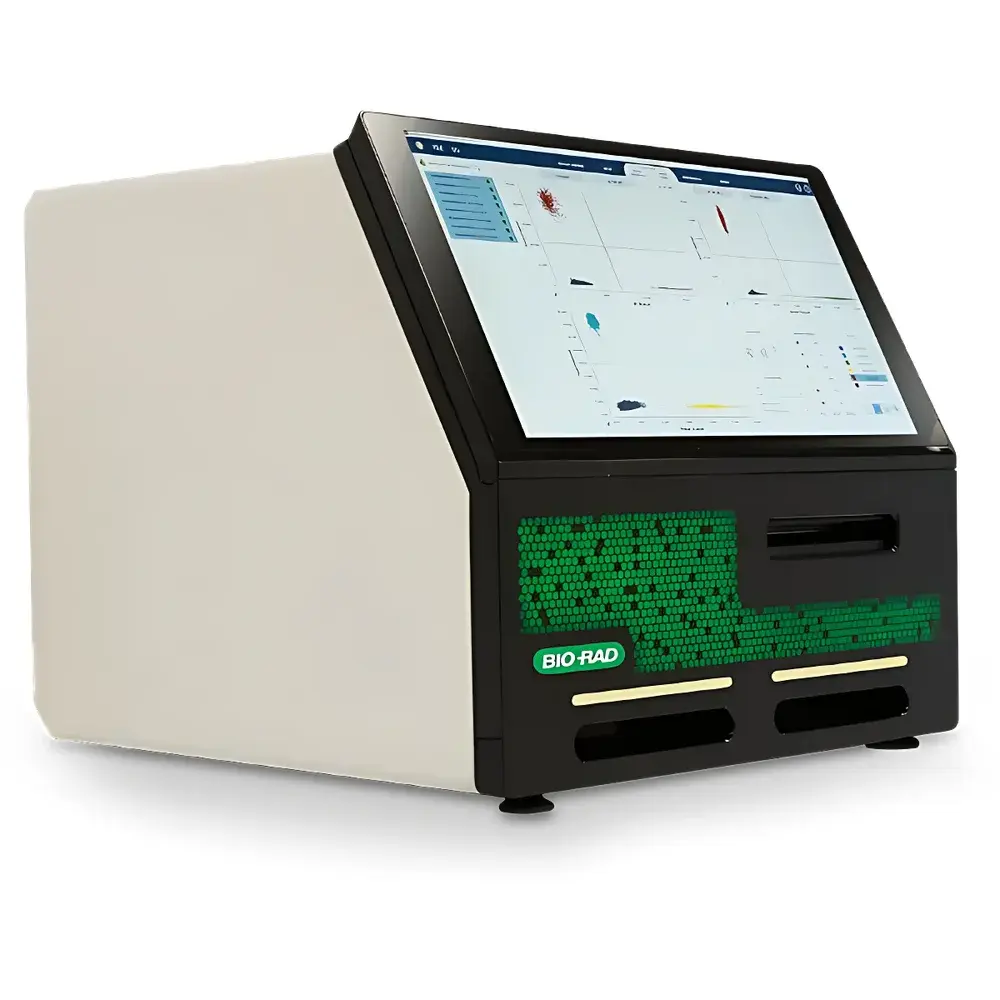
Bio-Rad QX700™ HT Droplet Digital™ PCR System
| Brand | Bio-Rad |
|---|---|
| Origin | USA |
| Model | QX700™ HT |
| Instrument Type | Digital PCR System |
| Sample Throughput | 384-well format |
| Detection Channels | 7-color multiplexing |
| Sample Input Volume | 5 µL |
| Effective Droplets per Sample | ≥17,000 |
| Automation Level | Fully integrated workflow (droplet generation, thermal cycling, and fluorescence reading) |
| Max. Chip Capacity per Run | 2 microfluidic chips |
| Time to Result | ≤2.5 hours for 96 samples |
| Time to Result | ≤8 hours for 384 samples |
| On-demand Loading | Yes, with independent thermal control per 16-well chip segment |
Overview
The Bio-Rad QX700™ HT Droplet Digital™ PCR (ddPCR™) System is a fully integrated, high-throughput digital PCR platform engineered for precision nucleic acid quantification in demanding research, clinical development, and biomanufacturing environments. Based on water-oil emulsion droplet partitioning and endpoint fluorescence detection, the system enables absolute quantification of DNA or RNA targets without reliance on standard curves. Each sample is partitioned into >17,000 nanoliter-scale droplets, where individual amplification events are digitally scored as positive or negative under Poisson statistics—delivering exceptional sensitivity, reproducibility, and resistance to PCR inhibitors. Designed as a single-instrument workflow solution, the QX700 HT eliminates inter-instrument variability by unifying droplet generation, thermal cycling, and optical readout within one robust architecture. Its 384-well compatibility and dynamic loading capability support both batch and staggered sample processing—making it suitable for longitudinal studies, QC release testing, and large-scale biomarker validation pipelines.
Key Features
- Fully automated ddPCR workflow: Integrated droplet generation, thermocycling, and fluorescence imaging eliminate manual transfer steps and reduce hands-on time.
- 7-channel optical detection: Enables simultaneous quantification of up to seven targets per well—including reference genes, multiplexed mutation panels, and internal controls—without spectral overlap interference.
- Dynamic on-demand loading: Supports flexible scheduling across two independently temperature-controlled 16-well chip segments; users may load samples incrementally without interrupting ongoing runs.
- High-resolution thermal control: Precise per-chip segment temperature regulation ensures uniform amplification efficiency across heterogeneous sample sets, critical for comparative gene expression or CNV analysis.
- Large-format touchscreen interface: Intuitive 12.1-inch capacitive display with context-aware navigation simplifies method setup, real-time monitoring, and result review—no external PC required for basic operation.
- Scalable throughput architecture: Processes 96 samples in ≤2.5 hours or 384 samples in ≤8 hours—optimized for labs transitioning from low- to high-volume ddPCR applications.
Sample Compatibility & Compliance
The QX700 HT accommodates standard 384-well PCR plates and Bio-Rad’s proprietary DG8™ cartridges, compatible with a broad range of sample types including purified genomic DNA, cDNA, FFPE-derived nucleic acids, plasma cfDNA, and viral RNA extracts. The system meets essential regulatory expectations for data integrity and traceability: audit trails, user access controls, electronic signatures, and secure data export align with FDA 21 CFR Part 11 requirements. Method validation documentation supports compliance with ISO/IEC 17025, CLIA, and GLP/GMP frameworks—particularly relevant for biotherapeutic cell line characterization, NGS library QC, and diagnostic assay development. All reagents used in conjunction with the platform—including QX200™ ddPCR Supermix and EvaGreen® or probe-based chemistries—are manufactured under ISO 13485-certified conditions.
Software & Data Management
The QX700 HT operates with QuantaSoft™ Pro software—a validated, version-controlled application that provides end-to-end data management from experiment design to statistical reporting. Key capabilities include automatic droplet classification using adaptive clustering algorithms, customizable gating strategies for complex multiplex assays, and batch analysis across multiple runs. Raw fluorescence data, thermal profiles, and droplet quality metrics are stored in vendor-neutral .qxp file format, supporting long-term archival and third-party analysis via open APIs. Export options include CSV, PDF, and structured JSON for integration into LIMS or ELN systems. Software updates follow a formal change control process, with release notes and impact assessments provided for each revision—ensuring continuity in regulated environments.
Applications
- Quantitative gene expression profiling with superior dynamic range over qPCR, especially for low-abundance transcripts.
- Validation of next-generation sequencing (NGS) variant calls—including SNVs, indels, and fusion transcripts—in oncology and rare disease research.
- Detection and monitoring of minimal residual disease (MRD) and circulating tumor DNA (ctDNA) at sub-0.01% allele frequency.
- Copy number variation (CNV) analysis in stem cell lines, iPSC-derived models, and CRISPR-edited clones.
- Characterization of viral vector titers (e.g., AAV, lentivirus) and host-cell DNA residuals in bioprocess intermediates.
- Environmental pathogen surveillance—including SARS-CoV-2, influenza, and enteric viruses—in wastewater epidemiology programs.
- Quality control of RNA therapeutics, such as siRNA, mRNA, and circular RNA constructs, during formulation and stability studies.
FAQ
What sample input volume is required per reaction?
Each reaction requires 5 µL of template nucleic acid solution, compatible with most commercial extraction kits and pre-amplification workflows.
Can the QX700 HT process partial plates or run multiple assay types simultaneously?
Yes—the dynamic loading feature allows incremental addition of samples, and independent thermal control per 16-well chip segment permits concurrent optimization of different annealing temperatures across assays.
Is QuantaSoft Pro compliant with 21 CFR Part 11?
Yes—QuantaSoft Pro includes role-based user authentication, electronic signatures, immutable audit trails, and secure data export functionality, validated for use in FDA-regulated submissions.
How does the system ensure droplet uniformity and assay reproducibility?
Proprietary microfluidic chip design, coupled with real-time pressure and temperature feedback during droplet generation, maintains coefficient of variation (CV) <5% across technical replicates—even with viscous or inhibitor-rich samples.
What maintenance is required for routine operation?
Routine maintenance is limited to weekly cleaning of the optical path and quarterly calibration verification using Bio-Rad’s certified reference standards—no consumable optics or lasers require replacement during normal instrument lifetime.



