
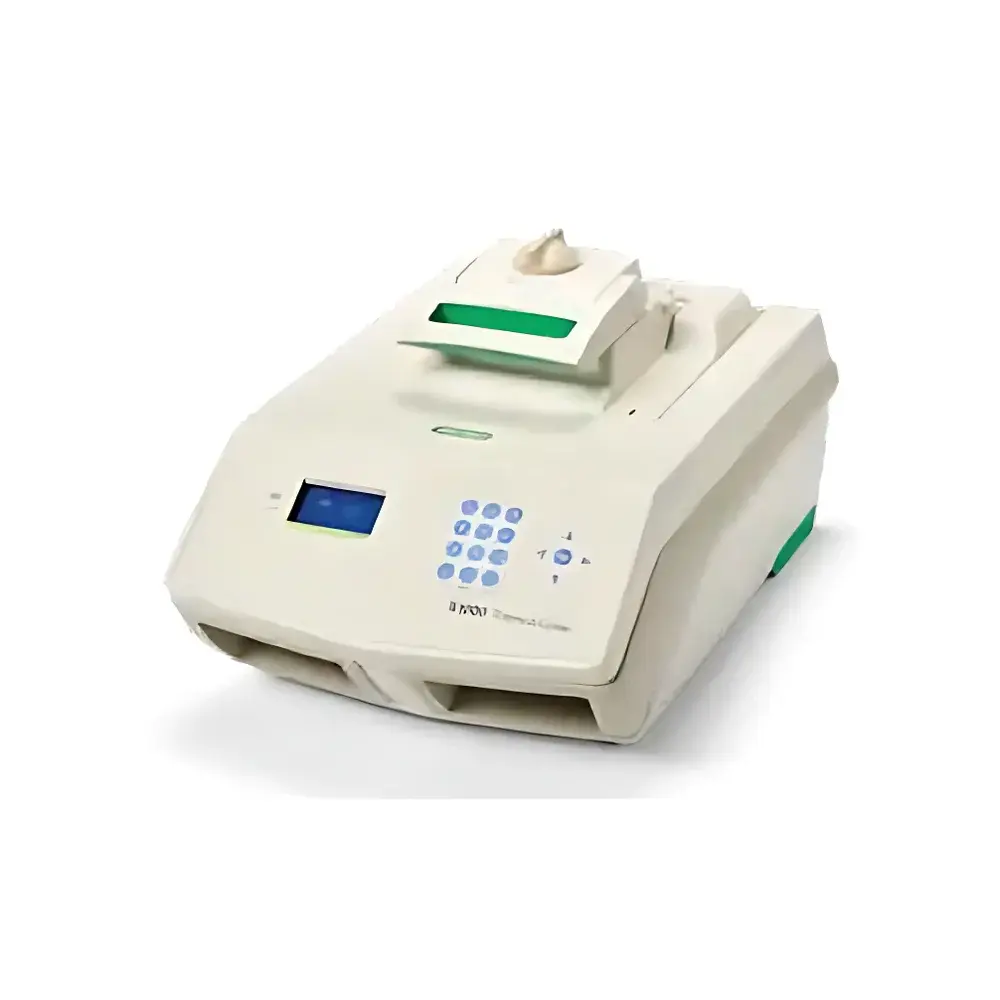
Bio-Rad S1000™ 96-Well Fast Thermal Cycler
| Brand | Bio-Rad |
|---|---|
| Origin | USA |
| Model | S1000™ 96-Well |
| Sample Capacity | 96 × 0.2 mL tubes or 1 × 96-well plate |
| Max Heating/Cooling Rate | 5°C/sec |
| Temperature Accuracy | ±0.2°C at 90°C |
| Well-to-Well Temperature Uniformity | ±0.4°C within 10 sec at 90°C |
| Gradient Range | 30–100°C, Span 1–24°C |
| Gradient Accuracy (Last Column) | ±0.2°C |
| Column Uniformity | ±0.4°C within 10 sec per column at target temperature |
| Input Power | 400 W max |
| Dimensions (W×D×H) | 33 × 45.7 × 20.3 cm |
| Weight | 10.4 kg |
Overview
The Bio-Rad S1000™ 96-Well Fast Thermal Cycler is a precision-engineered, standalone PCR instrument designed for laboratories requiring high-speed thermal cycling with exceptional temperature fidelity and reproducibility. Based on Peltier-based solid-state thermoelectric heating and cooling, the system delivers rapid ramp rates—up to 5°C/sec—enabling shortened cycle times without compromising amplification efficiency or specificity. Its proprietary honeycomb-style reaction block architecture ensures uniform heat transfer across all 96 wells, minimizing inter-well thermal variance and supporting robust endpoint and quantitative PCR applications. The S1000™ operates across a full temperature range of 0–100°C and integrates seamlessly into scalable workflows via optional connection to the C1000 Touch™ Thermal Cycler—up to three S1000 units can be daisy-chained to a single C1000 Touch, forming a coordinated 4-unit high-throughput PCR platform capable of parallel processing up to 384 reactions per run.
Key Features
- Modular flexibility: Interchangeable reaction modules—including 96-well fast, 96-well deep-well, dual 48-well fast, and 384-well formats—allow adaptation to diverse assay formats and tube types.
- Advanced thermal control: Patented honeycomb aluminum block provides rapid, uniform heat distribution; achieves ±0.4°C well-to-well uniformity within 10 seconds at 90°C.
- Programmable gradient functionality: Enables simultaneous optimization of annealing temperatures across 12 columns (spanning 1–24°C), with gradient accuracy of ±0.2°C in the last column and column-wise uniformity of ±0.4°C.
- Intuitive user interface: Dual-mode programming—text-based and semi-graphical—supports rapid protocol development and real-time visualization of thermal profiles.
- Adaptive heated lid: Adjustable pressure and temperature (up to 110°C) accommodate varying tube geometries and sealing methods, preventing condensation and ensuring consistent reaction volume integrity.
- Robust onboard storage: Stores >1,000 protocols locally; expandable indefinitely via USB flash drive (4 × USB-A, 1 × USB-B ports).
- Regulatory-ready operation: Compliant with ISO/IEC 17025 laboratory quality requirements; supports audit-trail-capable data export for GLP/GMP-aligned workflows when paired with Bio-Rad’s CFX Maestro™ or legacy PC-based software suites.
Sample Compatibility & Compliance
The S1000™ accommodates standard 0.2 mL thin-wall PCR tubes and full-skirted, semi-skirted, or non-skirted 96-well plates—including low-profile and high-binding variants—without adapter requirements. Its thermal design meets ASTM E2582-19 standards for thermal cycler performance verification. All firmware and software interfaces adhere to FDA 21 CFR Part 11 principles when used with validated configurations and electronic signature-enabled platforms. The instrument carries CE marking for IVD use in the European Economic Area and complies with IEC 61010-1 safety standards for laboratory electrical equipment.
Software & Data Management
While the S1000™ operates autonomously via its built-in LCD interface, it fully integrates with Bio-Rad’s CFX Maestro™ Software (Windows/macOS) for centralized protocol management, remote monitoring, and raw fluorescence data export (for downstream analysis in R, Python, or third-party qPCR tools). When networked via USB to a C1000 Touch™ controller, the system supports synchronized multi-instrument scheduling, batch protocol deployment, and time-stamped event logging—essential for QC documentation and method validation under ISO 13485 or CLIA frameworks. All exported files are timestamped, digitally signed where enabled, and compatible with LIMS ingestion via CSV or XML schema.
Applications
The S1000™ serves as a core platform for molecular diagnostics development, academic genomics research, clinical assay validation, and biomanufacturing process testing. Typical use cases include: multiplex PCR optimization under gradient conditions; high-fidelity amplification of GC-rich templates; rapid screening of CRISPR editing efficiency; preparation of NGS library fragments; and routine pathogen detection assays requiring tight thermal reproducibility across large sample batches. Its speed and precision make it especially suitable for labs transitioning from conventional to fast-cycling PCR chemistries (e.g., hot-start DNA polymerases with short extension times).
FAQ
Can the S1000™ be used without connecting to a C1000 Touch?
Yes—the S1000™ is a fully functional standalone thermal cycler with complete local control, protocol storage, and real-time display.
Is gradient PCR supported across all module types?
Gradient functionality is available only with the 96-well fast and 96-well deep-well modules; dual 48-well and 384-well modules operate in uniform-temperature mode.
What is the maximum recommended ramp rate for long amplicons (>5 kb)?
For optimal fidelity with large fragments, Bio-Rad recommends limiting ramp rates to ≤2.5°C/sec during denaturation and extension phases—configurable via semi-graphical programming.
Does the instrument support external temperature calibration verification?
Yes—calibration verification using traceable NIST-certified reference probes (e.g., Fluke 1523/1524) is supported per Bio-Rad’s Service Manual Rev. D, with documented procedures for internal sensor validation.
How is data integrity maintained during power interruption?
The S1000™ features non-volatile memory that retains active protocol state and runtime counters; upon recovery, it resumes from the last completed cycle or enters safe-hold mode based on user-defined settings.





