
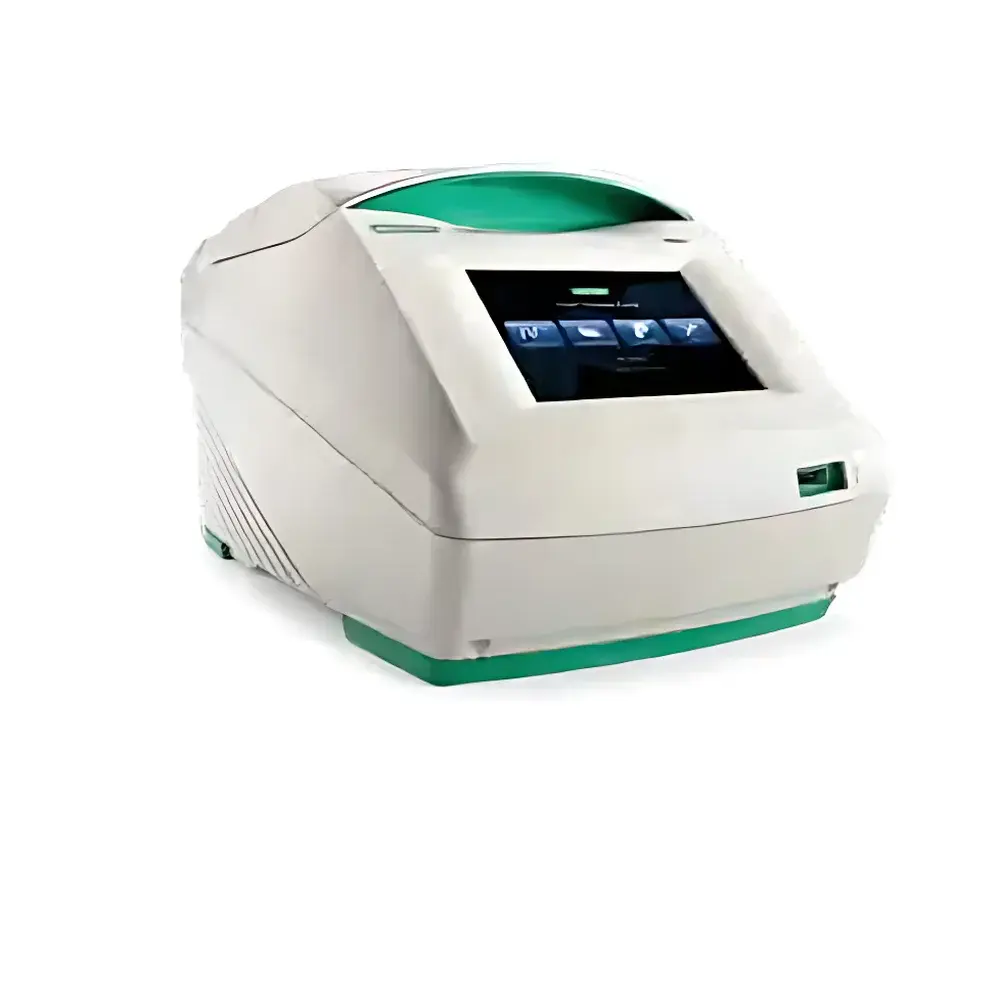
Bio-Rad T100™ Gradient Thermal Cycler
| Brand | Bio-Rad |
|---|---|
| Origin | USA |
| Model | T100™ |
| Instrument Type | Gradient PCR Thermal Cycler |
| Sample Capacity | 96-well (0.2 mL plates or tubes) |
| Max Heating/Cooling Rate | 4 °C/s |
| Temperature Accuracy | ±0.2 °C (at 90 °C) |
| Well-to-Well Uniformity | ±0.4 °C (at 90 °C) |
| Gradient Range | 30–100 °C |
| Gradient Span | 1–25 °C |
| Operating Temperature Range | 4–100 °C |
| Onboard Memory | 500 protocols |
| Display | 5.7" high-resolution color touchscreen |
| Interface | 1 × USB port |
Overview
The Bio-Rad T100™ Gradient Thermal Cycler is a precision-engineered, semiconductor-based thermal cycler designed for reliable and reproducible polymerase chain reaction (PCR) amplification across academic, clinical, and industrial life science laboratories. Built upon Bio-Rad’s two-decade legacy in thermal cycling instrumentation, the T100™ integrates solid-state Peltier technology with advanced thermal management architecture to deliver rapid, uniform, and highly accurate temperature transitions—critical for stringent nucleic acid amplification protocols. Its core function relies on precise spatial and temporal control of thermal profiles across a 96-well format, enabling both standard endpoint PCR and empirical optimization via programmable linear temperature gradients. The system operates within a validated thermal range of 4–100 °C and maintains ±0.2 °C accuracy at 90 °C—a specification aligned with ASTM E2922-13 and ISO/IEC 17025 requirements for thermal validation in molecular diagnostics workflows.
Key Features
- High-speed thermal cycling: Achieves up to 4 °C/s heating and cooling rates, significantly reducing cycle time without compromising denaturation or annealing fidelity.
- Integrated 8-channel gradient functionality: Enables simultaneous execution of eight distinct temperature conditions across adjacent columns—ideal for empirical determination of optimal annealing temperatures in primer optimization studies.
- 5.7-inch high-resolution color touchscreen interface: Provides intuitive, icon-driven navigation with real-time graphical display of active thermal profiles, ramp rates, and elapsed time—eliminating reliance on external PCs during routine operation.
- Robust mechanical design: Compact footprint (28.5 × 24.5 × 24 cm) and reinforced chassis support stable placement on shared benchtops or inside biosafety cabinets; no external cooling fans required.
- Onboard protocol storage: Securely retains up to 500 user-defined thermal programs with timestamped metadata, supporting GLP-compliant recordkeeping when paired with external audit logs.
- USB host port: Facilitates direct export of run logs and protocol files to FAT32-formatted flash drives—compatible with LIMS integration and offline data archiving per FDA 21 CFR Part 11 electronic record guidelines.
Sample Compatibility & Compliance
The T100™ accepts standard 0.2 mL PCR tubes and full-skirted, semi-skirted, or non-skirted 96-well PCR plates—including those certified for low-retention or DNA-free applications. Its heated lid (programmable up to 110 °C) eliminates condensation and ensures consistent evaporation control across all well positions. Temperature uniformity (±0.4 °C at 90 °C) meets ISO 13485 Annex A.2 criteria for thermal homogeneity in diagnostic device manufacturing environments. The instrument complies with IEC 61010-1 safety standards and electromagnetic compatibility (EMC) requirements per EN 61326-1, ensuring safe deployment in regulated laboratory settings.
Software & Data Management
No proprietary software installation is required for basic operation; all programming, execution, and data review occur natively via the embedded touchscreen OS. Protocol templates support multi-step cycling (up to 99 cycles), hold steps, and gradient-enabled ramp segments. Exported .csv log files include cycle-by-cycle temperature deviation metrics, lid temperature history, and real-time error flags (e.g., lid open detection, thermal sensor fault). When connected to institutional networks, exported files can be ingested into validated laboratory information management systems (LIMS) or electronic lab notebooks (ELN) for traceability. Audit trails—including user login timestamps, protocol edits, and run initiation events—are retained locally for ≥30 days, supporting internal quality audits under CLIA and CAP accreditation frameworks.
Applications
- Optimization of primer annealing conditions using single-run gradient profiling.
- Routine genotyping, cloning, and site-directed mutagenesis requiring high inter-run reproducibility.
- Preparation of amplicons for downstream NGS library construction where fragment size distribution and yield consistency are critical.
- Validation of qPCR assay parameters prior to transition to real-time platforms.
- Teaching laboratory environments requiring durable, low-maintenance instrumentation with intuitive pedagogical interfaces.
- Low-throughput clinical research workflows compliant with ISO 15189 pre-analytical phase controls.
FAQ
Does the T100™ support remote monitoring or network connectivity?
No—the T100™ operates as a standalone instrument with no Ethernet, Wi-Fi, or cloud connectivity. All control and data handling occur locally via the touchscreen or USB interface.
Can I import protocols from older Bio-Rad cyclers (e.g., MyCycler or S1000)?
Yes—protocol files saved in .pcr format from compatible Bio-Rad instruments can be loaded directly via USB drive, provided they conform to the T100™’s step definition syntax and thermal limits.
Is the heated lid pressure-adjustable?
No—the lid applies consistent downward force via spring-loaded mechanism; however, its temperature is independently programmable and auto-calibrates to match block setpoints.
What calibration documentation is supplied?
Each unit ships with a factory-issued Certificate of Conformance, including thermal verification data at 55 °C, 72 °C, and 95 °C per ASTM E2922-13 Annex B procedures.
How often does the instrument require preventive maintenance?
Bio-Rad recommends annual verification of thermal performance using an accredited third-party service provider or internal metrology team following ISO/IEC 17025 traceable standards.





